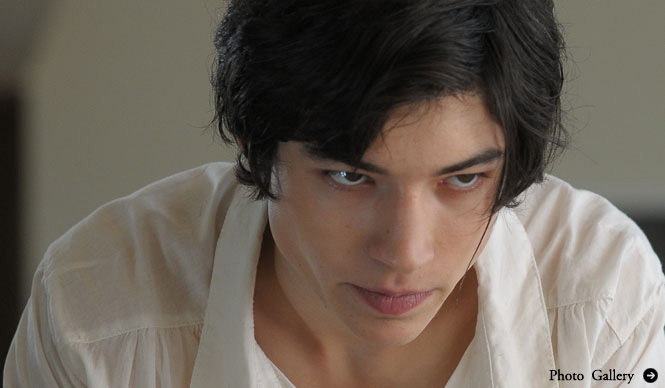
Ezra Miller on 'We Need to Talk About Kevin' | INTERVIEW
INTERVIEW | The Buzzworthy Film 'We Need to Talk About Kevin'
Ezra Miller Interview (1)
The overwhelming performances by Tilda Swinton, John C. Reilly, and Ezra Miller are dizzyingly brilliant (The Daily Telegraph).—The bestseller, winner of the Orange Prize, the highest honor in British women's literature, which was once deemed "difficult to film" due to its shocking content and over 400 pages, has finally been adapted into a movie. Ezra Miller, the rising star who plays Kevin, the son who embodies both cruelty and beauty, is garnering significant attention as the hottest young Hollywood star. The film 'We Need to Talk About Kevin' will be released on Saturday, June 30th, at TOHO CINEMAS Shinjuku.
Text by KAJII Makoto (OPENERS)
Hearing the good news on the streets of LA, I couldn't help but dance with joy.
—What were your initial impressions when you first received the offer for this film?
I thought it would be a wonderful piece of art. The script was brilliant, with its visual and auditory expressions of emotion. Kevin's character was also incredible, and I thought it would be amazing to play this role, but it took a year and a half from auditioning to the role being decided.
—Do you have any memorable moments from the audition?
On the final, sixth audition, we did a screen test for the last scene where Kevin's mask comes off. When that test finished, everyone on the staff was in tears. Two weeks later, I got the call saying, "You got the part." When I heard the news, I was on the street in LA and I started dancing with joy. Passersby were looking at me like, "What's wrong with this person?" But an hour later, I felt my blood drain away as if I'd been doused with water, and the pressure hit me. I felt the responsibility of having to do this.
—What kind of child do you think Kevin was?
Kevin was very intelligent, and from infancy, his ability to perceive his surroundings was exceptionally high. It was Kevin's hyper-intelligence that led him to realize the dynamic between his parents and himself, and to understand that his mother's actions towards him were not genuine but a pretense. Even as he grew older, Kevin wore the same T-shirt from when he was seven, refusing to let his mother pretend to be a good mother. He would make his own sandwiches to eat, deliberately not letting his mother do things for him. Kevin wanted his mother's sincere love, so I believe he wanted her to perceive the situation and the truth they shared.
—How did you approach preparing for the role of Kevin?
Even in stories depicting evil, they often involve things that are possible for humans. Half of reality is evil, and anyone can become that way, so I tried to explore that aspect of evil. The greatest fear was that Kevin would become a complete demon. I worried that if he did, the message wouldn't get across. I had no hesitation about playing him and potentially being disliked by the audience. In reality, I have a very good relationship with my mother and talk about everything with her. I even went to see this film's preview screening with her. My mother and I have never had a bad relationship, but even so, while playing Kevin, I recalled my own childhood.
When I was five or six years old, my mother, who used to drive me to kindergarten, would ask, "How was kindergarten today?" I would earnestly tell her about what I did, and then I'd glance at my mother and realize she wasn't listening. My mother was a choreographer, a working mother with three children, and she was driving, so she had a lot on her plate. But at that moment, I became incredibly angry. If she wasn't listening to me, why was she asking?! Now I understand that parenting is a continuous struggle for a mother, involving sacrifices. In Kevin's case, I acted while thinking, "What if he was constantly ignored and unloved, yet his mother was demonstrating maternal love?" He's pretending to love him, but in reality, he's as good as abandoned, so he'd be furious, wouldn't he? Humans instinctively believe they are meant to be loved, so I wonder what kind of anger a child feels when they don't receive their parents' attention. Don't children who grow up without parental attention want to be noticed no matter what? I think Kevin felt the same way.
INTERVIEW | The Film 'We Need to Talk About Kevin'
Ezra Miller Interview (2)
Eva (Tilda Swinton), a writer who has lived a free-spirited life, becomes a mother in the midst of her career. Her son, named Kevin, for some reason, repeatedly rebels against his mother, Eva, from a young age and refuses to open up to her. Eventually, Kevin grows into a beautiful, intelligent, and perfect son. However, his rebellious spirit towards his mother never subsides. And then, the devil-like son commits an act that destroys everything Eva has...
I couldn't have acted without believing in the role.
—In this film, the father's presence is minimal compared to the relationship between the mother and Kevin. What are your thoughts on this?
Of course, Kevin's upbringing is as much the father's responsibility as the mother's. As a theme of this film, when someone turns out bad, it's often blamed on the mother, and it might be convenient to place all the blame on her, but is that really the case? Is no one else responsible? Kevin's father also bears responsibility. The mother can only see her son's flaws, while the father, blinded by love and wanting him to be a good boy, cannot see reality. I believe the father, blinded by love, was merely a pawn in the battle between Kevin and his mother.
—Why do you think Kevin chose a bow and arrow?
Because a bow and arrow requires you to hit the target precisely. I think that's why he chose it. It suited his personality. The target he shot with the bow and arrow was his mother's heart. But this is my interpretation, and everyone's interpretation is different. That's what I think a film is about.
—What is the most memorable scene for you?
I believe this film is about memory. In Kevin's case, I thought he had accumulated his memories over time until he reached a terrifying place. In the final scene, Kevin, believing it was necessary, had become monstrous, but I think he realized he had to take off the mask. That was the most difficult scene to act.
—Could you explain that final scene?
It was difficult to act without empathizing with the character. I couldn't have acted without believing in the role. I had to understand why Kevin did what he did. Kevin grew up without receiving love, and his revenge is directed at his mother. Because his existence isn't acknowledged, he acts with what he believes is his own moral code. While searching for what is right, he exposes his evil to his mother. In the end, he becomes vulnerable and admits his guilt, but in the final scene, I, like Kevin, had to face reality, and it was shocking.
Adolescence, where one asserts oneself even if it means forcing it. I, playing Kevin, was also in adolescence, and it was in the final scene that I realized I thought I understood Kevin, but I actually didn't. Children believe they are omnipotent, but this is especially true during adolescence. In the final scene, he realizes he has destroyed himself through his actions. Facing his own deeds, having killed so many people.—It's like a Greek tragedy. For an hour after filming that scene, I couldn't stop crying. There are many children like Kevin, but without support, they end up exploding with their emotions, and then they have to confront themselves daily as if in torture. I believe it wasn't solely Kevin's fault that he became that way; it was also society's fault, the fault of those around him.
—You mentioned you saw the preview screening with your mother. How did she react during the final scene?
In the final scene where we embrace, my mother was shaking and crying. It was the first and last time I ever saw her like that.
—What was your own rebellious phase like?
I think my own rebellious phase was around 13. I suddenly hated everything, and I felt like everything people said was condescending, so I became a communist who liked punk and would think, "What are you talking about?! Damn it!" I'm the youngest of three siblings, and my parents had already gone through my older sisters' rebellious phases. I thought I had to raise the bar higher than with my sisters to be recognized as rebellious, so I rebelled quite strongly.
—This film features many close-ups of your face. How did that feel?
It feels really strange to see close-ups of my own face on screen. When my mouth appeared so large on screen, I thought, "This isn't necessary" (laughs). I even thought, "This is creepy!" (laughs).
INTERVIEW | The Film 'We Need to Talk About Kevin'
Ezra Miller Interview (3)
The film is supported by Tilda Swinton, who possesses a unique presence and is highly acclaimed for her talent, having won an Academy Award for Best Supporting Actress for 'Michael Clayton.' She portrays the confusion and self-negation of a mother grappling with her devil-like son with unparalleled realism, earning nominations and numerous awards, including a Golden Globe.
By fully embodying this role, I realized I could make a living as an actor.
—What was Tilda Swinton, who plays the mother, like?
Despite being an actress with such extraordinary performances, Tilda is actually a very warm and affectionate woman. She is highly sensitive and always open, and she was "bigger" than anyone I've ever worked with. I believe acting is about how much you can let go in the moment, and Tilda's concentration is incredible; she transforms the instant "Roll!" is called and gets into character. She's an actress who can truly separate the time she's acting from the time she's interacting as people. She can also be relaxed off-set. I'm a method actor, so I thought I'd have to maintain a strained relationship with Tilda even off-set while playing this role, but she was different, and she trusted me. Tilda, with her very clear thinking, was a great learning experience for me.
—What are your thoughts on appearing in this film?
I first read the script for this film about two or three years after I started acting. Until then, I felt like I was just getting by, but from the moment I wanted to do this film, I started thinking deeply about things. I had always admired Tilda as an artist, even considering her a role model, so I was serious about needing to commit fully. Furthermore, I saw the role of Kevin as a test of whether I could make a career as an actor. By fully embodying this role, this film made me realize that I could indeed make a living as an actor.
—You're only 19, but you started working at a young age. What are your thoughts on the acting profession?
The public tends to equate actors with celebrities. I think that leads to a condescending attitude. Film is something created by many people, so we actors are just a part of the staff. We happen to be the ones on screen, so we stand out as if we represent the whole, but people find value in storytelling. It's inherent in human nature, and actors are the ones who embody that, so perhaps they are glorified like celebrities.
For anyone, the difficult part is being judged. We receive both praise and criticism, but it's painful when only a visible part of us is praised or criticized, rather than our true selves. Especially during childhood, I felt pressured by the image others had of me and felt I had to conform to it. While I don't let others' judgments define me, with my limited experience at a young age, it's frightening. Young people don't notice many things, but when I felt I might be influenced by such things, I told myself that being recognized and famous means nothing. I always remind my friends who are in this line of work of that, so they don't forget. Therefore, I don't worry about what others think of me now.
—Do you have any plans for the future?
My future plans are a secret (laughs). I don't want to make the type of film a condition for the projects I get involved in. It's true that I'm probably suited for independent films, but I don't want to appear in low-quality films just because they're independent, nor do I rule out major studios... I want to choose projects based on their quality.
—What kind of roles do you want to play as an actor?
I want to play characters who are as different as possible from my true self. My dream beyond that is simply to exist. To "BE." To live as myself, or rather, just to be there. I don't really think about the distinction between my private self and my actor self...
—Do you have a message for the Japanese audience?
After watching the film, I hope you will think about it and ask yourselves questions. I would be happy if that kind of reaction occurs. Kevin in this film might evoke a sense of fear, but please do come and see it in theaters.
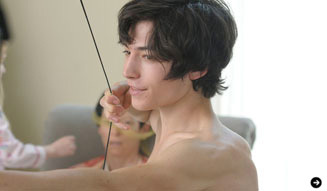
© UK Film Council / BBC / Independent Film Productions 2010
EZRA MILLER
Born in New Jersey, USA, in 1992. His screen debut was in 'Afterschool' (unreleased in Japan, 2008), which was screened at the Cannes Film Festival in 2008 and the Berlin International Film Festival in 2009, receiving critical acclaim and nominations for the Gotham Awards and Independent Spirit Awards. With his starring role in this film, Ezra Miller immediately became a figure of interest in the film industries of various countries. He subsequently played lead roles in 'City Island' (directed by Raymond De Felitta, unreleased in Japan, 2009), co-starring with Andy Garcia, and 'Every Day' (directed by Richard Levine, unreleased in Japan, 2010), co-starring with Liev Schreiber and Helen Hunt.
He garnered attention for his acting and presence, holding his own against veteran actors such as Ellen Barkin, Ellen Burstyn, Kate Bosworth, Demi Moore, and Martin Landau in 'Another Happy Day' (directed by Sam Levinson, screened at the 2011 Tokyo International Film Festival). His reputation continues to grow, with nominations for the Broadcast Film Critics Association Award for Young Actor and the British Independent Film Award for Best Supporting Actor for his role in 'We Need to Talk About Kevin.' His next project is the film adaptation of the bestselling novel depicting the real lives of American teenagers, 'The Perks of Being a Wallflower' (directed by Stephen Chbosky), in which Emma Watson plays the heroine.
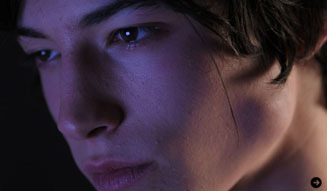
© UK Film Council / BBC / Independent Film Productions 2010
WE NEED TO TALK ABOUT KEVIN
Director | Lynne Ramsay
Starring | Tilda Swinton, John C. Reilly, Ezra Miller
Screenplay | Lynne Ramsay & Rory Stewart Kinnear
Based on the novel by | Lionel Shriver
2011 / UK / 35mm / Color / American Vista / Dolby SRD / 112 min
Original Title | WE NEED TO TALK ABOUT KEVIN
© UK Film Council / BBC / Independent Film Productions 2010
Official Website | shonen-yumi.com