20th Anniversary of 'dictionary's' Launch: A Conversation with Koichi Kuwabara (Part 1)
Congratulations on the 20th Anniversary of the Freepaper 『dictionary』!
An Interview with Shigekazu Kuwabara, Curator of Club King (Part 1)
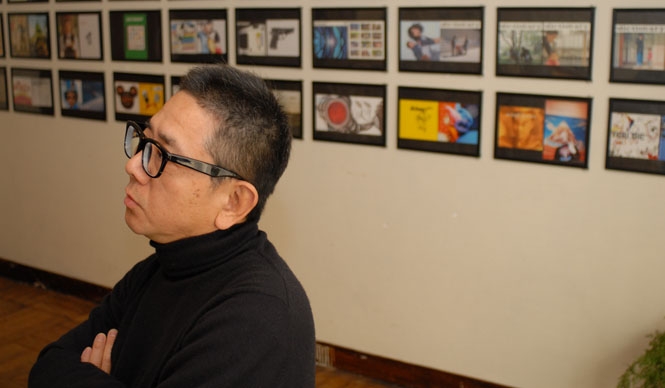
In 1973, Shigekazu Kuwabara was involved in the launch of 『Rolling Stone Japan』. Even before that, Kuwabara had been keenly sensing the cutting edge of the times, continuously grappling with the creation and dissemination of Tokyo culture through various media. In February 1987, he established Club King Co., Ltd., and in July 1988, he launched the groundbreaking freepaper 『dictionary』.
“I always had this sense of urgency, thinking that if we don’t secure a space where we can say what we want to say, there might come a time when we can’t say anything at all.”
Let’s look back at the history of 『dictionary』, which celebrates its 20th anniversary and continues to expand as a digital library.
Photo by UZAWA Kay
At the Time of Launch, We Wanted to Create Something Priceless
—Congratulations on the 20th anniversary of 『dictionary』.
Shigekazu KuwabaraIt’s become intertwined with my own life, in a way. I mean, as one accumulates burdens over a long life, the burden of continuously publishing 『dictionary』 is something I’ll carry to my grave. It took me quite a struggle to come to terms with that.
—At the time of its launch, freepapers were revolutionary.
Today, major corporations have entered the freepaper market, adopting a stance of “Information is free, so please take it with you.” This has become a trend of the times. But for us, it meant, “We believe information should be free, but we want to create something that cannot be bought with money.” Around 1988, there was a feverish mood, like the dawn of the bubble economy. Most people around us thought, “What’s the fun in putting out a freepaper if you’re not making money?”
—Where did the concept for 『dictionary』 come from?
After launching Club King in '87, I was enthusiastically thinking, “Let’s create club culture in Japan!” But we needed support. That support came from people who had already brought London’s club culture to Japan – in other words, people from the fashion industry. Mr. Takeo Kikuchi introduced London’s street culture, which was very inspiring. Mr. Gen Suisui of Hollywood Ranch Market used to bring back large-format freepapers from overseas and display them in his shop. And then there was Mr. Katsuyuki Yoshida of Yoshida & Co. We were inspired by these seniors from around the time we were in high school. I remember going to see Mr. Take (Kikuchi) for support before we launched 『dictionary』, and he bluntly told me, “Shigeichi, culture won’t grow in Tokyo.” (laughs)
—Culture won’t grow in Tokyo! And from Mr. Take!
If Mr. Take said that, what were we supposed to do? (laughs) It was tough to hear such a direct statement from a senior we respected. Perhaps at the time, we were heavily influenced by American culture and had been replacing our own lifestyles with it. So, he might have been saying that unless we embraced our “borrowed” identity, we couldn’t express the complexity and messiness of Tokyo culture. But Mr. Take has always been supportive.
A Youth Forced into Premature Maturity
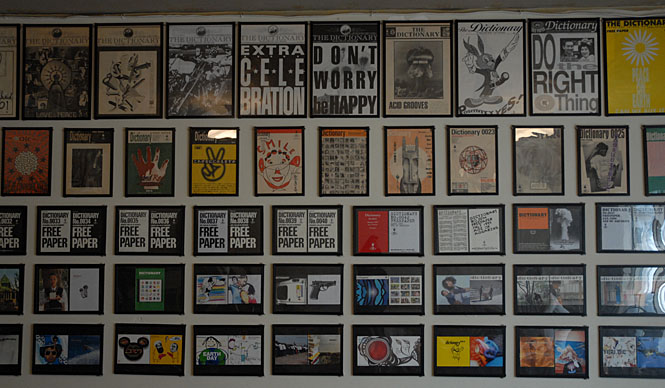
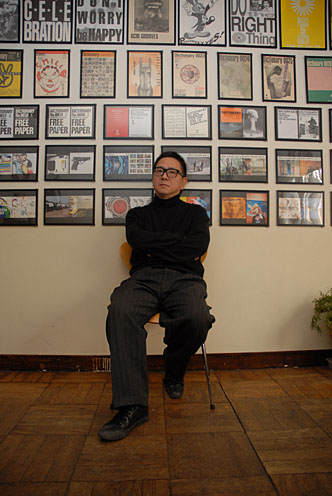
—The covers of 『dictionary』 from its inception are displayed on the first floor of your office.
Before we reached 100 issues, we used to hold an awards ceremony each year for content featured in 『dictionary』. At that time, someone asked me, “Why don’t you create the 『dictionary』 you want to make, the one you love?” I used to think of myself as a custodian of the media, and I felt it was wrong for a custodian to assert their own opinions. I didn’t want to be like an editor-in-chief of a conventional magazine, dictating the direction.
—Why was that?
I wanted 『dictionary』 to last for a long time. But 10 or 20 years is still too short. After more than 60 years since the war, I feel that what we create must endure for the next generation and the one after that, not just for these 20 years. Displaying the covers here is a form of self-discipline, and creating the digital library was necessary to commit myself to not letting these 20 years go to waste.
—So, you intended to continue it for a long time from the beginning?
I always had this sense of urgency, thinking that if we don’t secure a space where we can say what we want to say, there might come a time when we can’t say anything at all. Also, I believe everyone grows while working and studying. At the time of the launch, being on the front lines where what was happening around us took shape every two months was beneficial for me. It might have prevented me from pondering, “Why am I alive?”
—When did that sense of urgency begin?
I helped out in a bar in Nishi-Azabu from when I was in high school. American soldiers would come in, drinking before heading to Vietnam the next day. Witnessing such an indefinable scene, I realized, though I couldn’t quite articulate it, that there was a difference between them drinking and listening to rock music, and us listening to rock music.
—And that was...
Around '69, I think. Until I started 『Rolling Stone Japan』 in '73, things felt hazy, like there was no way forward.
—That bar was your family's establishment, wasn't it?
Yes, my family's. I didn't get an allowance back then, so I worked until morning. Neighbors included Mr. Take (Kikuchi), Minako Yoshida, The Brain Police, and Shintaro Katsu. It was chaotic, but fun. I was forced to mature early (laughs). I used to go around record stores and select songs for the jukebox. That’s how Mr. Katsuyuki Yoshida noticed me and said, “Your song selections are interesting.”
—And that led to your involvement in music?
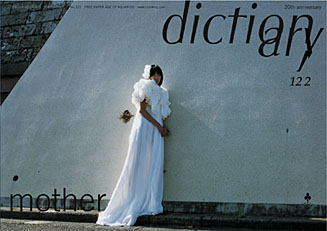
『dictionary』 Issue 122
Distribution starts Tuesday, June 10th
Feature: “mother”
This issue explores the concept of motherhood (present in both men and women) that is essential in today's world, through conversations such as Ayumi Tanabe x Meisa Fujishiro and Yaya Uchida x Kenichiro Mogi. It also proposes items needed for modern families, including the organic cotton wedding dress on the cover.
Club King Official Website│http://www.clubking.com/
<Cover Credits>
Art Direction: Osamu Ohashi (thumb M)
Model: Ayumi Tanabe
Photography: Shin Suzuki
Wedding Dress Production: Takashi Okano (FOR)
Corsage Production: Nao mi Okano (la fleur)
Hair & Makeup: Sachiko Narita (SHIMA)
A library where you can see everything from Club King's 『dictionary』 20th Anniversary
“DICTIONRY LIBRARY”
DICTIONRY LIBRARY│http://dictionary.clubking.com/index.html
CLUB KING (Club King) [Dictionary 20th Anniversary Commemorative] Cover Artwork Reproduction Design T-shirts are available for purchase on the web shopping magazine "L'HOMMES".
