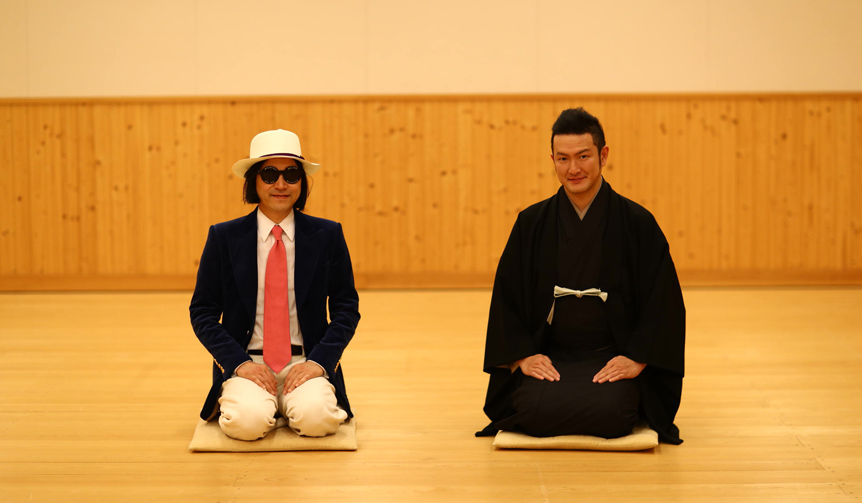
Tomoki Sukezen & Editor Daimaō Dialogue | vol. 38 Shido Nakamura
Page. 1
This installment of the "Editor Daimaō Dialogue" features Nakamura Shido, a Kabuki actor who will appear in "Off Theater Kabuki," held from May 11, 2019, at Warehouse Terrada in Tennozu, Tokyo, and Shinjuku FACE in Kabukicho. He discusses Chikamatsu Monzaemon's "Onna Goroshi Abura no Jigoku" (The Woman Killer and the Hellish Oil), a play not previously staged in Kabuki, and shares his enthusiasm for performing in these unconventional spaces.
Interview by SUKEZANE TomokiPhotographs by MAEDA AkiraText by ANDO Sara (OPENERS)
Kabuki Performances in New Theatrical Spaces: Warehouses and Live Houses
SUKEZANE Tomoki & Editor Daimaō (hereafter, SUKEZANE)This production of "Onna Goroshi Abura no Jigoku," based on Chikamatsu Monzaemon's original work, is a collaboration with Akahori Masaaki, who handled the script and direction. What is its most compelling aspect?
NAKAMURA Shido (hereafter, SHIDO)When I first played the role of Kawachi-ya Yohei in 2006, it was staged in a small space, the Mitsukoshi Theater. I always thought I'd like to revisit this play in a different way someday. When I went to New York in my twenties, I saw various styles of theater, including Off-Broadway and performances in warehouses. Around that time, I started thinking I'd like to stage Kabuki in a warehouse someday. I felt it would be interesting if Kabuki or theater could be held in a warehouse, just as fashion shows are. I also thought it would be nice to perform it traditionally by candlelight in a warehouse. However, in reality, typical warehouses often lack restrooms, making them quite difficult for theatrical productions. Especially since we wear white face paint, we need water. That's when Warehouse Terrada came into consideration. They host fashion shows, so I decided it would be perfect to perform there.
SUKEZANEI see.
SHIDOThen, I thought it would be interesting to perform a dark Kabuki play in the chaotic city of Shinjuku, Kabukicho, with its diverse mix of races, genders, and generations. "Onna Goroshi Abura no Jigoku" is sometimes performed at the Kabuki-za, but this play is based on an actual incident that occurred 300 years ago. It's a brutal story of juvenile delinquency, where a dissolute son, burdened by debt, murders the wife of an oil merchant for money.
SUKEZANEIt sounds like something that could still happen today.
SHIDOYes. I chose this play because I was drawn to its themes, which resonate with modern times.
SUKEZANEWhat will the stage design be like?
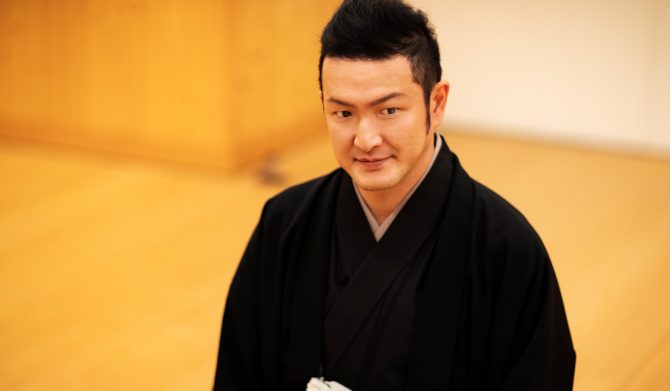
SHIDOFirst, I wanted to create a production where, the moment you step out of your modern life, you feel like you've time-slipped into Chikamatsu's era 300 years ago, as if you're peeking in on that incident and its scene from somewhere.
SUKEZANEThe distance to the audience will also be close, won't it?
SHIDOYes. Rather than feeling like you're watching a play, you might feel like you've witnessed an incident unfolding right before your eyes. And this time, the stage is visible from all 360 degrees. We've kept it simple, without elaborate props. That's precisely why acting skills are put to the test. It doesn't matter who's the lead or supporting role; there's no moment to rest, and certainly no room for carelessness, as you're constantly being watched from all 360 degrees.
SUKEZANEThere is seating, right?
SHIDOTo put it simply, it's like a boxing ring—the stage is the ring, and the seats surround it.
SUKEZANEThat makes sense. It will further enhance the live feel. It sounds like it will be exciting, and we might get a glimpse of a new image of Kabuki.
SHIDORather than adding things, I want to strip them away and keep it simple. Instead of doing something flashy and unconventional, I aim to clearly highlight the human drama and the individual characters. To express the moment of time-slipping from the modern world to Chikamatsu's era, we plan to use projection mapping. When you enter the venue, visuals will be playing, and we're planning a production where you'll suddenly enter the world of Kabuki at a certain point.
SUKEZANEIt's interesting to be guided into the world from the beginning, making it easier to immerse oneself.
SHIDOWe also plan to use it for the murder scenes within the play. It's not about merging digital and analog, but rather using them as means to express Kabuki. While "Super Kabuki" with Hatsune Miku is a fusion of digital and Kabuki, this production focuses on crafting something rooted in Kabuki's classical traditions.
SUKEZANEI'm looking forward to it. The presentation has similarities to tent theater.
SHIDOYes. I was influenced by the underground theater of the 80s, and I've always admired it. This play is dark and has an underground feel. Kabuki itself originated as an underground, street-based art form. In those days, there were no fashion magazines, so people probably imitated Kabuki actors' styles. Naturally, there was no punk or rock music, so perhaps those with that spirit were Kabuki actors. I believe the spirit of pushing boundaries, known as "Kabukimono," still exists within Kabuki. As someone living in the present day, I love rock, punk, and fashion, but I want to showcase that all these elements are present in Kabuki. I especially want young people who like fashion but aren't interested in Kabuki to see this. That's why I initiated this project.
Page02.Kabuki is popular entertainment, so please enjoy it casually
Page. 2
Kabuki is popular entertainment, so please enjoy it casually
SUKEZANEIt would be great if today's youth could feel the fashion and anarchic spirit from Kabuki.
SHIDOYes. Many people probably associate Kabuki with "tradition" or "formality." But I hope they can also grasp the "spirit of the Kabuki actor." That's why I chose a story about an incident that could happen even today. Kabuki is at the forefront of its time. To express Kabuki's street sensibility, I asked Shinsuke Takizawa, the designer of the street brand "Neighborhood," to create a limited edition T-shirt for the performance. This is an unprecedented initiative for a Kabuki performance. I want young people and fashion enthusiasts to connect with Kabuki as well.
SUKEZANEThat's interesting. What kind of T-shirt turned out?
SHIDOI requested a ukiyo-e motif. When foreigners think of Japan, they often think of ukiyo-e. The image is of a rock T-shirt with a ukiyo-e motif, like something you'd see on an 80s heavy metal band's tour shirt.
SUKEZANEIt reminds me of wearing a Kansai Yamamoto ukiyo-e sweatshirt in the 80s. I wore it in my high school yearbook too.
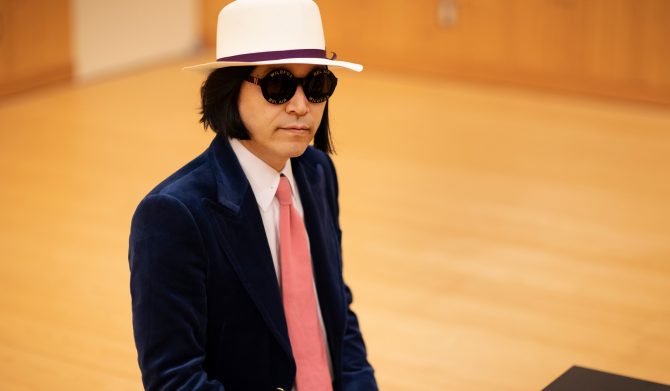
SHIDOKansai-san often used Kabuki motifs, didn't he?
SUKEZANEThere's a dynamism to it, which is great. I feel the energy.
SHIDOThis time, Masaaki Akahori, a contemporary playwright and film director, has added his touch from a modern perspective. The basic story remains as Chikamatsu Monzaemon wrote it, but there are newly added scenes, and some lines are slightly simplified for clarity. I believe even those who find Kabuki difficult and tend to avoid it might enjoy it without needing an audio guide. The proximity is such that those in the front rows might even feel the sweat and breath (laughs).
SUKEZANEI heard Ryunosuke Watarai is also appearing.
SHIDOYes. I met him when we worked on the movie "Ping Pong" released in 2002, and we became good friends. We always talked about how great it would be to perform Kabuki together someday. My 17-year-long wish has finally come true with his appearance in this Kabuki production.
SUKEZANEAre cases like this unusual?
SHIDOYes, they are. However, Takashi Sasano was a regular in Cocoon Kabuki and Heisei Nakamura-za, which were initiated by my elder brother (the 18th Nakamura Kanzaburo). Also, Tomohito Yashima will be appearing in a new Kabuki play written and directed by Koki Mitani, which will be staged at the Kabuki-za in June. There's a rush of new productions lately, with various types of new Kabuki plays. I myself have been involved in "Arashi no Yoru ni," "Super Kabuki," and now "Off Theater Kabuki." It's about tradition and innovation. Pursuing innovation while preserving tradition—that's the way of life that feels most like me. I want to continue pursuing a Kabuki that is uniquely my own.
SUKEZANERegarding this "Off Theater Kabuki," I have high expectations that we will see something truly new.
SHIDOBecause the space is small, I believe we can pursue the realism within Kabuki more deeply. The Kabuki-za is a large theater with a capacity of 2,000 people, but both Warehouse Terrada and Shinjuku FACE have capacities of only about 500 people. This means the distance is such that you don't need to project your voice loudly to be heard. I think each actor's performance will become more realistic and intimate.
SUKEZANEAs you mentioned earlier, Shido-san, even fashion shows in small venues have a sense of witnessing an event.
SHIDOAlthough this is theater, I want people to come and witness the incident as if they were attending an event. Rather than seeing something beyond their means, it's about experiencing something as fellow Japanese people. Kabuki was originally entertainment for the masses. Perhaps the image of it being high-barrier is due to its tradition and history, but fundamentally, it's popular entertainment, so I would be happy if people could come without feeling too intimidated and enjoy it casually.
SUKEZANEIt feels like something spontaneous might happen.
SHIDOIt will probably be different every day. Performing in the stylish setting of Warehouse Terrada in Tennozu versus the gritty atmosphere of Shinjuku FACE in Kabukicho will surely affect the performers' energy levels.
SUKEZANEKabuki in Kabukicho is also fitting. It's a bit of a pun, but it works.
SHIDOKabuki in Kabukicho—it's never been done before. And it's a story about an incident, no less.
Page03.Pursuing Nakamura Shido's Unique Style While Preserving Tradition
Page. 3
Pursuing Nakamura Shido's Unique Style While Preserving Tradition
SUKEZANEBy the way, how do you feel playing the role of Yohei?
SHIDOWhat's strange is that after committing murder in a Kabuki performance, there's applause (laughs). It's a brutal story of juvenile delinquency, a murder, yet applause erupts.
SUKEZANEI suppose it's because it's a dramatic highlight, but it is indeed strange (laughs).
SHIDOIt's a peculiar play where applause bursts forth at the moment of a successful execution. What I always think is that such incidents have occurred throughout every era, unchanged.
SUKEZANEThere are people like Yohei, aren't there? (laughs)
SHIDOWhile wondering why they become that way, yes, there are (laughs).
SUKEZANEMy older brother was like Yohei.
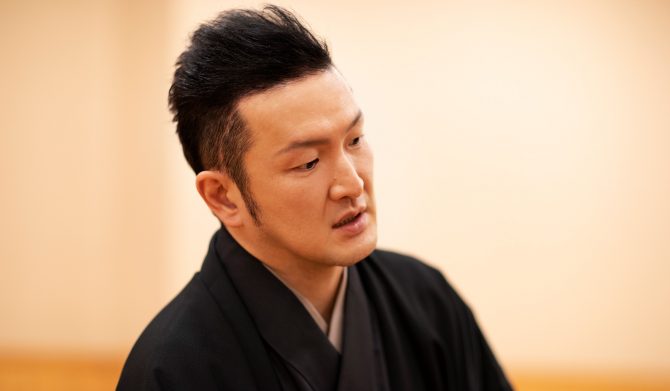
SHIDOReally?
SUKEZANEHe used to argue with our father all the time (laughs).
SHIDOYohei's father is not his biological father, but his stepfather.
SUKEZANEThat's why he couldn't get truly angry.
SHIDOHe does get angry because Yohei is so terrible, but there's a part of him that can't be truly angry. I think Yohei himself has a dilemma stemming from that. It's like a family complex.
SUKEZANEThere's a drama in that aspect.
SHIDOHe was spoiled growing up, and he's indulgent with himself. He's constantly swayed by those around him, going with the flow. He thinks a man must repay his debts, trying to act tough, but when he's refused after humbly asking for money, he ends up killing someone. Then he steals money again and goes out to play. It's a story about a completely hopeless person.
SUKEZANEHe's truly hopeless (laughs).
SHIDOIt's the story of a completely hopeless person (laughs).
SUKEZANEIt sounds fascinating. I feel like you're moving forward again, Shido-san. That's wonderful. What do you see in your future?
SHIDOI want to continue pursuing a Kabuki that is uniquely Nakamura Shido. I want to connect my experiences, what I've done, and what I've felt with Kabuki. That's my way of life, and perhaps it's something only I can do. I want to continue pursuing a Kabuki that is true to myself.
SUKEZANEI'd love to see the performances at both Warehouse Terrada and Shinjuku FACE, even just once. I'm looking forward to it. Thank you for your time today.
SHIDOThank you as well. I truly appreciate it. Please do come.