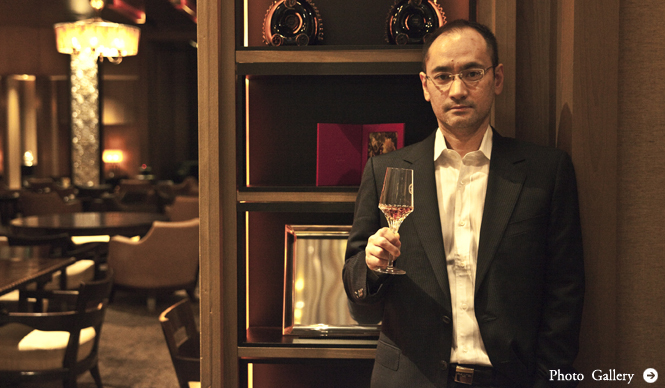
Rémy Martin Louis XIII Chapter 16 Ambassador Shuichi Yoshida
LOUIS XIII
Ambassador Interview 13
Shuichi Yoshida (Author)
A unique brandy, LOUIS XIII, born from an immense passage of time and uncompromising craftsmanship. This interview series features 13 ambassadors, chosen to share its allure, broadcasting from "Maison Louis XIII" (a limited-time space within the bar "Maduro") at Grand Hyatt Tokyo. In this final installment, the 13th, we feature Shuichi Yoshida, a writer widely read internationally and one of Japan's foremost contemporary authors, known for works like "Villain," which was also a major film topic.
Text by MONZEN NaokoPhotographs by IGARASHI Takahiro
The Purity of Compromise
LOUIS XIII prides itself on its "uncompromising approach to winemaking"... While I admire the principle of not compromising in one's work and would like to assert that about myself, when it comes to my own writing, I've never submitted a novel that I felt was "100% complete."
This is due to various reasons, including the inherent nature of creative work where absolute expression is elusive, and also physical constraints like time. However, I never feel a work is "perfect." I always reach a point where I must compromise and present it. Yet, the precision of that compromise has increased with each successive work, becoming more refined. Reflecting on what I couldn't achieve last time, I apply it to the next, gradually narrowing the distance between my aspirations and the final product, enhancing its precision and purity. Perhaps my previous works are a record of this process of trial, error, and continuation.
Just as with winemaking, the higher the artisan's dedication to their craft, the higher their standard for satisfaction must be. It seems rare to achieve true perfection. Though it might sound contrarian, I suspect that even the creators of LOUIS XIII have made compromises at certain stages.
However, the "purity of compromise" achieved over more than a century of unwavering acclaim is exceptionally high. Simply maintaining the quality of what has been created, and what was created before, is a monumental task. It's no wonder that to the outside eye, it appears as "work without any compromise."

A Spirit That Turns Focus Inward
I mostly drink alcohol not at home, but when dining out. With Japanese food, I prefer sake; with Western cuisine, I enjoy wine that complements the meal. Rather than something light and easy to drink, I favor aged spirits with a rich complexity. If one wants to savor a drink slowly, LOUIS XIII might be the ultimate example. The long-lasting aftertaste and aroma that linger after it goes down the throat. It's a spirit best enjoyed in silence after drinking. It creates an image of one's consciousness turning inward... As it's a spirit that brings a sense of contentment on its own, contrary to my usual habits, I'd prefer to enjoy it unadorned, savoring it by itself.
I once visited the Isle of Islay in Scotland, famous for its many malt whisky distilleries. The whisky I drank there, surrounded by beautiful nature outdoors, was exceptionally delicious. For me, LOUIS XIII evokes an image of daytime, not nighttime. I'd like to enjoy it amidst nature, much like the whisky I tasted on Islay. It would pair well with lush greenery, or perhaps even snow.
Just yesterday, I was in Nanto City, Toyama Prefecture, known for its Gassho-zukuri farmhouses. I believe this spirit would also pair well with the snowy landscapes I saw there. A quiet scene of clear skies after heavy snowfall. To fully appreciate the introspective sensation that LOUIS XIII brings, external stimuli are best avoided. Not conversation with others, or delicious food... but rather, a grand, beautiful landscape and one's own self within it. By placing oneself in an open space, rather than a confined one, I find the inward-turning consciousness becomes sharper and more palpable.
If It Were to Appear in My Work
If LOUIS XIII were to appear in my work... I have a new novel, "Taiyo wa Ugokanai" (The Sun Does Not Move), scheduled for release in April. It's a story about an industrial spy protagonist moving through Asia, including China, Mongolia, and Singapore. There are many scenes set in hotel bars, similar to "Maduro" where I am now, and alcohol features prominently. It's a shame I've already finished writing it, as it would have been the perfect narrative to feature LOUIS XIII.
Regarding other plans for this year, a film adaptation of my work "Yokomichi Yonosuke" has been decided. Filming begins this March, with a release planned for early next year. The director is Shuichi Okita, known for "The Chef of South Polar," the screenplay is by Shiro Maeda, and the cast includes Kengo Kora and Yuriko Yoshitaka. Please look forward to it.
Personally, I'd like to revisit Nanto City in Toyama Prefecture, which I mentioned earlier. I tend to return to places I like multiple times. I'm considering visiting again to coincide with the "Summer Season," a series of performances by the contemporary theater company SCOT (Suzuki Company of Toga) at Togakure Art Park, which features an outdoor theater. I imagine LOUIS XIII would also be a fitting companion for a summer visit to Nanto.
Shuichi YOSHIDA
Author. Born in Nagasaki Prefecture in 1968. Debuted in 1997 with "The Last Son," which won the Bungakukai Newcomer Award. In 2002, received the 15th Yamamoto Shugoro Prize for "Parade" and the 127th Akutagawa Prize for "Park and Live." "Villain," serialized in the Asahi Shimbun, earned him the 61st Mainichi Publishing Culture Award and the 34th Oya Soichi Non-fiction Prize in 2007. "Villain" was adapted into a film in 2010, with a co-written screenplay by director Lee Sang-il, and has been translated and published in Europe, America, and various Asian countries. Known for his diverse writing style that transcends genres, his other major works include "Sayonara Keikoku" (A Farewell to the Valley), "Heisei Saru Kani Gassen" (The Heisei Crab and Monkey Battle), and "Yokomichi Yonosuke," which received the 23rd Shibata Renzaburo Prize in 2010. His works have been translated into English, French, Chinese, and Korean, garnering significant international acclaim.