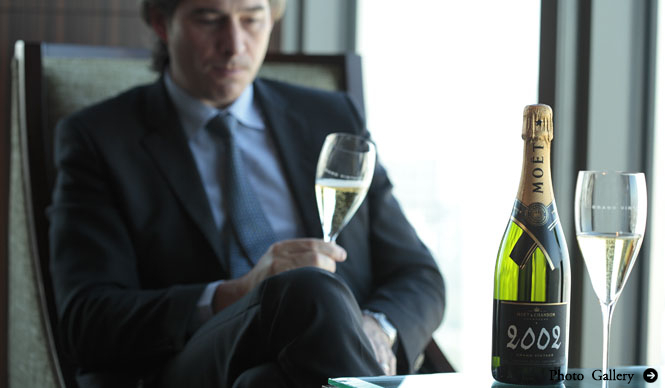
INTERVIEW | Moët & Chandon Cellar Master Benoît Gouez
INTERVIEW | Moët & Chandon Chef de Cave Benoît Gouez
Will Moët's signature style be lost with such a different approach?
Grand Vintage: A Special Release (1)
Moët & Chandon, the most renowned Champagne house in the world. Since its founding by Claude Moët in 1743, it has remained a great brand, consistently at the forefront of Champagne. Owning approximately 1,150 hectares of vineyards, the largest in the Champagne region and four times that of the second-largest house, it ships over 2 million cases annually worldwide. From this leading Champagne house comes a special bottling, "Grand Vintage," now presented with a new label. We interviewed Benoît Gouez, Chef de Cave (Chief Winemaker), and report on a collaborative event with globally acclaimed chef Keisuke Matsushima at 'Restaurant-I' in Jingumae, Tokyo.
Text by MATSUO Dai (OPENERS)
Photo by JAMANDFIX (INTERVIEW)
Innovative, Free, Luxurious
Benoît Gouez became Chef de Cave at Moët & Chandon in 2005 at the young age of 35. Having joined the company in 1999 and becoming dedicated to vintage wines in 2000, Moët & Chandon had already been releasing "Millesimé Champagne"—wines made exclusively from grapes of a particularly good harvest year—before his appointment. However, these were non-vintage and did not deviate significantly from the style of Brut Impérial, the core of Moët & Chandon's image.
Gouez revolutionized the image of Millésime Champagne at Moët & Chandon. While respecting tradition and prestige, he aimed to maximize the appeal of grapes harvested in exceptional years. Under the concept of "Innovative, Free, Luxurious," he released Grand Vintage in 2007.
The New Grand Vintage
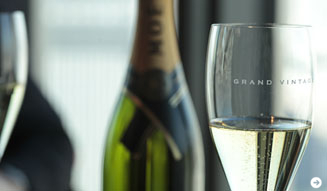
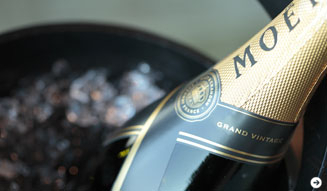
Grand Vintage is now being released with a new label. The reason behind this is to emphasize the harvest year, the vintage, as the primary focus. The font used, according to the cellar, was chosen with authenticity in mind.
Gouez states, "The personality of the vintage is important" for Grand Vintage. The blend is determined after assessing the performance of the base wines, and therefore varies significantly by harvest year. While 2002 was composed of 51% Chardonnay, 26% Pinot Noir, and 23% Pinot Meunier, the 2003 vintage features a ratio of 43% Pinot Meunier, 29% Pinot Noir, and 28% Chardonnay, likely lending it a stronger Blanc de Noirs nuance.
Gouez explains, "Grand Vintage is entirely different from Impérial. I believe those who seek Grand Vintage trust the Moët brand but are looking for something distinct from Impérial, something that will surprise them. It's different and unique. Grand Vintage is not about logic or intellect; it's a more subjective and emotional Champagne."
Will Moët's signature style be lost with such a different approach?
"What I consider the Moët style isn't just the blend of grape varieties. The vibrant fruitiness, sensual and appealing taste, and elegant maturity are common to all Moët & Chandon Champagnes."
When asked about the characteristics of each Grand Vintage, he responded, "The 2000 vintage has a strong grape flavor, with smoky notes, iodine, minerality, fruitiness, and a touch of greenness, like green pineapple. It's an energetic and dynamic vintage. The 2003 vintage is the opposite, evoking sweet spices like vanilla and licorice. It's round, rich, and full-bodied. The 2002 vintage combines characteristics of both; it has fruitiness and aged notes, offering complexity. It possesses richness and a consistent character, with good acidity and a long finish."
Moët & Chandon "Grand Vintage 2002"
Price | ¥8,715
Moët & Chandon "Grand Vintage Rosé 2002"
Price | ¥9,975
INTERVIEW | Moët & Chandon Chef de Cave Benoît Gouez
Will Moët's signature style be lost with such a different approach?
Grand Vintage: A Special Release (2)
Climate change is a major concern in winemaking, including Champagne production. The Champagne region, located near the northern limit for grape cultivation in France, is particularly vulnerable to global warming. Could this pose a significant threat to Champagne production? However, he asserts:
"Perhaps due to climate change, grapes have ripened well in most vintages since 1988, resulting in lower acidity. Cultivation areas are indeed getting warmer. Yet, so far, the quality of the grapes has actually improved. Ripe grapes make good wine. I believe we've never had such excellent conditions. Vintages like 1947, 1951, 1959, 1976, and 1990 are considered exceptional, and they all had low acidity. 2003 is another prime example. While acidity is a crucial factor for a wine's structure, it's not the only one."
Finally, we asked a somewhat challenging question about his opinion on the increasingly popular small-scale producers known as RM (Récoltant Manipulant).
His response was, "When it comes to Champagne production, the larger the scale, the better." Moët & Chandon boasts 1,150 hectares of vineyards, four times the size of the second-largest house, with half of it classified as Grand Cru. They hold significant holdings in Aÿ, a village renowned as "aristocratic" within the Champagne region. In Champagne, where the climate is more unstable compared to other wine-growing regions, it is essential to select the finest grapes from a large pool. Moët & Chandon, with its ability to meticulously choose from an extensive selection, holds a unique position in the Champagne region.
Gourmet + Tasting = Gourming
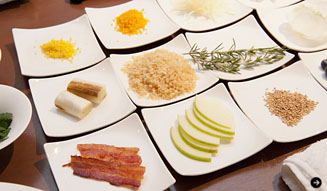
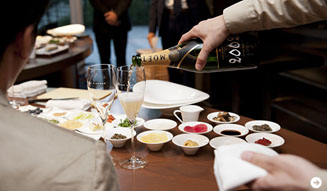
What kind of ingredients and preparation methods create the ultimate pairing with Grand Vintage, which has been aged for a long time with great care? With this concept in mind, Moët & Chandon devised "GOURMING."
Gourming, a portmanteau of "Gourmet" and "Tasting," is an experiential tasting where guests select ingredients and seasonings, which are then combined and prepared to explore pairings.
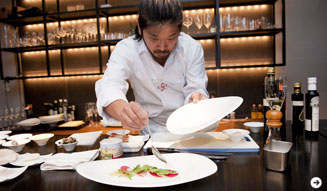
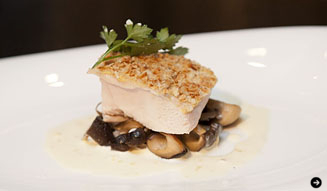
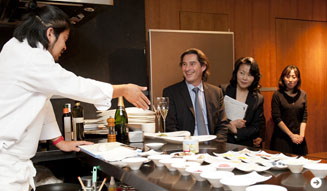
The venue was 'Restaurant-I' in Jingumae, Tokyo, headed by Grand Chef Keisuke Matsushima, who has earned six consecutive Michelin stars at 'KEISUKE MATSUSHIMA' in Nice and is active globally. The event focused on dishes paired with "Grand Vintage 2002" and "Grand Vintage Rosé 2002."
Guests combined basic ingredients like scallops and chicken with olive oil, herbs, and walnuts. There was also a moment where Chef Matsushima spontaneously proposed dishes, which Benoît Gouez then enjoyed, creating a dynamic interplay between the chef and the winemaker.
Gourming involves understanding the characteristics of ingredients, choosing personal seasonings, and creating pairings with Champagne. It's a way for guests to actively participate and discover their own perfect Champagne matches. Gourming-style home parties, perhaps with Champagne as a gift, might become a trend in the future.
Restaurant-I
1-4-20 Jingumae, Shibuya-ku, Tokyo Park Court Jingumae 1F
Tel. 03-5772-2091
Hours | Lunch 11:30–15:00 (Last Order 13:30)
Dinner 18:00–22:00 (Last Order 21:00)
www.restaurant-i.jp
MHD Moët Hennessy Diageo
Tel. 03-5217-9906
http://www.moet.jp