INTERVIEW | Four Seasons Hotel Tokyo at Marunouchi's Dining Room Undergoes First Renovation
INTERVIEW|Four Seasons Hotel Tokyo at Marunouchi Unveils First Dining Room Renovation
An Interview with Architect André Fu
The New Allure of Four Seasons Hotel Tokyo at Marunouchi (1)
This April, Four Seasons Hotel Tokyo at Marunouchi welcomed its new hotel dining destination, MOTIF RESTAURANT & BAR. The design was helmed by the rising architectural star, André Fu. This marks the hotel's first major renovation since its opening. We delve into the allure of this project through an interview with Mr. Fu about his vision for the design.
Text TODA KotaroPhotographs by ABE Masaya
Redesigning the Space Around the Bar Counter
—You've worked on notable projects such as Michelle Yeoh's home in Hong Kong, The Fullerton Bay Hotel in Singapore, and the Gong Bar on the 52nd floor of The Shard in London. What was your very first project?
André Fu (hereinafter André)It was about 10 years ago, a restaurant called OPIA in Wan Chai, Hong Kong. It was very popular, but it no longer exists. Hong Kong is a city where establishments change rapidly. The first project that truly propelled me to my current global standing was the hotel project for The Upper House in Hong Kong. This hotel was recognized in this year's Travelers' Choice Awards, and its restaurant, Café Gray Deluxe, is also immensely popular.
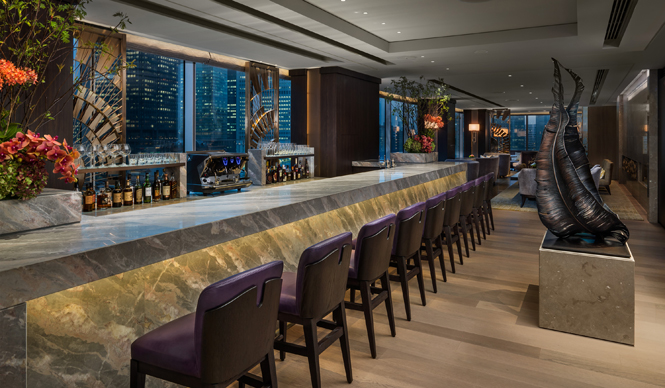
The bar counter at Four Seasons Hotel Tokyo at Marunouchi, reborn this April.
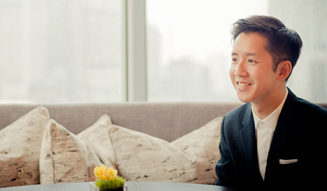
Rising architectural star André Fu, who designed the space.
—What was the most challenging aspect of this project?
AndréI received the offer from Four Seasons about a year and a half ago. The main challenge was the shape of the room itself. Its extreme, elongated rectangular form gave visitors a fragmented and isolated impression. Therefore, we needed elements that would foster a sense of unity, wholeness, and intimacy. Let me walk you through it. I enjoy being interviewed on-site like this. Words alone cannot convey everything; seeing it is essential.
In the previous restaurant, the entrance was inconspicuous, and the reception was small and tucked away. This time, we've placed the reception in the center of the space, creating a flow where upon entering, guests are immediately met with the bar counter. The bar, which previously faced the wall, has been relocated and newly constructed facing the windows. Since everyone enjoys a drink, this immediately draws people into the space. With the bar as the focal point, everything has found its proper function and role. Most of the problems have been resolved.
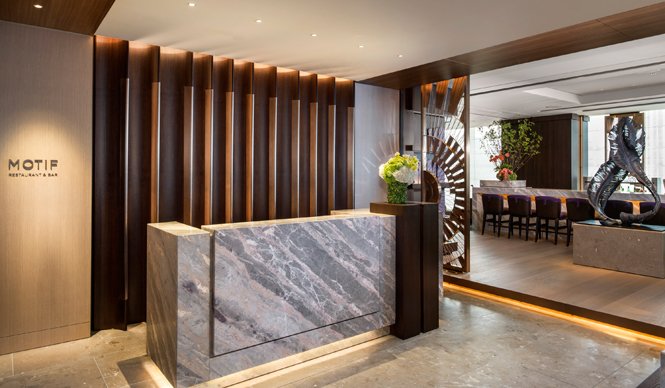
The entrance to the hotel dining space, MOTIF RESTAURANT & BAR.
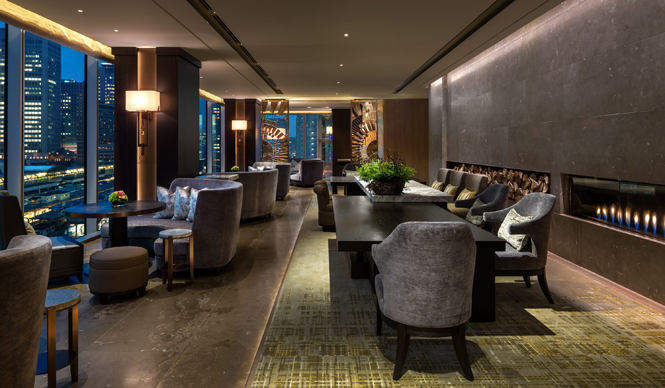
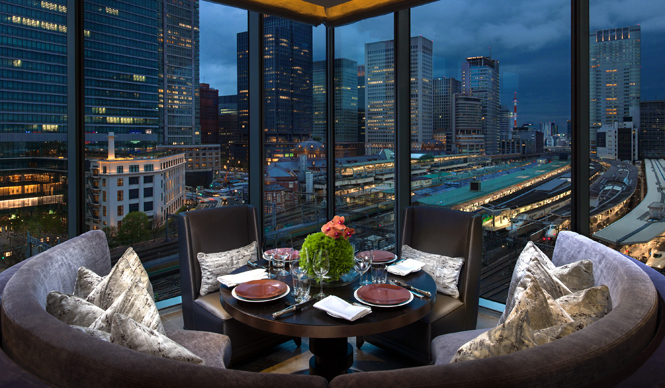
The bar lounge area unfolds to the right of the entrance. Beyond it, views of the Tokyo Station platforms.
AndréThe pattern on the screen separating the reception and the bar lounge area, 'The Living Room,' is inspired by the domed ceiling of the Tokyo Station Marunouchi Building. This screen appears in nine locations throughout the interior, placed to create a sense of distinct scenes. With the bar directly ahead, Tokyo Station visible to the far right, and the lounge area featuring a stepped design evoking a Japanese rock garden, we've also incorporated a long table. There's a bronze sculpture by Yasmin Hussein, inspired by the 'crane couple,' and the wall installation is by ceramic designer Lok Ming Fung, who drew inspiration from Japanese roof tiles and flower petals.
The buffet area, named 'The Gastronomic Gallery,' features a large 100% silk tapestry on its walls. Further beyond lies the main dining room, designated as 'The Social Salon.' The interior lighting for this main dining area is original, designed by French designer Hervé Van der Straeten. By making these distinct spaces visible to each other, the aim is to create a sense of intimacy, akin to being in a spacious living room, and an overall feeling of unity.
Page 2.The Allure of Interiors That Transform Mood and Attitude
INTERVIEW|Four Seasons Hotel Tokyo at Marunouchi Unveils First Dining Room Renovation
An Interview with Architect André Fu
The New Allure of Four Seasons Hotel Tokyo at Marunouchi (2)
The Allure of Interiors That Transform Mood and Attitude
—What was the theme for this design?
AndréI often describe my recent work as 'restorative luxury.' It's about relaxation and luxury. For this project, 'intimacy' and 'holistic' were particularly key themes.
—Your English is impeccable, like a native speaker from Queens, yet you reside in Hong Kong.
AndréI was born in Hong Kong. At 14, for my education, I attended a boarding school in the UK. After studying architecture at Cambridge University, I established my design office, AFSO. Following 14 years in the UK, I moved back to Hong Kong 10 years ago.
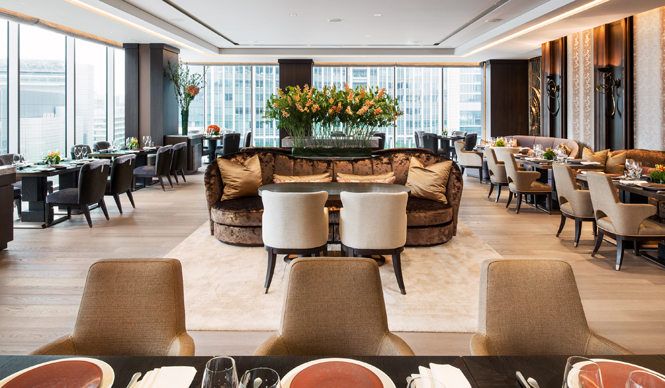
An elegant main dining area offering French course menus.
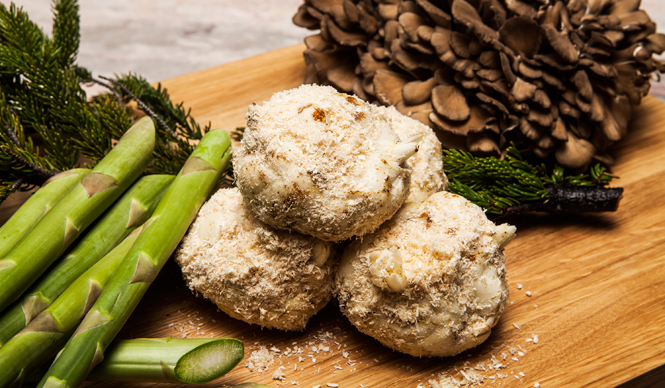
Crafting an exquisite dining experience that engages all the senses, using seasonal ingredients.
—Should I call you an architect?
AndréWhile I studied architecture at Cambridge, my work has increasingly shifted towards interior design. This is because I enjoy providing hospitality and creating experiences for people. For instance, a project like this allows visitors to experience certain textures and sensations, enhanced by music and art. My passion lies in creating spaces that offer an intimate and comprehensive experience.
In Asia, whether it's Jakarta, Hong Kong, or indeed Japan, you often find numerous restaurants within a single high-rise building, or several clustered in a small block. Despite this, the interior design alone can transform a floor into a bar or a restaurant. What's fascinating is how the interior can alter the mood and even the demeanor of the people who visit, whether they're dining on Italian, Mexican, or Chinese cuisine. In this rectangular space, I believe we've succeeded in offering a luxurious, restorative environment that is both intimate and encompassing.
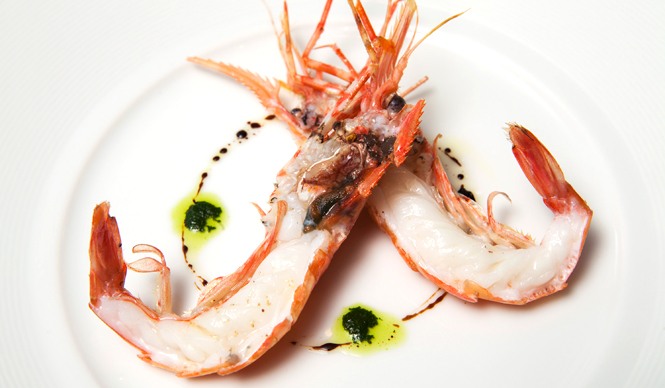
The culinary direction is led by Head Chef Hiroyuki Asano and Mr. Hiroshi Nakamichi, owner-chef of the Michelin three-starred restaurant Molière in Hokkaido.
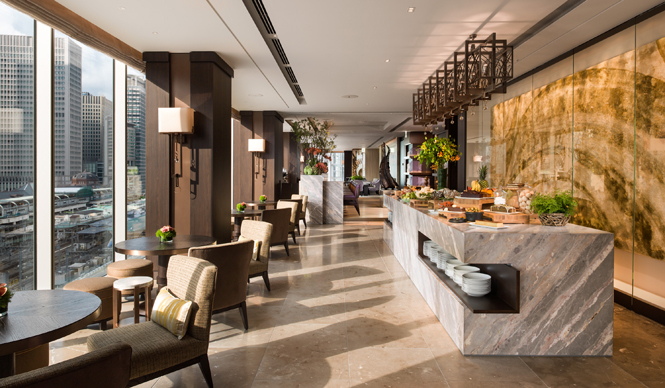
A live kitchen table is arranged in the center of the floor, offering various items depending on the time of day, such as desserts and appetizers.
—Did you draw inspiration for these feelings from restaurants you visited with your parents in Hong Kong when you were young?
AndréNo. My experiences in the UK, where I lived from age 14, and the European countries I visited with my parents were formative. What I saw firsthand – Scandinavian interiors, Southern European lifestyles, the modern art, art history, and architecture I studied at university, and postmodernism – forms the foundation of my work. Furthermore, upon returning to Asia and through my work, I've met many talented and wonderful people who have greatly inspired me. I've also learned practical perspectives from those who operate hotels and restaurants, such as how to ensure a restaurant functions effectively. I aim to continue growing in my field.
—Aside from your own projects, what is your favorite hotel in the world?
The Park Hyatt Tokyo. It's a timeless masterpiece, arguably the world's first high-end modern design hotel. Even after 20 years, its allure remains undiminished. It's a triumph by John Morford, though he has since retired. I also admire the Parco dei Principi in Sorrento, Italy. It was designed by Gio Ponti in the 1960s. As one of the earliest design hotels, its furniture, views, tiles, and stucco finishes are all exceptional and truly awe-inspiring.

André Fu
Born in Hong Kong, he moved to the UK at age 14 and graduated from Cambridge University in 2000. He established his design office, AFSO, in the same year and relocated its base to Hong Kong in 2004. He excels in architectural and interior design that masterfully incorporates Asian aesthetics, with meticulous attention to detail in spaces, lighting, and materials. He has undertaken numerous international projects, including hotels and restaurants.
Four Seasons Hotel Tokyo at Marunouchi
Tel. 03-5222-7222 (Hotel General Inquiries)
http://motiftokyo.com