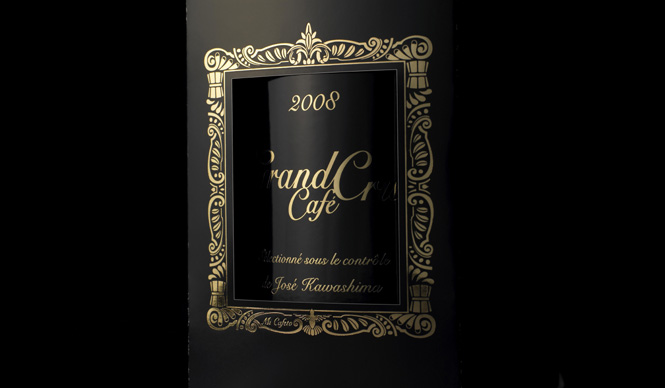
The aroma of coffee, now understood for the first time: the "true taste" conveyed by "Grand Cru Café".
Grand Cru Café
The Aroma of Coffee, Now Understood for the First Time
The "True Taste" Conveyed by "Grand Cru Café"
Vast vineyards belonging to historic chateaux. Among them, the rank of "Grand Cru" is given to vineyards that produce the finest grapes under optimal conditions. Coffee, too, has its own "select coffee" akin to this. That is "Grand Cru Café." This coffee, realized by Yoshiaki Kawashima, who grew up in a family of coffee roasters and studied at the National Coffee Institute of El Salvador, is an "unknown taste" that even coffee-haters should try.
Purchase the product (coffee beans in champagne bottles) introduced here at rumors.
Text by OPENERS

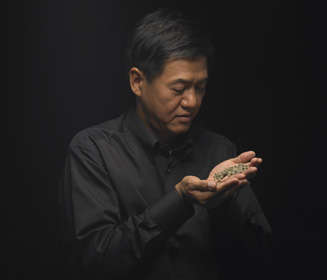
Yoshiaki Kawashima, Representative of Mi Cafeto. He also serves as Chairman of the Japan Sustainable Coffee Association.
What Kawashima insists on is the "original taste of the coffee bean." If the coffee bean itself is truly delicious, there's no need for elaborate roasting or complex extraction methods.
"About 80% of the deliciousness of a cup poured into a mug is determined by the quality of the coffee bean and how it's stored. Roasting and extraction probably only account for about 20%," says Kawashima.
However, while there are many coffee-producing regions, a stable supply of high-quality coffee beans is difficult. "It's my theory, but for wines produced and consumed in developed countries, consumers can easily visit wineries, and producers are also consumers, so information flows easily between the two.
But coffee is often produced in developing countries and consumed in developed countries, so information from consumers and the market doesn't reach the producers. Therefore, I feel it's still a relatively underdeveloped luxury item compared to wine."

Coffee blossoms. They bloom 6 to 7 times over three months. Even magnificent blossoms wilt after just three days.
Collaborative Work with Producers Essential for Preserving Quality
Kawashima, wanting to convey the taste of the finest coffee, visited coffee farms around the world. "For example, the Typica variety is famous as a high-quality coffee bean, but even within the same Typica variety, the taste differs completely depending on the soil and climate conditions of the farm. Therefore, the prerequisite is that the soil and climate conditions must be optimal for growing Typica."
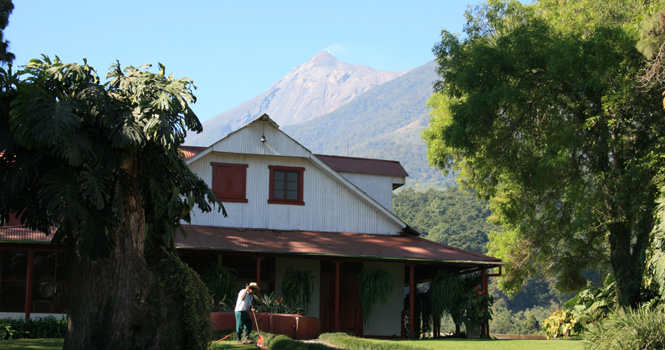
The San Sebastián farm, renowned for producing high-quality coffee. Coffee beans for Grand Cru Café are also produced here.
Kawashima discussed his knowledge and philosophy as a coffee cultivation technician, along with his commitment to processing methods, with producers, and carefully selected six farms for "Grand Cru Café." Alongside the natural environment and cultivation varieties, he emphasized the high aspirations of the producers. "Coffee trade flows differ by country. In El Salvador, it's common for farms to ship the harvested cherries directly to a processing plant. Guatemalan farmers dry the beans on their own farms before shipping."
"Therefore, for beans destined to become Grand Cru Café, we maintain quality by providing technical assistance if needed, ensuring all work from harvest to shipment is done according to my specifications. Even at the renowned San Sebastián farm in Guatemala, out of an annual shipment of 5,500 bags, only 15 bags meet the quality standards for Grand Cru Café. Without their willingness to cooperate, this wouldn't be sustainable. Of course, I visit the farms twice a year, coinciding with their harvest, hulling, and shipping seasons."
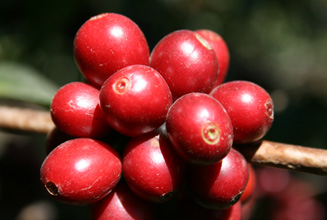
Ripe coffee cherries.
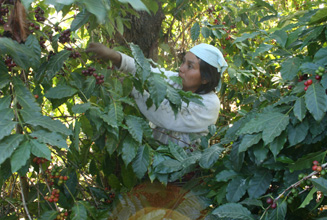
Harvesting scene for Grand Cru Café. The number of skilled pickers is said to be decreasing year by year.

The bag on the left contains ripe Grand Cru Café beans. The difference from mass-produced beans (right) is immediately apparent.
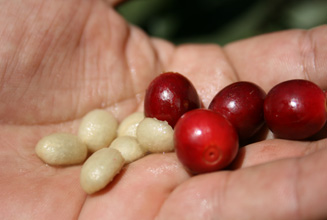
Ripe cherries (right) and beans immediately after the pulp has been removed. A mucilage called 'nuru' surrounds the beans, which decomposes and peels off upon contact with air.
Ripe coffee cherries are called "coffee cherries" due to their shape. "Grand Cru Café" harvests only these ripe cherries during a three-day period at the peak of the three-month harvest season, when the densest cherries are picked. Even the pickers are specified. "Only experienced pickers are used. They can tell the ripeness just by touching the cherries, so the harvested cherries they bag are uniformly ruby-colored." In conventional harvesting, some less ripe cherries are picked along with the ripe ones, resulting in a mixture of differently ripened beans, which is said to cause the "off-flavors" in coffee.
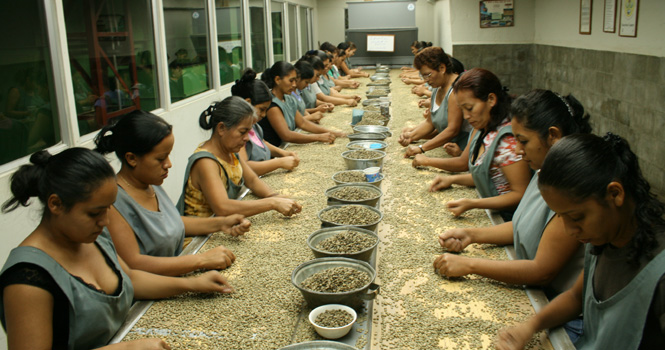
Bean selection process through hand-picking. To support the farm workers, the farm owners build churches and schools and provide for their livelihoods.
The processing steps Kawashima requests from the farms are simple and obvious, but time-consuming. Even in an era of increasing mechanization for mass production, manual labor is prioritized. "To maintain the quality of harvested coffee, drying, which takes 18 hours by machine, takes 10 to 14 days of sun-drying. Bean selection relies entirely on hand-picking, and the beans are rested in silos for 60 days before hulling. Since coffee, an agricultural product, undergoes harsh processes from harvest to hulling and drying, it needs to rest to relieve stress."
Coffee Beans Shipped Under Complete Management Until After Roasting
All shipped coffee beans are transported by air. Sea freight, which takes a month to reach Japan, is avoided because the temperature inside the container can reach 60 degrees Celsius when passing through the equator, inevitably degrading the coffee beans.
The burlap sacks used for shipping are also equipped with a special inner vinyl lining to prevent the unique smell and oils of burlap from transferring to the coffee. "Upon arrival in Japan, Grand Cru Café beans are immediately packaged in 500-gram units with oxygen absorbers and moved to our in-house coffee cellar. This coffee cellar is likely the first of its kind in the world. The temperature is maintained at 18 degrees Celsius. We store them as green beans and roast them in 500-gram batches."
The roasted "Grand Cru Café" is packaged in champagne bottles, but there's a reason for this. "It's definitely not for show," Kawashima continues.
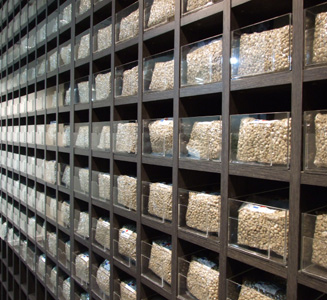
Rows of boxes belonging to owner members line the cellar. Owner members select their preferred beans from the six farms and entrust their storage here. The system allows them to order by phone when they want to drink, and freshly roasted coffee is delivered.
"Roasted coffee releases carbon dioxide, so it's common to package it in bags with one-way valves to release the accumulated gas, or to let it sit for a while after roasting to release CO2 before vacuum packing.
However, this allows the aroma to escape with the gas. So, I thought, could we store the beans while trapping the aroma inside by using a pressurized container? For this purpose, we chose champagne bottles. They also have the effect of blocking light, which can cause deterioration."
At a recent fair held at Isetan Shinjuku, the coffee beans bottled attracted attention, and many people experienced "Grand Cru Café." Coffee connoisseurs were amazed by the "new taste unlike any coffee before," while those indifferent to coffee found it "easy to drink" and "without an unpleasant aftertaste," sparking their interest.
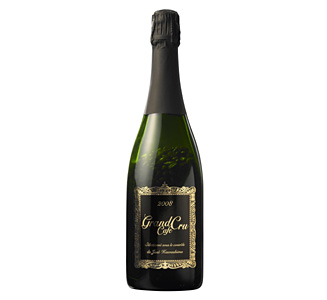
The brand names are the names of the coffee-producing farms, such as Guatemala's "San Sebastián Farm," Panama's "Carmen Farm," Panama's "CotoWa Farm," and Colombia's "Bella Vista Farm." Each half bottle (100 grams) costs ¥5,775, and a full bottle (200 grams) costs ¥10,500.
"People who dislike coffee probably remember the first coffee they ever drank. In fact, even at high-end hotels and Michelin-starred restaurants, while the wine might be good, it's rare to find one serving excellent coffee. When asked why such poor coffee is served after a delicious meal, they might reply, 'Oh, this is imported directly from Italy...' But without quality coffee beans, proper processing to preserve them, and correct storage methods before extraction, no amount of focus on brands or machinery will make it delicious."
A Cup as a Luxury Item, Recommended Even for Coffee Haters
Common expressions used to describe coffee characteristics, such as "body" or "aroma," do not apply to "Grand Cru Café." The first sip surprises with the smoothness of the mouthfeel, where aroma and flavor are perfectly harmonized, followed by a subtle, lingering body from the back of the throat. No bitterness or off-flavors remain on the tongue. The acidity felt in the aftertaste is less "acidity" and more "refreshment," with a natural sweetness lingering like the memory of the bright red, ripe cherries at harvest. This is truly the work of aroma, and the essence of a luxury item.
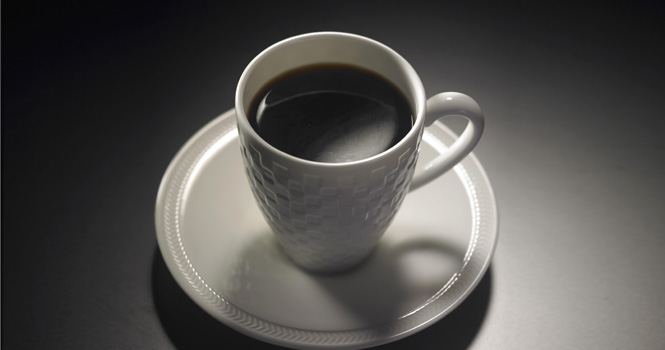
What's more astonishing is that this coffee's flavor evolves with temperature changes. Just like fine wine that transforms with decanting, a cup poured into a mug reveals deeper flavors as it cools. The aroma remains in the empty cup. For Japanese people sensitive to emotional nuances and lingering impressions, the delicacy of this coffee is irresistible.
Kawashima, who has received feedback such as "I felt elegance in the coffee," was inspired by his father's grumbling, "Coffee used to be delicious," to pursue the true taste of coffee and complete "Grand Cru Café." Through thorough natural fermentation and a dedication to maximizing the inherent quality of the ingredients, a return to the basics and the meticulousness of a cultivation technician have given birth to a new stage, "Grand Cru," for the familiar luxury item of coffee.
Mi Cafeto Concierge Desk
Tel. 03-5771-4171
