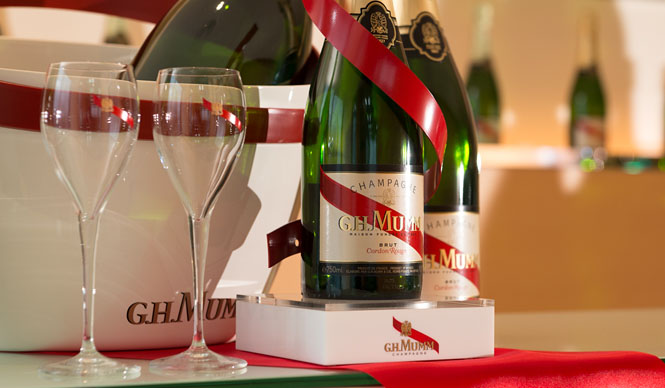
G.H. Mumm: Champagne to Celebrate Life | G.H.MUMM
G.H.MUMM | G.H.Mumm
Cellar Master Didier Mariotti on its Appeal (1)
G.H. Mumm: Champagne to Celebrate Today and Pledge for Tomorrow's Joys
Didier Mariotti, Cellar Master of the renowned French Champagne house G.H. MUMM, famous for its "red ribbon" (Cordon Rouge) modeled after the French Legion of Honour, visited Japan. When asked, "How would you appeal the brand to those unfamiliar with G.H. Mumm?" he replied, "In French, there's a word, 'Gourmandise,' which means gluttony, epicureanism, or a feast. G.H. Mumm is a Champagne with that kind of image; one sip makes you want more and more. Its charm lies in the sensation of fresh fruit."
Photographs by SUZUKI ShimpeiText by KAJII Makoto (OPENERS)
France's Number One Champagne House
"G.H. Mumm is a Champagne house with a long history, founded in 1827 in Reims, Champagne, France, by a German family," says Didier Mariotti. "It was the official Champagne for royal courts across Europe, including the British Royal Family, and those of Austria, Hungary, Belgium, and the Netherlands. In Japan, we received the title of official Champagne for the Imperial Household in 1911."
For many years, it held the title of the world's best-selling Champagne house. However, "due to its German origins, it faced difficulties in France during the two World Wars. Currently, it ranks third worldwide in sales, but remains number one in France," he explains.

A Drink for a Life of Daily Adventure and Victory
G.H. Mumm's signature Champagne, "G.H. MUMM Cordon Rouge," is the official Champagne of Formula 1, and many will recall the podium celebrations. Furthermore, in 1904, French polar explorer Jean-Baptiste Charcot opened a bottle of Cordon Rouge to celebrate reaching the Antarctic continent. Among Champagne enthusiasts, it has become a symbol of courage and success, cherished as the "Champagne of adventure and victory."
Mariotti expresses his pleasure with the "Champagne of victory" image, but adds, "Cordon Rouge is not an elitist drink for the jet set; it's something to be shared with dear family and friends during small celebrations. For me, Champagne is a drink to celebrate life itself."
When asked if he is currently pursuing any challenges, Mariotti stated, "In my work, I aim to maintain the same quality for Cordon Rouge, the symbol of the brand, each year while continuously improving it. In my private life, I want to get better at golf, which I started playing four years ago."
A Simultaneous Burst of Fresh Acidity and Ripe Fruitiness
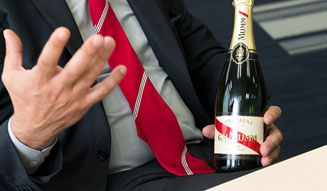
"The style of G.H. Mumm's Champagne is related to our 218-hectare estate vineyards," says Mariotti. "Most of the grapes grown are Pinot Noir, and since Pinot Noir is the dominant grape in all G.H. Mumm Champagnes, the presence of fruit is a key identity."
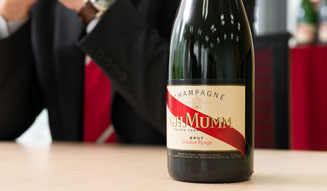
Regarding the brand's flagship, "G.H. MUMM Cordon Rouge," he explains, "It's composed of 45% Pinot Noir, 30% Chardonnay, and 25% Pinot Meunier. You'll experience the freshness of the fruit and the acidity of freshly picked berries, along with the ripe juiciness of white fruits like pears and apples, and yellow fruits like peaches and apricots. Even as a non-vintage, its long aging period of two and a half years and the use of 20-25% reserve wines contribute notes reminiscent of preserved fruits or fruit tarts."
Cordon Rouge is recognized as a cuvée symbolizing the house's exceptional skill and know-how, and is currently enjoyed in 150 countries worldwide.
G.H.MUMM | G.H.Mumm
Cellar Master Didier Mariotti on its Appeal (2)
G.H. Mumm: A Champagne for Moments Shared with Friends and Family
Cellar Master Didier Mariotti suggests enjoying G.H. Mumm's Champagnes, which showcase the fruitiness of Pinot Noir, by saying, "Drink Mumm on any day that calls for a little celebration!" He adds, "People in the Champagne region open Champagne whenever they meet someone or when friends visit, finding any good reason to celebrate. Opening a bottle makes that moment special."
The Busiest Time of Year: The September Harvest
When asked about his top priority as Cellar Master of a Champagne house seeking a perfect balance of freshness and strength, Mariotti replied, "Uncompromising commitment, and being true and respectful to the brand." He continued, "This job involves nature, so overthinking doesn't lead to solutions (laughs), but everything comes down to tasting the harvested wine."
September is the grape harvest season. "During the three weeks of harvest, I work without a day off, from 7 AM to around 10 PM. I help with the grape picking in the vineyards and observe the pressing process near the fields to gauge the quality of the vintage."
Two Months Focused on Tasting
After these "three special weeks of savoring the harvest," the wine tasting begins in November. "Over November and December, my team tastes approximately 300 different wines, each tasting them twice. This allows us to confirm the quality of the year's vintage," he says.
These two months involve starting work at 7:30 AM, followed by a team meeting, and then focused tasting sessions from 11 AM to noon and again from 4 PM. "We confirm the wine's taste here, and each team member memorizes it before we move on to assemblage (blending)."

2014: A "Splendidly Good Harvest Year"
When asked about the difficulty of transitioning from tasting to blending, Mariotti responded, "Things flow naturally." He explained, "The process from tasting to blending is very organic, akin to that of a musician or painter. While wine proportions are determined in writing, blending works better intuitively than by writing sheet music."
After the two months of tasting in November and December, the grapes harvested the previous autumn are blended in January and February of the following year, with all work concluding in March. The 2014 vintage was a "splendidly good harvest year." "Because the grapes were of such high quality, we also produced a vintage. How it will age is up to fate, though," he says with a smile.
Open it Casually Like Wine, and Pair it with Food
When asked for advice on how to enjoy Champagne with Japan's diverse cuisine, encompassing Japanese, Western, and Chinese dishes, Mariotti suggested, "It's probably best if I don't set rules. I hope everyone in Japan will try pairing Champagne with various dishes. While Champagne is often perceived as a drink for 'special occasions,' I encourage you to think of it like wine. In restaurants, I recommend consulting with the sommelier, who knows the chef's cuisine well, to find the perfect food pairing. Japan has many excellent sommeliers."
How does Mariotti enjoy Champagne at home? "Recently, when drinking Champagne, I've been enjoying the Lebanese mezze style. Mezze is a spread of various appetizers on large platters, and compared to a traditional French dinner, it's more casual. You can pick what you like, and it's easy to serve Champagne freely. I highly recommend everyone look it up and try it."