ART | "Fukushima and Its Influence: Artists and Architects Gathered by Reiko Ikemura's Call" Exhibition
ART | Questioning the Relationship Between Nature and Humanity in the Wake of the Nuclear Accident
"Fukushima and Its Impact: An Invitation to Artists
and Architects by Leiko Ikemura" Exhibition
The Great East Japan Earthquake and the ensuing Fukushima Daiichi nuclear disaster caused immense damage to Fukushima and other regions in eastern Japan. In response, artist Leiko Ikemura organized an event to question what art can achieve. Many artists, active both domestically and internationally, such as Curtis Anderson, Yoko Ono, and Jun Kaneko, responded to Ikemura's call and gathered in Berlin.
Text by OPENERS
Talk Session Held on Recovery from Disaster
On March 11, 2011, an unprecedented earthquake and tsunami struck the Tohoku region of Japan. The subsequent nuclear accident at the Fukushima Daiichi power plant, which remains unresolved, has posed many problems not only for Japan but for countries around the world. In this context, Leiko Ikemura, a Japanese artist active in Berlin and Cologne, Germany, took action.
She invited artists and architects, including her friends Wim Wenders and Boris Mikhailov, to plan an exhibition at KW Institute for Contemporary Art in Berlin, showcasing works that contemplate the current situation in Fukushima and eastern Japan. The exhibition questions our attitude towards the Earth and the cycle of creation and destruction.
Responding to Ikemura's call were, in addition to the two mentioned above, internationally acclaimed artists and architects such as Curtis Anderson, Yoko Ono, Jun Kaneko, Katharina Grosse, Yutaka Takanashi, Daido Moriyama, Eikoh Hosoe, and Rosemarie Trockel. Their works encourage us to consider what attitudes and actions we should take towards the future, offering guidance for the path ahead.
Following this event, a discussion forum involving architects will be held on topics such as reconstruction, emergency housing, energy conservation, and nuclear power. Furthermore, a charity auction to support the disaster victims is also being planned for this autumn.
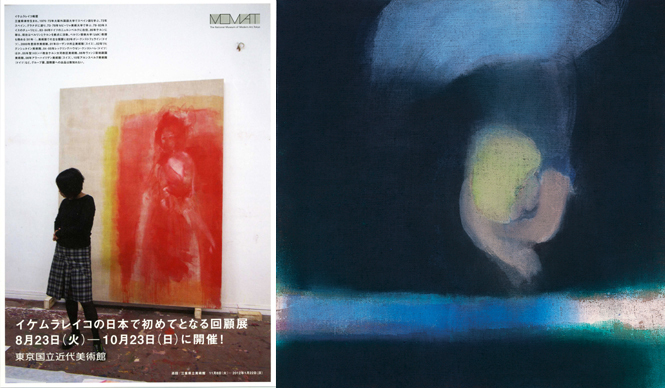
Ikemura herself is scheduled to have her first major retrospective exhibition in Japan, "Leiko Ikemura: Transitory," at the National Museum of Modern Art, Tokyo, in August.

"Emerging from Black," 1998-99, Toyota Municipal Museum of Art. Photo: Tatsuo Hayashi
Ikemura's works, with their private and poetic approach, gently embrace opposing qualities, conveying an emotional strength within a profound stillness. At a time when we must seriously consider the "transitory" nature of things, her art is sure to pose questions to the viewer and gently illuminate the way forward.

"Fukushima and Its Impact: An Invitation to Artists
and Architects by Leiko Ikemura" Exhibition
Fukushima and the consequences: LEIKO IKEMURA invites artists and architects
Dates: June 9 (Thu) - July 17 (Sun), 2011
Venue: KW Institute for Contemporary Art in Berlin
Leiko Ikemura: Transitory Exhibition
Dates: August 23 (Tue) - October 23 (Sun), 2011
Venue: The National Museum of Modern Art, Tokyo
Tel. 03-5777-8600 (Hello Dial)
http://www.momat.go.jp
Leiko Ikemura
Born in Mie Prefecture, Japan. After studying Spanish in Japan, she pursued art studies in Seville, Spain. She subsequently moved to Switzerland and then Germany, and is now based in both Berlin and Cologne, where she also holds a professorship at the University of the Arts. Her work spans a wide range, including painting, sculpture, and drawing. In her paintings, while using oil paints, a medium symbolic of Western art, she employs extremely thin layers that allow the canvas to show through, suggesting an intention to bridge Eastern and Western sensibilities. Highly acclaimed, she received the August Macke Prize in 2008.