March 13, 2015
Noriko Asano | "Winds of Africa" Chapter 23: Another Side of South Africa 2
Chapter 23: Another South Africa 2
In the previous "Winds of Africa," I interviewed my Rastafarian friend B.Z. George (49) about "apartheid," a topic that cannot be avoided when discussing South Africa.
This is a continuation. I spoke with him about "today's South Africa," 15 years after the complete abolition of apartheid. Please learn about the current reality of South Africa. This interview was conducted in March of last year.
Interview by Noriko AsanoTranslation by Masafumi Kajitani

—Tell me about the ANC (African National Congress). What is the ANC?
The ANC is a movement. A movement started by our ancestors. It's a political party that should support the people at the bottom.
—Is Nelson Mandela part of the ANC?
Yes.
—Did the ANC's activities lead to the abolition of apartheid? How does the current ANC compare to that time?
It has changed. Today, a Black person is president, and the parliament is mixed with all races, called the Rainbow Nation. At that time, the ANC worked hard and brought about good change. But the current ANC... well, there are corrupt politicians and Chairman Zuma, who has been indicted, so it has problems. It's not that the ANC is bad, but rather that some individuals within the ANC are bad.
—I heard that the ANC is divided into two factions between the younger and older generations?
This isn't the first time the ANC has split into two. I was born in 1960, so I heard this from my father, but in the 50s, the ANC also split into two, and the PAC (Pan Africanist Congress) emerged from that. Everything changes. Some people resist that change. That's how it is. However, compromise is also necessary to move things forward.
My father was with the ANC, but he joined the PAC when it split off. He believed that Africanists should be Africanists, and that they should have freedom and land. All the houses around here are from the apartheid era. When we gained freedom, we expected to be told, "You've been paying rent all this time, so we'll give you the house now, and you can be self-sufficient." But we are still paying rent.
The roads outside haven't changed since the 60s, and only the roads visible to tourists are nicely paved. But if you turn off the main road, it's terrible. Many people are disappointed with the ANC.
—Might a new president emerge from the ANC in the April presidential election?
Yes.
—What do you think about the possibility of ANC Chairman Zuma becoming president? I heard he paid a large sum of money to avoid rape charges.
The possibility of him becoming president is high. Regarding him, bad rumors keep coming out. But the truth is unknown. In any case, the current ANC has many problems due to corruption charges and other issues.
—The ANC is in conflict with other political parties, isn't it?
You mean the IFP (Inkatha Freedom Party)?
—If armed conflict begins between the ANC and the IFP, will the 2010 World Cup be canceled?
Yes. That concern is certainly there. The issue between the IFP and the ANC has continued since the apartheid era.
—Are they from the same ethnic group?
I was just about to say that. The IFP is more of a Zulu ethnic group, while the ANC is Xhosa. Mr. Mandela is also Xhosa. And Chairman Zuma is Zulu. This is primarily a conflict between the Xhosa and Zulu.
For us Rastafarians, both Zulu and Xhosa are the same people. The Xhosa people originated from the Zulu people. Southern Africa was all Zulu. Then, due to wars and other events, people scattered, some cut their cheeks to form new tribes, and others made large holes in their ears to create new tribes. New languages were also born. King Shaka of the Zulu fought against white colonialists, resulting in the formation of various tribes, but they all originated from one. It's a sad story.
—Are the Zulu the largest ethnic group in South Africa?
That's correct.
—How will the ANC affect the future?
Personally, I think it will have a negative impact.
—For example?
The abortions and same-sex marriages that the ANC recognizes are sinful. We were created by Adam and Eve, and we must send children into the world. I can never agree with abortion. To kill a baby before it can be born... isn't that killing the future? I cannot accept that. There are still many problems. The current state of South Africa is not very good.
—After the presidential election in April, how do you think South Africa will change?
There will be good changes and bad changes. Jobs might increase, but some may have to compromise their pride. We might have to kowtow to the so-called Westerners who come from abroad. I can't explain it well, but that's a bad change. There are good aspects and bad aspects. We Rastafarians, in particular, try to see things from a different perspective. My concern is that something from the West will negatively impact our lives. South Africa is becoming a gateway to Africa for Westerners to adapt flexibly.
—For example, people in developed countries might not know about the current situation between the ANC and IFP and think that South Africa has no ethnic conflicts. But if the conflict between the ANC and IFP starts, won't people's perceptions change?
Yes. If that happens, no one will come to South Africa.
—If the politics stabilize and the worsening public safety is resolved, South Africa has much to look forward to in the future, including tourist resources like safaris, Cape Point, and Durban; mineral and energy resources like diamonds, gold, uranium, and natural gas; and delicious fish and beef, wine, etc. Furthermore, the paved roads, which are easier to drive on than in Japan, offer various possibilities, including distribution.
It has been 15 years since apartheid was abolished, and the situation is gradually improving. If the conflict between political parties intensifies now, everything will be ruined. What do you think about that?
Yes, conflict must be avoided. The ANC and IFP should reconsider and stop their conflict. What's important now is for everyone to work together to improve the country...
—What other problems does South Africa face?
Hmm, there are various issues, but I would say AIDS. Especially AIDS among young people is a major problem.
—Is this a problem in Gugulethu? Or in South Africa as a whole?
It's a problem for all of South Africa.
—Are there many AIDS patients in Gugulethu as well?
Yes, many.
—Many people don't use condoms, do they? Why is that? Is it a religious issue?
I wonder why. I think it's simply because they don't find it pleasurable. Even though they might get sick.
—Are you receiving support from NGOs in other countries?
Yes, we are. They are working hard. The problem is the behavior of South African youth. For a while, the AIDS situation improved with the cooperation of NGOs from other countries. Even now, among those living in urban areas with a certain standard of living, the AIDS situation has improved. However, the neglected poor... especially children in the slums, cannot go to school and have given up on life. They use drugs and have sex indiscriminately... In Gugulethu, in particular, the problem of alcohol abuse is severe.
—Even children?
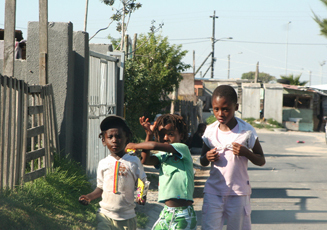
Yes. The problem of children drinking alcohol is severe. Especially in the slums. They drink alcohol, do drugs, steal things, get beaten to death... Many boys are wasting their lives. Recently, girls as young as 13 or 14 are also getting into drugs.
—What kind of drugs?
Mainly TICK. I think it can be bought for $2 to $3.
—Is it like cocaine?
You inhale it from a bag. And when you're high, you don't sleep. Even if the room is clean, you keep cleaning it. If you inhale it, you absolutely won't sleep. Your body will break down and you'll die.
—In which country is TICK produced?
I don't know. TICK is a white powder. It's dangerous and cheap. It's quite cheap and widespread. It flows in from the coloured areas. White people are also involved, and it's a difficult situation. Alcohol and drugs are major problems. Children are the future. The current situation where children are addicted to alcohol and drugs is the worst.
—What was the drug situation like during apartheid?
It wasn't non-existent, but the situation wasn't this severe. Now, with cocaine, heroin, and many other drugs coming in from South America and other foreign countries, it's the worst. Especially since the inexpensive TICK started becoming popular.
—What are your thoughts on the current situation in South Africa?
Current South Africa... I don't know. I thought we would be freer, but democracy... for some reason, democracy doesn't work well in Africa. I can say that for sure. It might work a little, but is it really suitable for Africans...?
—What problems are you personally facing right now?
Lack of work. During the apartheid era, there was work. Unlike now, if you worked for 20 years, you received a pension. Now, jobs end with 6-month or 12-month contracts.
—There's a shopping mall being built in Gugulethu right now, isn't there? Will there be jobs there?
I wish there were. Being unemployed is tough.
—I think it's not difficult to start a business if you change your perspective a little.
Of course. My mother ran a business. She used to pluck chicken wings and make chicken dishes. I'd like to open a guesthouse, internet cafe, or coffee shop someday. My brother makes delicious food. If you come next time, I'll treat you.
—Thank you. Lastly, what do you wish for the children who will carry on the next generation?
Health. If you have health, you can do anything.
Indeed, South Africa surpasses other African countries in various aspects. Tourist resources, energy resources, mineral resources, and so on. In urban areas, if you look only at the surface, it's no different from the West. The roads are also surprisingly well-maintained, making travel incomparable to other African countries. In particular, infrastructure development is rapidly progressing towards the success of the World Cup to be held next year.
However, internally, it is still a developing country. The economic disparity, in particular, is incomparable to developed countries.
But what's surprising is that even people living in impoverished areas don't have a fundamental sense of "despair." Each person believes in their own potential and that of their peers. I believe this comes from the confidence gained from surviving the worst era of apartheid and a strong desire to build a new country with their own hands. They are truly strong to be able to believe in that potential.
If there's one thing I'm worried about, it's the children born in the slums who are caught up in drugs and alcohol, and their future.
When Nelson Mandela became the first Black president in 1994, he declared free education. However, this has not yet been realized. Although education is said to be free for children from the poorest strata, the quality of public schools is so low that parents who want a future for their children strive to work hard to send them to private schools. However, there are no jobs.
I sincerely hope that the upcoming World Cup will create even a few more jobs, that the reality for these children will improve even slightly, and that they will find light in their future.
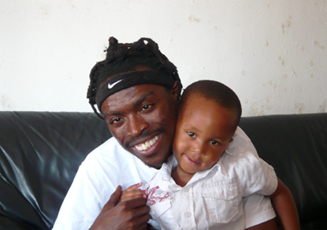
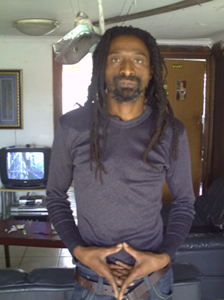
B.Z. George, who I interviewed this time, is not wealthy, but he is always calm and always smiling. Friends are constantly coming and going at his home, and many people look up to him.
His son, Crosby, is a rapper actively involved in music and is participating in the currently produced "African JAG vol.2." They are trying to convey the reality of the world they live in through beats to the world. Please listen to their voices. I believe that something begins with knowing something.
I intend to continue interviewing people from all walks of life, whether famous or unknown. I hope to convey the reality of people living on the same planet in real-time, even if only a little.
African JAG / Producer Noriko Asano
Note: This interview was conducted in March 2009. In the presidential election one month later, ANC Chairman Zuma was elected the first Zulu president. The feared large-scale armed conflict between the ANC and IFP has not occurred so far. I have heard from people who experienced apartheid in various places say, "We are tired of people clashing. Precisely because this is a country that experienced apartheid, we want to unite beyond ethnic lines and build a good country." I hope those words will be passed down to the children of the distant future.
