Noriko Asano: "Winds of Africa" Chapter 22: Another South Africa 1
Chapter 22: Another South Africa 1
South Africa will host the World Cup next June. The Japanese national team has already secured its spot, and this southernmost country in Africa is currently drawing considerable attention. While Japanese media often focuses on negative news, portraying it as "the most dangerous country in the world," my actual experiences reveal distinct areas of safety and insecurity. The nation is actively enhancing security measures in preparation for the World Cup. Above all, the South African people are deeply committed to making this major event a success, and many have treated me with great friendliness. I've visited about seven times and have never encountered a dangerous situation.
Of course, if you walk down a dark street adorned with flashy jewelry, you might be robbed, but that's not unique to South Africa. Please don't assume that Japanese common sense applies everywhere in the world. Exercise discretion and visit South Africa, a country undergoing significant change, especially with the World Cup as a catalyst.
Now, when discussing South Africa, it's impossible to avoid the topic of "Apartheid" and the country's transformation after its abolition. I interviewed a Rastafarian friend of my age who lives in Gugulethu, a township/ghetto in Cape Town. I will present this interview in two installments. In this first part, I will share his actual experiences during the Apartheid era.
Apartheid, by the way, was a policy of racial segregation legalized in 1948 and officially abolished in 1991 (fully dismantled by 1994). Under the white minority government, people were classified into four racial categories, and racial discrimination was rampant. Specifically, the indigenous black majority, who constituted the overwhelming majority of the population, were restricted in their residential areas. Public facilities such as transportation, restaurants, schools, and even public restrooms were segregated into "whites only" and "non-whites." Black individuals entering white-only areas faced immediate arrest or, at times, execution. This policy was based on white supremacy. The film "Beyond the Gates" vividly portrays the reality of that time and is a must-see!
Interviewer: Noriko AsanoTranslator: Masafumi Kajitani
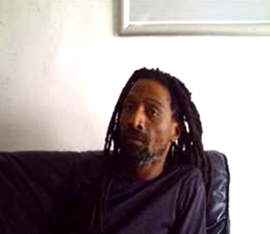
— Please tell us your name, age, occupation, and ethnicity.
B.Z. George. 49 years old.
Currently unemployed. I occasionally sell peanuts at a local stand. My ethnic group is Xhosa.
— What did Apartheid mean to you?
To me, Apartheid was the worst, most evil system in history. It was a painful time. For example, I couldn't shop freely. There were stores exclusively for whites, and some stores even had separate sections inside for "whites" and "non-whites." Education was also terrible. They called it Bantu education, teaching children nonsensical things and ruining their lives.
— What were you doing during the Apartheid era?
I was still a student during Apartheid. The riots began on June 16, 1976, and I had to drop out of school. My father passed away in 1978, my mother was unemployed, and my brother was an alcoholic, so I had no choice but to work and support my family.
— Are there any unforgettable incidents or experiences from the Apartheid era?
Too many... But the worst experience I still can't forget is having to change our Xhosa surname in '76 or '77, before my father, a human rights activist, passed away. If we didn't, we didn't know when the white police might kick down our door and arrest us, the family of activists. We were PAC (Pan Africanist Congress) supporters. So, we changed our surname from Bolani to George. My father wanted to prevent his descendants from being persecuted after his death. I still go by George, but my real name is Bolani.
And then there was "Gugulethu 7"... that incident is something I can never forget. I'll tell you about it later.
— What were your thoughts when Apartheid was abolished?
First, I thought education would change and become free. Until then, South African education was designed to narrow our horizons and suppress us, training us black children to be laborers for the whites.
I also thought there would be more job opportunities. They introduced a new system called "Publicisation," but it wasn't beneficial for us. That system didn't suit us. Even 15 years after the complete abolition of Apartheid, finding employment is still difficult.
— When Nelson Mandela was released and the black government was established in 1994, wasn't there a sense of hope?
Absolutely!! We were filled with hope. Everyone watched the parade on the first day Mandela was released. Everyone was full of hope. We thought we would finally be free.
— It's been 15 years since Apartheid was abolished, but has everything changed as you expected?
The answer is no. Not everything has changed as expected. Some things have improved, but problems remain. There is still much that needs to be improved, especially regarding education.
— Could you please tell us about the incident known as "Gugulethu 7" that occurred here in Gugulethu during the Apartheid era (1987)?
The "Gugulethu 7" were my brothers. At that time, the Rastafari movement was beginning in Cape Town, especially in Gugulethu, and spreading to other towns. We used to dance together and hang out as Rastas. However, there was one difference between them and us. While we were all Rastas, our approach to fighting Apartheid differed.
They resorted to violence as anti-establishment activists. On the other hand, we fought with our spirits. We believed, "We resist Babylon, and God watches over us." But they took up arms and decided to fight the white police and their system with violence. We couldn't do that...
One night, late, the brothers came to a dance hall where a gig was being held to recruit soldiers. But we Rastas refused to take up arms, saying, "No, we fight with our spirits. This system will eventually fall." We sought peace... What happened to them was a tragedy.
— What did you think when the "Gugulethu 7" incident occurred?
It was a moment when I truly felt the horror of Apartheid. Initially, the operation was planned with eight or more soldiers, not just seven. But several soldiers didn't show up at the time of the operation. Perhaps they informed the police. Because when they approached the hiding place, a large number of police were lying in wait. The police were waiting, hidden in bushes and trees. It was a complete ambush.
Then, as the "Gugulethu 7" dropped their weapons and raised their hands to surrender, the police officers approached. An officer shot Jab (one of the Gugulethu 7), who was unarmed, from above. It was a horrific act. I will never forget it.
— How many people died?
All seven of them. It was reported on television, but they all had their hands up and were unarmed. Even though they had put their guns down on the ground, the police continued to shoot them until they stopped moving.
— Were those white police officers arrested?
Of course not! They were never arrested.
— Why weren't they arrested?
I don't know. Bishop Tutu, the chairman of the Truth and Reconciliation Commission, intervened, and witnesses at the scene recounted the truth of the incident, and the parents of the deceased brothers pleaded tearfully, but nothing came of it.
— Were there no black police officers?
There were. Of course, there were both black and white police officers. They were probably ordered by their white superiors to set up the ambush and engage in a shootout.
— I heard that the "Gugulethu 7" incident is fading from memory...
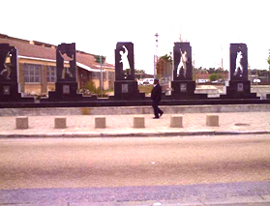
Yes. Even their bronze statue erected on the main road has no enclosure and is exposed to the elements. The people in this area (Gugulethu) are all poor and hungry. So, they are even scraping copper from the statue at night to sell for money. They are too poor to care about whose statue it is... It's too sad.
— Do you believe racial discrimination still exists?
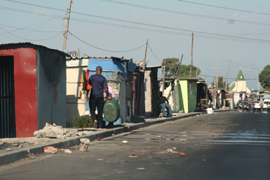
Yes, it does. Racial discrimination definitely still exists. And I won't lie and say it's one-sided. Discrimination exists on both sides. Both whites and blacks discriminate against each other. Here in Cape Town, there are the "Coloureds" (people of mixed race), who are also victims of Apartheid. White people are considered the most superior, Coloureds second, and blacks at the bottom. Not all, but some Coloured people discriminate against black people, and there is still a gap between Coloureds and blacks. The relationship is certainly not good. But I have a Coloured daughter. This is proof that we Rastas do not discriminate. All people are the same. We are one. If you cut our skin, red blood flows. We are all the same human beings... To be continued.
It has only been 15 years since Apartheid was completely abolished. 15 years ago,
I reflected on what I was doing at the time.
KRUSH achieved global success, I produced special TV programs, traveled the world, and was at the peak of my career.
That was the year I first set foot on the African continent.
The people of South Africa, who have lived through such different realities while existing in the same world in real-time, are now eagerly anticipating the hopeful festival of the World Cup. I sincerely wish for the success of this event.
Next time, we will cover the issues currently facing South Africa.
