April 17, 2015
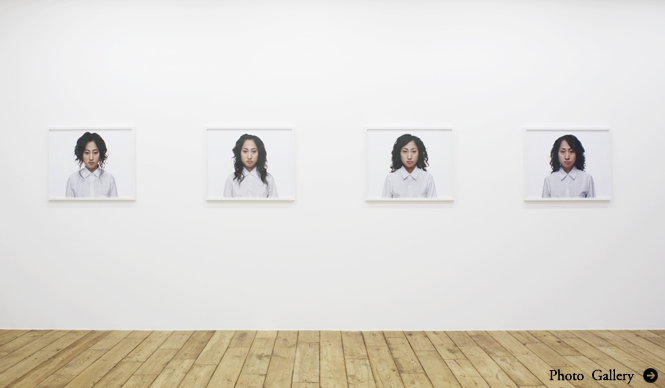
RAT HOLE GALLERY | Keizo Kitajima Solo Exhibition Vol. 45 "PORTRAITS" (3)
Rat Hole Gallery | Keizo Kitajima's 45th Solo Exhibition 'PORTRAITS' (Part 3, Final)
Is There a Way to Photograph Faces More Directly?
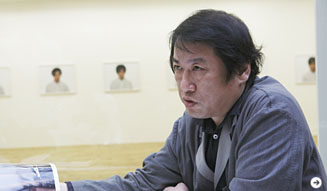
This is the final installment of our interview with Keizo Kitajima. Our conversation moves from the trial and error leading up to the 'PORTRAITS' series to the true meaning Kitajima aimed to convey through these works.
As the interviewer, I found the content incredibly engaging, significantly altering my perspective and feelings about this series, and indeed all of Kitajima's previous work, both before and after our discussion.
Photo by Jamandfixedit by TAKEUCHI Toranosuke(City Writes)
With This Method, There Are No 'Rejects' in the System
— 'PORTRAITS' is, in a sense, an experiment to discover the unique and mysterious qualities of individuality. The result is a collection of wonderfully enigmatic images.
But to prove this, I decided to refrain from exhibiting for at least six years. I felt that unless I had about six images, I wouldn't know if my conviction was correct. However, the same person can't be photographed perfectly every year. So, it ended up taking nine years from when I started shooting until the exhibition.
— That must have required immense patience and courage.
It did. During that time, I was only shooting landscapes, so there was some anxiety, but I thought it might be interesting to have someone like that around.
— For this exhibition, you chose three models. What was the reason for selecting these three?
Honestly, that's a difficult question to answer. Of course, when holding an exhibition, I select from an archive of about 2,000 images, fitting the available space. But the selection process is fundamentally different from street photography.
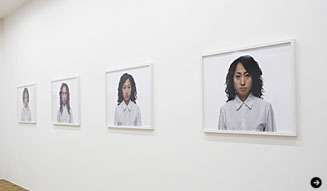
When selecting street photographs, I would 'curate' what I considered 'good' photos. However, with this project, while I edit based on the exhibition space, there's essentially no curation. This time, the selection happened to be this way, but it doesn't mean the other photos are inferior. In other words, there are no 'rejects' in the system. This is a crucial element for me. The arrangement is similar; this time, I happened to arrange the three individuals chronologically, but there are countless ways to edit from the 2,000 images. In that sense, it's all an experiment.
People on the Street Don't Have Their Own Original Expressions
— Was the rule of a white background and a simple white shirt decided upon quickly?
I had a general idea, but I experimented with various approaches. I immediately discarded the idea of a black background. For clothing, I tried everyday wear and even nudity. However, nudity introduced an element of idealization and aesthetics, reminiscent of Greek sculpture, which I wanted to avoid, so I abandoned that too.
Furthermore, the Soviet series I shot in '91 was actually an intentional experiment in doing the exact opposite of what I had in mind for 'PORTRAITS.' That is, I aimed to incorporate all sorts of attributes and social symbols. Ultimately, what remained was the rule of a white background, a white shirt, and looking directly forward with the gaze slightly averted.
— Does this lead to an ultimate sense of anonymity?
It's a bit different from anonymity. When I was taking street photos, I noticed that people in New York had a New York-like expression, and people in Eastern Europe had an Eastern European expression. In other words, people on the street don't have their own original expressions. So, I thought about how to capture faces more directly, and this method was the result.
— When you started this method, did you consider photographing foreigners?
When I began this project, precisely because it was delicate, I deliberately excluded certain elements. First, celebrities. I also decided against creating something like a racial catalog. While I could come up with any number of excuses, going that far would likely introduce a different kind of meaning and, I felt, would bore me. In that way, I tried to avoid incorporating anything conventionally 'interesting.'
To bring out the overall interest of the work, each individual piece had to be the same. In essence, I made them uninteresting to make them interesting.
— I see. This has been a very insightful conversation. Thank you very much.
Thank you as well.
(The End)