April 17, 2015
RAT HOLE GALLERY | Keizo Kitajima Solo Exhibition Vol. 44 "PORTRAITS" (2)
Ratt Hole Gallery | Keizo Kitajima Solo Exhibition "PORTRAITS" (45) (2)
The Conviction That Something Utterly Strange Would Emerge
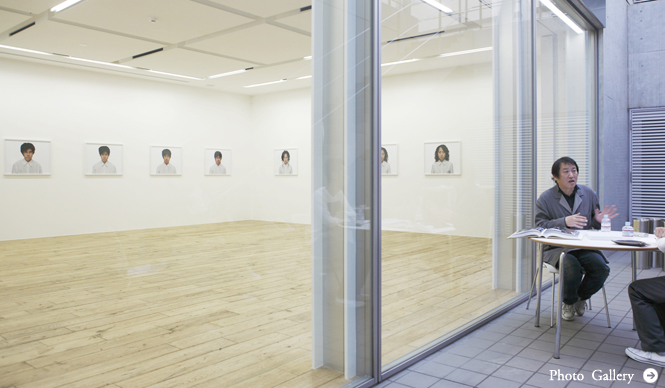
Following up on our previous report, we present the interview with Keizo Kitajima conducted at the opening of his "PORTRAITS" exhibition.
Kitajima, who felt he had reached the limits of street snaps in cities worldwide and drastically shifted his style from the streets to the studio in 1992, chose portraiture. Why? This time, we delve into the intriguing truth behind his decision.
Photo by Jamandfixedit by TAKEUCHI Toranosuke(City Writes)
The Interesting Cities I Knew Were Gone
—Even with photographs that appear fresh, there's always a foundational image somewhere. You felt you had reached the limits of the act of 'seeing' there, and that's what led you to shoot in the studio, correct?
That was the biggest factor, but another reason is that the cities themselves became uninteresting to me.
—Does that mean everywhere in the world?
There are probably interesting places somewhere in the world. For example, I think I could take interesting photos if I went to Antarctica.
But that's not what I mean. The first time I took street snaps was in 1975, after the Vietnam War ended. I went to a city called Koza in Okinawa, which was a bustling entertainment district with so-called A-sign bars (permits allowing US military personnel and their families to patronize establishments) at the time.
However, it's not like that anymore, is it? Shinjuku was an underground city in the 60s and 70s, but it's different now. In the 80s, I lived in West Berlin and photographed Eastern Europe, but in '89, the Berlin Wall fell, and the Soviet Union dissolved. In short, I was photographing the interesting cities of the Cold War era, and they've all disappeared.
—Does 'interestingness' always correlate with the era you lived in?
I think so. It naturally becomes an interestingness tied to the era and politics in which one lived. That's why going to Antarctica or Africa isn't the point. Of course, one goes with a certain sensibility, but I believe the result is that 'those things are included.' The combination of these changes in the times and the sense of pre-established harmony I mentioned earlier led me to start thinking that street snaps weren't for me anymore.
Hypothesizing: How Would I Take Portrait Photos Now?
—I see. But why did you then think, 'I should take portraits in the studio'?
Of course, I didn't arrive at that conclusion smoothly. There was a period of about two years when I found it difficult to take photos after I started having doubts. During that time, as I looked back at my old photographs, I felt that perhaps I wanted to photograph people's faces, so I decided to make people's faces my theme. And when it comes to photographs of people's faces, there's the established format of portraiture, isn't there? So, I made a slight shift in my thinking.
In other words, instead of thinking, 'How should I photograph people's faces?', I posed the question: 'If I were to take a portrait photo today (1991), how would I do it?' If I did that, all I'd have to do is provide the answer. And the answer I came up with was this method for "PORTRAITS." Perhaps if I had approached it with the conventional idea of approaching people on the street and photographing them, it wouldn't have worked.
—I understand. So, "PORTRAITS" and your previous work are like two sides of the same coin? You also started taking photos of empty landscapes around the same time; what's the meaning behind that?
Since I had derived the answer of portraits from my own photography, it seemed a waste to leave the remaining landscapes. So, I then thought, 'How would I photograph landscapes without people?' and started that series.
—So, in a sense, your portrait photography and landscape photography can also be seen as the original street snaps splitting into two?
Yes.
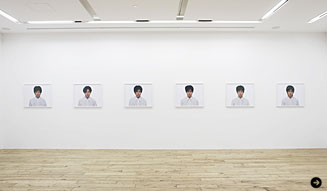
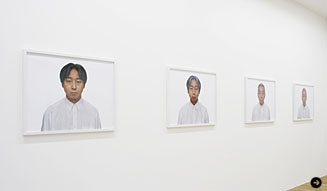
—Then, I'd like to ask about the "PORTRAITS" exhibition you have on display now. Seeing the portraits of the same individuals, taken with such deliberate neutrality, evokes an almost frightening intensity.
The strangeness of seeing the same person, imbued with the passage of time, within photographs that appear, at first glance, to be identical. Did you anticipate this outcome from the beginning?
No, I didn't anticipate it at all initially. My original concept wasn't there. For example, if you take five consecutive photos of a face with a motor drive, they all look almost the same, don't they? However, each shot is a distinct photograph, possessing its own individuality and irreplaceability. That's where I first felt the photographic potential. That was the beginning.
The reason I continued for a long period was the idea that if I did this once a year for ten years, that individuality would become even more pronounced. So, at first, I chose people around my own age, in their 30s, who seemed unlikely to change much. But even though I didn't know what the outcome would be, I had the conviction that something utterly strange would emerge.
Keizo Kitajima Solo Exhibition "PORTRAITS" (3 - Final)To be continued