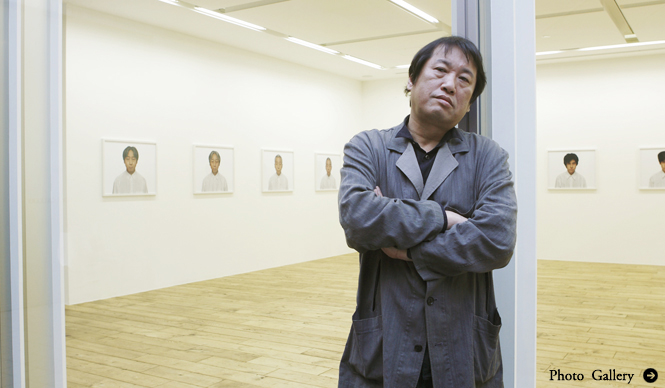
RAT HOLE GALLERY | Keizo Kitajima Solo Exhibition Vol. 43 "PORTRAITS" (1)
Rat Hole Gallery | Keizo Kitajima Solo Exhibition 'PORTRAITS' (1)
The Limits of the Act of 'Seeing'
Keizo Kitajima's solo exhibition 'PORTRAITS' is on display at Rat Hole Gallery until Sunday, July 5th.
As the title suggests, this series is a collection of portrait works that Kitajima has been shooting for an impressive 17 years, from 1992 to the present. While the shooting was done somewhat randomly, approximately once a year, the body of work comprises over 300 models and more than 2,000 pieces. This solo exhibition features a selection of 14 works from this vast collection, focusing on three models.
On the occasion of the opening, OPENERS caught up with Kitajima himself just before the exhibition. We were able to ask him about the background of the exhibition and his thoughts on this series. We will be presenting the interview over three installments.
Photo by Jamandfixedit by TAKEUCHI Toranosuke(City Writes)
The Preordained Harmony Felt in 'Interesting' and 'Good' Photos
—First, could you tell us about the background of this exhibition?
KitajimaIt all started around October two years ago when Osamu Wataya from HYSTERIC GLAMOUR approached me with the idea of making a book.
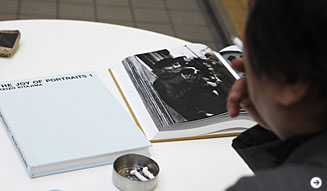
—So the book came first? And that led to this photo collection, released in early June, which is a two-volume set with a total of 872 pages?
Yes, that's right. And we decided to hold an exhibition to coincide with the book's completion. A year and a half from when Wataya proposed the idea might sound like a long time, but it was actually quite tight (laughs).
In the end, I reviewed almost everything I had shot up to that point and produced prints of over 1,500 images.
—Indeed, this photo collection is not only impressive in its volume but also feels like a comprehensive survey of Kitajima's work. Structurally, the first volume is 'PORTRAITS,' and the second volume presents his earlier work in chronological order.
What strikes me again here is the clear shift in stance before and after 'PORTRAITS.' Kitajima, known for his work in the 70s and 80s, captured the atmosphere of cities and their times by taking candid shots of people moving through them. Yet, he deliberately set that aside and chose portraiture, a seemingly opposite approach. What kind of change in mindset led to this?
To put it bluntly, I felt the limitations of street photography. I had a premonition of this quite early on; even when I was shooting in New York (in '81-'82), I was already feeling a sense of ennui in the back of my mind. I was pursuing 'interesting photos' and 'good photos,' but there was a feeling that anything I considered somewhat interesting or good was, in some way, preordained. The very act of being interesting started to feel tiresome.
Without Reference Images, Humans Cannot Truly See
—Logically, one might think that studio photography is more closely associated with the term 'preordained,' but that wasn't the case for you?
Certainly, studio photography typically involves a target destination and a storyboard, and the process is about getting closer to that. With street photography, you're heading towards an unknown outcome. However, for me, it was the opposite.
—Is this because street photography became a more common approach?
Not entirely. What I realized was that when selecting my own photos, even those that appear fresh, there's always a reference image somewhere. It could be the work of a photographer I admire, an advertisement, a film, or even a landscape from my childhood. But I felt there was a systemic limit to this.
—When you say 'system,' do you mean the mechanism of the brain?
Simply put, it's the limit of the precision of the act of 'seeing.' When we look at something, I believe humans cannot see without a reference image. In other words, I realized that we are unable to break free from, surpass, or exist outside of images we've seen somewhere before. That's what made me dislike my own photography.