March 13, 2015
Yasuhiro Mihara│3rd Talk: With Chieko Watanabe, President of Avanti (4/Final)
Considering the Cotton You Wear Today
Conversation with Chieko Watanabe, President of Avanti (Part 4, Final)
This is the final installment of our conversation with Chieko Watanabe, a leading figure in organic cotton in Japan and president of Avanti, a pioneering company in the field.
Watanabe advocates not only for the spread of organic cotton but also for the importance of agriculture. Inspired by her thoughtful perspective, Mihara reaffirms his pride in his own work.
Photos by JamandfixSummary by Yasuhiro Takeishi (City Lights)
New Endeavors and Fading Traditions
MiharaBy the way, is cotton currently cultivated in Japan?
WatanabeNot at an industrial level, but it exists as a hobby. However, starting this year, I've also been participating in cotton cultivation in Nagano Prefecture. I've begun growing brown cotton, hoping to create 100% Made in Japan cotton products. It's a collaboration with the Faculty of Textile Science and Technology at Shinshu University. They preserve the seeds of Japanese native cotton varieties, and this is part of a plan to promote them further in Japan and actually produce goods.
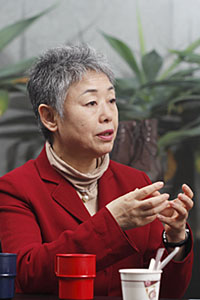
Chieko Watanabe
MiharaThat sounds interesting.
WatanabeDoesn't it? I hope you'll try it too, Mihara-san. Shinshu University's Faculty of Textile Science and Technology has 2,000 students, and I want them to graduate with a strong sense of environmental awareness.
Speaking of which, I recently visited Kurume, and there was a project to create Kurume Kasuri using organic cotton. But when I got there, the situation was far from that.
Kurume Kasuri has a process called 'kuri' (tying), which determines the pattern of the ikat. However, there is now only one craftsman left who can perform this process for the warp and one for the weft. If either of them can no longer do it, the tradition of Kurume Kasuri will end.
MiharaHas Kurume Kasuri really reached that point?
WatanabeOne of them has been doing 'kuri' for 50 years. In fact, I went to the Ministry of Economy, Trade and Industry today to urge them, saying, 'Stop wasting money on trivial things and invest it here.'
Organic Cotton Prioritizes the Environment
MiharaThat's a critical situation. I certainly agree that the government should allocate funds to such matters. But changing the subject, what is the difference between organic cotton and regular cotton? For instance, does the texture differ?
WatanabeWell, one important point is that organic cotton is not a functional material. While it's sometimes said to be good for allergies like atopic dermatitis, that's not the case. The premise is that organic cotton is a product that prioritizes the environment above all else.
MiharaI see. The first time I wore organic cotton was in a T-shirt made by a friend's brand. I found the texture pleasant, and the way it softened and conformed with wear seemed appealing from a product perspective. Perhaps it's an illusion because I knew it was organic. But ideally, one would find it comfortable without knowing, and then discover it was organic upon checking.

WatanabeI'm aiming for that too. One thing I can say is that organic cotton that meets our standards is undamaged. For example, simply by not dyeing it, the cotton itself experiences very little damage. This preserves the cotton's inherent warmth, fullness, and softness. That might be why it feels so good to wear. However, if you try to quantify it, it's hard to say. There are aspects that cannot be measured by numbers.
But human preconceptions are powerful. Organic cotton is marketed as safe and secure. Traceability, where you can track the raw cotton to the yarn, the yarn to the fabric, and the fabric to the product, contributes to this sense of safety. The reason organic cotton baby products sell well is likely due to this perceived safety, rather than a significant difference in actual functionality. When mothers and fathers imbue it with their love and think, 'This is truly a wonderful product,' they may genuinely feel that way.
Work That Connects to What Matters Most to Humans
MiharaYou're very candid, Watanabe-san. Many people try to prove the functionality of organic cotton, but I sometimes wonder about the significance of that. Let me change the subject slightly. What do you envision as the ideal future for organic cotton?
WatanabeIdeally, I'd like to see 10% of the world's cotton become organic. Currently, it's 1%, but if it reaches 10%, I believe it will become a significant global trend and bring about change. I expect I can continue my work for about another 15 years, and my goal is to achieve that 10% within that timeframe.
Another goal is to place greater importance on agriculture. Of the 'food, clothing, and shelter,' both clothing and food originate from agriculture, a fact that is easily forgotten. Cotton and hemp are both agricultural products. If we don't value this more, our foundation will become unstable.
The reason we're cultivating cotton in Nagano Prefecture is because we want to engage in manufacturing with a focus on our roots. Furthermore, I believe our staff shouldn't talk about organic cotton without understanding cotton cultivation (laughs).
We're also planning to relocate our headquarters to Nagano. It's about recognizing how crucial agriculture and soil are to humans, especially to Asians, who are historically an agrarian people. We want to foster that recognition.
For me, the next 15 to 20 years will be dedicated to making agriculture more familiar to Japanese people. Currently, the food self-sufficiency rate is around 38%; I believe Japan will perish if we don't increase this to about 70%.
U.S. President Obama introduced the 'Green New Deal,' a protectionist policy encouraging the purchase of Made in USA products. China will also likely reduce exports to Japan as it continues to develop. In such a scenario, Japan will have to become self-sufficient. The government shouldn't be subsidizing fallow land; they should be focusing on this.
MiharaI see. So you're concerned not only about organic cotton but also about Japanese agriculture.
The Order of 'Clothing, Food, and Shelter'
WatanabeI also believe that 'soil' might be what helps normalize Japan's youth, who are currently struggling. In that sense, my next target, and where I feel I am needed, is to develop agriculture through organic cotton.
MiharaThe economic crises happening worldwide are problems with human-created systems, not because humans themselves have changed. Therefore, I agree that what is needed now is something more fundamental, perhaps the soil itself.
WatanabeWhen I imagine the atmosphere of the thawing season, when the soil warms up and the 'fukinoto' (butterbur sprouts) peek out, I truly feel glad to be alive and sense an energy. These natural cycles have continued unbroken, and compared to them, humans seem so ephemeral. Yet, we can draw energy from nature. I want everyone to have such experiences.
MiharaI'd like to organize a cotton-picking event.
WatanabeYes. Let's all weed and pick cotton, and then spin yarn. Let's do it. I believe everyone will change through that experience. By the way, Mihara-san, do you know why the order is 'clothing, food, and shelter'?
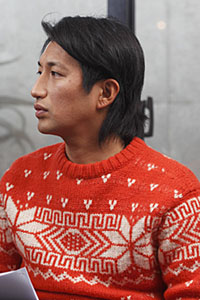
MiharaWhy is that? I've never thought about it.
WatanabeThe answer to this gives us courage. When a baby is born with a cry, the first thing it needs is swaddling clothes, a 'okurumi.' Not mother's milk, but clothing. When I heard this, I felt immense pride in my work. To be engaged in clothing, not food or shelter, but something most essential to human beings.
MiharaThat's a wonderful story. I too will continue to work with pride in my profession. Thank you for today.
WatanabeThank you as well.
(End)

Chieko Watanabe
Born in Shari District, Hokkaido, in 1952. After graduating from the Faculty of Commerce at Meiji University, she joined Tassco Japan, a lens manufacturing company. While serving as vice president of the company, she established Avanti as a subsidiary in 1985 and became its president.
She first encountered organic cotton in 1990 and began specializing in it at Avanti that same year. In 1993, she established a local subsidiary in Texas, USA, and was instrumental in founding the Japan Texas Organic Cotton Association. In 2000, she became vice chairman of the Japan Organic Cotton Association (JOCA). She actively participates in NPOs and gives lectures, working to promote organic cotton and establish global standards.
Avanti Direct Web Store 'Pristine'
http://www.pristine.jp/
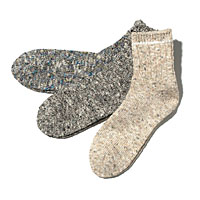
The socks created by fashion designer Yasuhiko Mihara prioritize both functionality and natural materials. To achieve both moisture-wicking and quick-drying properties, a blend of cotton and hemp was chosen. Utilizing a杢 (heathered) yarn with a mix of colorful threads and neps, the socks feature unique color adjustments and an embroidered brand logo on the heel to serve as a stylish accent. Knitted on a 60-gauge machine, they result in a relaxed, comfortable fit.
These socks, sold exclusively through the web store 'Rumors,' will have a portion of their proceeds donated to welfare facilities in Tokyo through the Tokyo Charity Bank, operated by the Tokyo Council of Social Welfare. This initiative reflects the intentions of Mihara and Openers.
