March 13, 2015
Yasuhiro Mihara | Episode 3: A Conversation with Chieko Watanabe, President of Avanti (Part 2)
Considering the "Cotton" You're Wearing Now
Part 3: A Conversation with Chieko Watanabe, President of Avanti (2)
This is the second installment of a dialogue between designer Yasuhiko Mihara and Chieko Watanabe, president of Avanti, a leading company in organic cotton and a pioneer in the field in Japan.
Through Ms. Watanabe's extensive knowledge, Mr. Mihara deepens his understanding of organic cotton, confronting various issues that had previously been unseen.
Photo: JamandfixSummary: Yasuhiro Takeishi (City Lights)
What is Organic Farming, Independent of All Chemicals?
MiharaBy the way, what kind of state is organic soil in?
WatanabeIt's soil that uses organic fertilizers without pesticides. By replacing chemical fertilizers, including nitrogen, phosphorus, and potassium, with organic fertilizers made from cow dung and cultivated bacteria, the soil becomes organic.
The production of organic fertilizers seems to be a major business in America now. In India, farming methods that use earthworms to make soil organic are becoming popular.
MiharaAre such organic farming methods used even in the mechanized agriculture of developed countries?
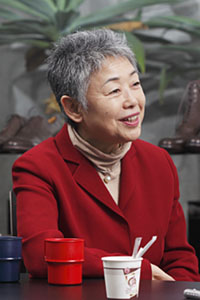
Chieko Watanabe
WatanabeBoth mechanized modern agriculture and traditional human-based farming fundamentally use organic fertilizers. Also, the non-use of herbicides, defoliants, and genetically modified varieties is the same.
MiharaI see. So, cotton cultivated through such organic farming methods is called "organic cotton."
WatanabeThe definition of organic cotton is, first, that it is not a genetically modified variety. Second, it is organically cultivated without relying on chemical fertilizers. And third, chemical pesticides and herbicides are not used. To achieve this, natural enemies are used to control pests, weeds are tilled into the soil, or manual harvesting is necessary. Also, since defoliants cannot be used, it is necessary to wait until the frost falls and it naturally withers. Regarding insecticides, there are organic options; in India, for example, a mixture of neem tree and cow urine is used as a natural insecticide.
MiharaSo, it means not relying on anything chemical in all aspects.
WatanabeThat's right. And there is one more important thing. It is to protect the environment of the farmers engaged in agriculture. This includes not exploiting wages or using child labor, and it is the most important item.
Cotton Processing That Damages the Environment
MiharaIs that so? Generally, people probably only think about the cultivation aspect.
WatanabeThat's right. However, the environment of the farmers is always included as an indispensable item. It is connected to fair trade, and I believe it is a very important item.
MiharaI see. I understand the agricultural aspect well. Now, could you please tell me about the industrial processing of cotton?
WatanabeYes. First, after the cotton is picked, it is spun. Not much water is used in this stage, so the environmental impact is not that significant. The most environmentally burdensome stage is dyeing after it becomes fabric.
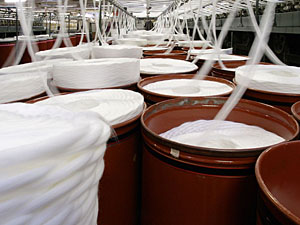
Spinning Process of Organic Cotton
Cotton contains a lot of oil to protect the seeds from wind and snow. Unless this oil is removed, it will not absorb water and cannot be dyed. Also, since it is originally a natural beige color, vivid colors cannot be achieved by dyeing it as is. Therefore, it is necessary to degrease using caustic soda and bleach, which pollutes the environment.
Then it is dyed with dyes. Fixatives are often used to prevent color fading, and some strong fixatives contain heavy metals. Furthermore, softeners are used to reduce stiffness, and anti-shrink agents are used because cotton shrinks. Despite being a natural material, cotton uses so many chemicals.
MiharaSo, industrial processing is unavoidable for cotton, isn't it?
WatanabeYes. The question is what kind of chemicals are used in such processing. Whether they are environmentally friendly or not. Therefore, we have established criteria for what constitutes friendly chemicals. Products processed according to these criteria are given tags from the Japan Organic Cotton Association or certified with standards like GOTS (Global Organic Textile Standard). By providing these, we enable consumers to make informed decisions.
Does "Natural" Not Always Mean "Environmentally Friendly"?
MiharaSo, to obtain such certifications, is it a condition not to use caustic soda or fixatives?
WatanabeFor example, caustic soda can be used, but we ask them to reduce its concentration. Chlorine bleaching is not allowed, but hydrogen peroxide, used for disinfection, is acceptable. Although it takes time and effort, we encourage the use of such chemicals.
Regarding dyes, we use reactive dyes and ask that fixatives containing heavy metals not be used. Natural dyes are of course good, but depending on the color, an inorganic agent called quaternary ammonium is actually needed to bind with natural cotton. Organic compounds do not bind directly; a mediator is required, but this is very bad for the environment.
MiharaIt's generally thought that natural dyes are environmentally friendly, and people don't often consider the chemicals used in the process. Actually, I also did plant dyeing when I was a student, but it was difficult to achieve beautiful colors.
WatanabeEveryone says, "If you're dyeing organic cotton, it must be with natural dyes, right?" but I don't necessarily think natural dyes are good.
Especially plant dyeing is often done in small factories, and there can be issues with wastewater.
Larger dyeing facilities, however, have wastewater treatment systems and stricter standards.
Therefore, I believe chemical reactive dyes are better. In fact, such dyeing is now the standard.
MiharaI understand about spinning and dyeing, but are there no issues with processes like sewing?
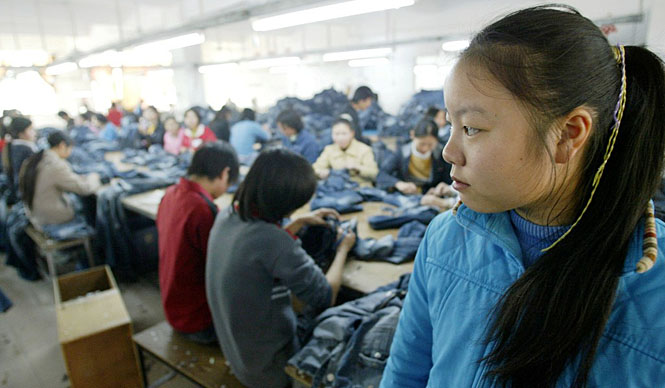
WatanabeRegarding sewing, there is a relevant film. It's a documentary called "The Price of Fashion" (originally "Gong Li" or "Elegy of the Factory Girls"), which depicts the working conditions of female factory workers in China. China is the "world's factory," but this film shows what is happening there now. A female worker put a letter in the pocket of jeans saying, "Please look at our situation," and it reached America, leading to an investigation. It revealed that to be the cheapest factory in the world, it was common practice to employ female workers at extremely low wages. They were forced to work like slaves, with unreasonable deadlines.
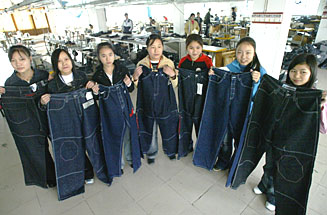
© 2005 Teddy Bear Films
"The Price of Fashion" DVD release June 3rd (Wed) ¥3990
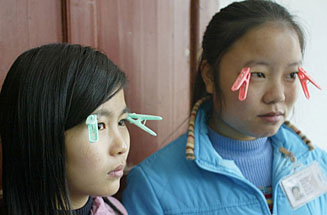
© 2005 Teddy Bear Films
"The Price of Fashion" http://www.espace-sarou.co.jp/jokou/
MiharaI saw that film too. It was shocking.
WatanabePeople in the fashion industry probably don't know much about these issues either. That's why I believe we must promote ethical fashion more.
In fashion, only the glamorous aspects are highlighted, which is, in a sense, "vanity." Those glamorous aspects belong to the realm of commerce and are built on the sacrifices of agriculture and industry. I believe this should not be the case. If we don't strive for ethical fashion in the future, it may not be sustainable for long.
MiharaI also believe there are limits. In reality, there are already unbelievably cheap products. It will likely reach a point where the cost of sewing a single item is fractions of a cent. If commerce could sustain that, it might be one thing, but currently, even that has stopped.

Chieko Watanabe
Born in Shari-gun, Hokkaido, in 1952. After graduating from the Faculty of Commerce at Meiji University, she joined Tasco Japan, a lens manufacturing company. In 1985, while serving as vice president of the company, she established Avanti as a subsidiary and became its president.
She first encountered organic cotton in 1990 and began to focus exclusively on organic cotton at Avanti that same year. In 1993, she established a local subsidiary in Texas, USA, and worked to establish the Japan Texas Organic Cotton Association. From 2000, she served as vice chairman of the NPO Japan Organic Cotton Association (JOCA). She actively participates in NPOs and lectures, working to promote organic cotton and establish global standards.
Avanti's directly managed web store "Pristine"
http://www.pristine.jp/
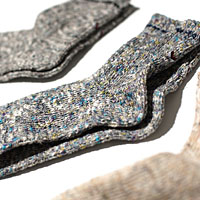
The socks created by fashion designer Yasuhiko Mihara prioritize functionality and natural materials, choosing a blend of cotton and hemp for moisture-wicking and quick-drying properties. Using a nep yarn with unevenly mixed colorful threads and neps, they were given unique color adjustments and a brand logo embroidered on the heel to serve as a style accent. Knitted on a 60-gauge knitting machine, they are comfortable and fit the foot well.
These socks, sold exclusively through the web shopping site "LUMORE'S," will have a portion of their sales donated to welfare facilities in Tokyo through the Tokyo Charity Bank, operated by the Tokyo Council of Social Welfare, as per the intentions of Mihara and OPENERS.
