March 10, 2015
A Conversation with Kōmu Yoshida (PORTER Designer) - Part 2
#003 A Conversation with Kōmu Yoshida (Porter Designer) - Part 2
M a, the communication tool launched by Eiichi Izumi, director of the fashion brand MINOTAUR.
We continued our conversation with Kōmu Yoshida, designer at Yoshida & Co., discussing the origins of each series, the cultures that have influenced him, and the future of Yoshida & Co.
Text and photos by M aEdited by Hideshi Kaneko (This magazine)
Izumi: What were you doing around the time of the Tokyo Olympics?
Yoshida: Back then, we were what you’d call a wholesale bag dealer.
In any case, good foreign materials and hardware, and that culture, were coming into our company. The material suppliers at the time didn't go overseas. There were no magazines, no internet information. Especially for fashion information, you had no choice but to go abroad and see it for yourself.
So, I think being able to go overseas during that era was valuable. We bought samples, and we were able to touch materials we'd never seen before for the first time. Especially with leather, the difference between Japan and overseas was apparently huge back then. However, the craftsmanship was perceived as more skillful and meticulous by the Japanese.
Izumi: I see. So you were a wholesaler. The first time I saw a Yoshida bag was at select shops like Beams in Fukuoka, or in bag stores in Tenjin Core, or Okuma Bag Store.
Yoshida: Around that time, we were in a period of licensing business. In other words, it was like buying just the brand name.
Izumi: Your father, Shigeru, returned from overseas in '60, right? When did your uncle, Katsuyuki, go abroad?
Yoshida: Around the 1970s. Katsuyuki's era was the time of student protests.
So, if you went to school, it was all demonstrations, wasn't it?
He didn't like that sort of thing, so he seemed to have gone with a "might as well go abroad" attitude. When he went to London, he found it interesting, including the fashion, and stayed there for about two years. After that, he went to New York. New York apparently was even more interesting than London, and he lived there for about two years as well.
He returned to Japan when I was in the 5th or 6th grade of elementary school, around '74. After that, designers like Rei Kawakubo of Comme des Garçons, Mitsuhiro Matsuda of Nicole, Takeo Kikuchi, Yohji Yamamoto, and Kansai Yamamoto began competing overseas with their original brands as Japanese designers, and it became an era of quasi-import brands.
My uncle seemed to be mingling with those kinds of people.
It seems he also became friends with Paul Smith and Barneys during that time.
Izumi: Paul Smith started his brand with ties, didn't he?
Yoshida: That's right. The magazine 'Popeye' was launched during that era.
Izumi: It was a magazine that focused not only on clothing but also on the culture scene, wasn't it?
Yoshida: Exactly! That was around the time I was in junior high school.
Popeye introduced all aspects of American casual culture, from skateboarding and pinball to, of course, clothing. Our generation was all greatly influenced by Popeye. When Popeye was launched, I exhibited the GRIPPER series at New York Collective.
I learned about cultures other than bags from Katsuyuki, and was greatly influenced by him. I still want to be like my uncle.
Izumi: You mean you want to be like Katsuyuki, even outside of bags?
Yoshida: Yes.
Initially, I didn't think about taking over the family business. If my uncle hadn't been there, I probably wouldn't be doing this job now.
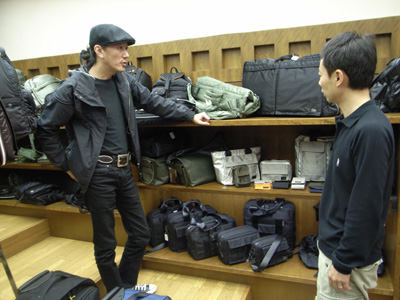
He did really cool things, like creating the GRIPPER series, and was doing interesting work.
It was because of him that we ended up wholesaling bags to Beams, which was the first select shop to do so. At the time, Beams was still a small store, and Mr. Shigamatsu of what is now United Arrows was the manager. Select shops like that started carrying backpacks and bags he had made.
However, it seems that initially, other wholesale stores perceived the GRIPPER series as, "Are you going to war? What is this?"
But I suppose Barneys and Beams in overseas recognized them properly.
Then there's TANKER. It's taken for granted now, but Katsuyuki made bags using the fabric from MA-1 jackets, which were completely unavailable in Japan at the time.
Izumi: The GRIPPER, TANKER, and LINER lines.
Yoshida: For those, both the fabric, the hardware, and the zippers were things that didn't exist in Japan at the time. We created them originally.
Izumi: Kōmu, what prompted you to take over the company? You were invited by Katsuyuki to join the company, weren't you?
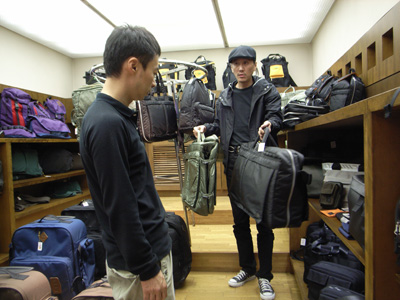
Yoshida: Yes.
My uncle "gave me" a sense of self-will. At first, I accompanied Katsuyuki on his business trips abroad, and I would just wander around on my own. That was—this time in the 80s (laughs).
Izumi: Did you go to Europe?
Yoshida: Europe and New York. But that was before I joined the company. When I went to New York, it was the era of Keith Haring, Jean-Michel Basquiat, and all that.
Levi's denim could still be bought cheaply at vintage stores and flea markets. It was an era where you could see both old and new things. The music was hip-hop. Keith Haring's "POP SHOP" had just opened, and it was a bit of a strange
combination of a store. I was really influenced by things like that.
I wasn't making things or designing yet, but it was an era where I learned how to do it.
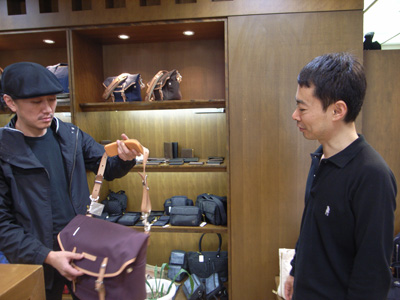
Izumi: It was around the time when the time difference between Japan and overseas began to become real-time, wasn't it?
Yoshida: My generation and your generation are probably a little different.
Izumi: In my case, I was precocious, and I really admired people from your generation, so I think I'm part of the last generation that was able to hang out with them. So, even though it wasn't real-time, I felt like I was barely touching those people in terms of sensibility.
Yoshida: I see. I really like the sense of mixing old and new sensibilities in your approach to "making things."
Izumi: Thank you.
I like combining new materials like GORE-TEX with established fabrics, or art with music, and mixing various elements. It might be the same sensibility as Keith Haring's "POP SHOP." I'm simply amazed that through our connection, I'm able to collaborate with Yoshida & Co., a brand I've always admired, on bags and other items.
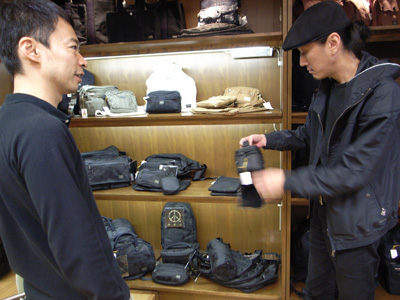
It's not just meeting you, Izumi, but through our connections, I have various people around me. I think that's the lifeline of Yoshida & Co. However, the past of Yoshida & Co. might have progressed in a similar way.
Izumi: Various fusions can be achieved regardless of experience, recognition, or generation, can't they?
Yoshida: I can't do anything other than bags. But if I only focus on bags, I naturally get stuck. So, by interacting with people from completely different fields, like you, Izumi, completely different values from what we seek in bags come into me, don't they? So, in a way, I feel like I'm the one learning from you.
Izumi: I am accompanying you with respect, aiming to create items that convey the sense of the times through culture. What can we do going forward?
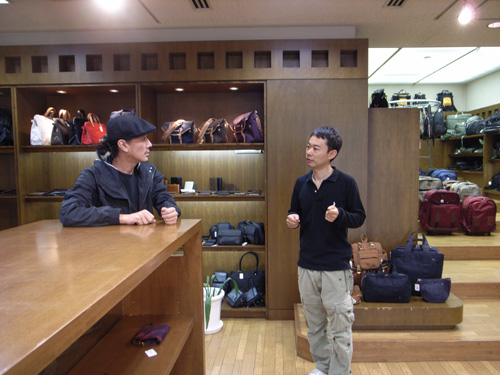
Yoshida: I believe we need to leave projects and plans for future generations. Your generation faces challenges with environmental issues and resource problems, doesn't it? We are also doing organic, but some people ask, "Is this a chemical dye?" Of course, it's difficult to do everything. It would mean eliminating all industry, returning to the primitive era (laughs). Toyota doesn't make all its cars hybrid, does it?
However, I hope that by considering the environment and using organic cotton, things will change even slightly for the next generation.
Izumi: I agree. Lastly, could you give us your future goals or a final word?
Yoshida: Well...
I don't want to change my stance, or waver from it.
Ultimately, it comes down to 'One stitch, one soul.'
(End)
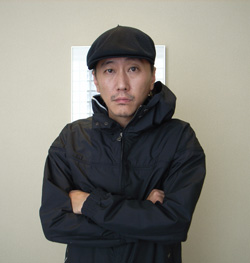
Kōmu Yoshida
Joined Yoshida & Co. in 1987.
He has worked on collaborations with major companies, as well as the classic PORTER SMOKY and CONDITION series. For Fall/Winter 2005, he designed PORTER TANGO BLACK and PORTER MAGNUM.
The urban life line of fashion brand "MINOTAUR"MUG" products
Available on rumorsYou can purchase them at.