May 11, 2015
Part 38: Stories of 'Shelter' - Writing Utensils (Part 1)
Part 39: Tales of "Home" - Writing Utensils (Part 1)
A vast array of writing instruments exists in the world. Of course, these days, some people might find they don't need pens or pencils as long as they have a computer. Yet, the humble pencil, perhaps a bit old-fashioned, is an exceptionally versatile tool, capable of drawing any line imaginable.
Compiled by Fuyuki TogawaPhoto by Jamandfix
The All-Purpose Writing Tool: Drawing Lines of Infinite Thickness
Pencils are something everyone likely used in elementary school. However, in the business world, where writing text is far more common, convenient mechanical pencils and ballpoint pens have become the standard. Mechanical pencils, with their consistently sharp leads, are certainly well-suited for writing small characters. But they aren't ideal for drawing.
When it comes to design work, I still use pencils for everything. I'm quite a heavy user, a true pencil partisan (?!), and consider the set of pencil, sharpener, and eraser my "three sacred treasures" for work.
Depending on how you hold it and the pressure you apply, a pencil can create a variety of lines: thick or thin, faint or bold. If you sharpen the lead, you can draw delicate lines, or use a rounded lead to color in, smudge, and add various textures.
And if you don't like a line you've drawn, you can easily erase it with an eraser. It's truly a flexible and convenient writing instrument.
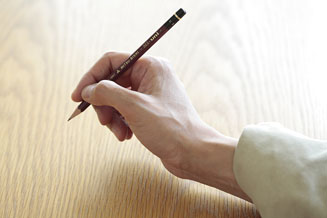
The Uniformity of Pencil on Paper is Superb
I've tried virtually every pencil imaginable, from domestic Japanese brands to renowned foreign manufacturers. But since my early twenties, I've consistently relied on one: the Japanese-made "Mitsubishi Hi-uni." I consider it unmatched.
You probably recognize it – the pencil with the familiar reddish-brown body. (Hi-uni was released in 1966. The slightly lower-grade Uni, launched in 1958, celebrates its 50th anniversary this year. Both are long-sellers.)
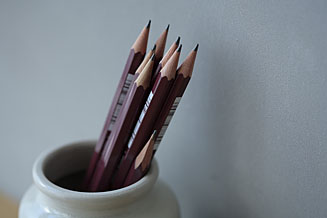
What's truly remarkable about the Hi-uni is the uniformity when the lead touches the paper. There's no gritty sensation or the pencil suddenly slipping on the paper as you draw. This is surely due to the extremely fine and uniform particles in the lead.
Incidentally, my preferred lead hardness is H. It's difficult to explain precisely, but the writing feel is exceptionally smooth and satisfying.
It may be "just" a pencil, but the high quality felt in this smooth drawing experience is truly a "good design" we can be proud of worldwide.
I've been using the Hi-uni for nearly a quarter of a century now, and I haven't strayed. As expected from Japan's premium pencil, the price is in the top tier (laughs). However, the slight exhilaration of using Japan's finest pencil is also quite pleasant.
It can be used for technical drawings and illustrations, and it retains its timeless design. The pencil is the all-rounder of writing instruments. The reason most pencils have a hexagonal cross-section is said to be that the corners make them easier to grip with three fingers (multiples of three are easier to hold), and it's also the shape that minimizes wood waste during manufacturing.
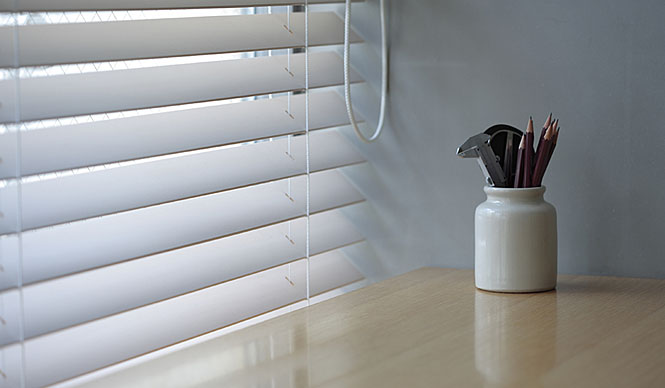
Those who enjoy cooking might have noticed: I use an empty jar of Pômery mustard as my pencil holder. Doesn't it have a wonderfully unpretentious charm? (laughs) Placing this jar, filled with tools like pencils and calipers, on the table instantly sets up my workspace.