Life is Edit. #011 ~ The Art of Living Beautifully, Taught by "Art Deco" ~
#011 Life is Edit. ~What it means to "live beautifully" as taught by Art Deco~
New "somethings" are spun and born through encounters with people. New "somethings" are born, drawn by a single object. An editor's job is precisely to create such "encounters." And life itself is editing—Editor Akira Shimada introduces the inspirations from people, objects, and events he has encountered.
Text and Photos by Akira Shimada
This time, I'll talk about Art Deco, a keyword that, along with fashion, art, fly fishing, and Buddhist statues, constitutes "me," and the people I've met through it.
An obsession that became my nickname
Art Deco is a design movement that became a major trend in modern architecture and decorative arts following the 1925 Paris Exposition. So, what is ARTDECO? For those who ask, I'll explain Art Deco in my own way...
The period from 1925 to the 1930s was an era of dramatic change in people's lives, marked by the emergence of locomotives, cars, and airplanes. The advent of machines that could transport people to distant lands in a short time must have made people at the time excited, thinking, "A brilliant future has arrived!" And on top of that, to see for the first time the beauty of those streamlined lines, the metallic sheen, and the power and beauty of machines backed by functionality—it's no wonder they were completely knocked out, thinking, "Wow! So cool!" Naturally, everyone's spirits soared, like a kid seeing a supercar (laughs).
A single design can make people feel positive and uplifted. I learned the underlying power of design through Art Deco. It has a past where it was sometimes misused, even as a tool for nationalistic propaganda, like by the Nazis. The influence of design on people's emotions is immense. This is also true for fashion.
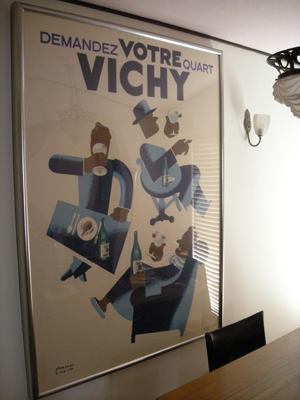
A 1948 poster for the beverage VICHY, created by Paul Colin.
In my home, it's displayed next to the dining table. Colin was
the mentor of Cassandre and left behind many masterpieces, including theater posters.
I purchased this poster 12 years ago at "Kiya Gallery," a long-established poster shop in Daikanyama.
And so, for about 15 years, I was in love with Art Deco...
I'd pore over numerous photo books, visit Christie's, check market prices in auction catalogs, sometimes bid, occasionally win, and then sell items when they no longer fit in my room (laughs). Especially around 12 years ago, when I discovered eBay, the world's largest online auction site, good Deco items were available at reasonable prices because their popularity in Japan was still low, which was incredibly fulfilling... (It's impossible now, as many professional dealers participate, making it difficult for amateurs...). Oh, and once, eBay sent me a survey asking for my opinion on the Japanese market, as part of their market research.
In this way, I was engrossed in the treasure hunt of Art Deco. Since Art Deco was a trend encompassing all aspects of design, my collecting spanned a wide range: posters, tableware, furniture, glassware, ashtrays, and clocks. As a result, my collection grew enormous, and a large portion of my salary went towards Art Deco (laughs).
When I told Paul Smith, with whom I had become good friends, about my passion, he even gave me a nickname: "From today, I'll call you Deco!" (laughs).
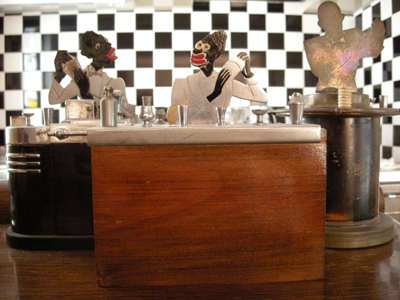
It took me nearly 10 years to collect these three sets—a testament to my obsession? It's a trilogy (laughs).
This bar tender series, featured in the book by renowned collector Philippe Garner,
includes, from right to left: JUNIOR BARTENDER (made in USA, 1938, purchased on an online
auction 12 years ago), FRENCH CIGARETTE DISPENSER (date unknown,
made in France, purchased at Alfie's in London 7 years ago), and THE RONSON TOUCH-TIP
LIGHTER (made in USA, 1936, purchased at Christie's 5 years ago).
Art Deco draws people in
There was one person who ignited my passion for Art Deco.
About 13 years ago, it was Kazuhiro Tanaka, a senior colleague from the Men's Club editorial department where I belonged at the time. Thanks to assisting Tanaka-san, I had the opportunity to work with brilliant and famous photographers like Noboru Morikawa, Kishin Shinoyama, and Kei Ogata, not to mention my involvement with Art Deco. But what was most stimulating was visiting Tanaka-san's home after shoots. It was truly amazing, like stepping into an Art Deco room. Completely captivated by its coolness, I began my serious Art Deco collection from then on.
Then there was another teacher of Art Deco I must not forget.
That person is Mr. Suda, the owner of the shop "Art Deco Modern" in Meguro-Takaban, where he still operates. Mr. Suda, who also owns "Modanica," a shop now well-known in the interior design world for mid-century furniture, has his roots in the design world at "Art Deco Modern." Surrounded by masterpiece Art Deco items, I would enjoy delicious coffee served in a Fire-King mug while receiving thorough lectures. I used to visit about once a week back then.
Through frequenting such a shop, I made many wonderful new acquaintances. Among them, the encounter with the poet Shuntaro Tanikawa left a lasting impression.
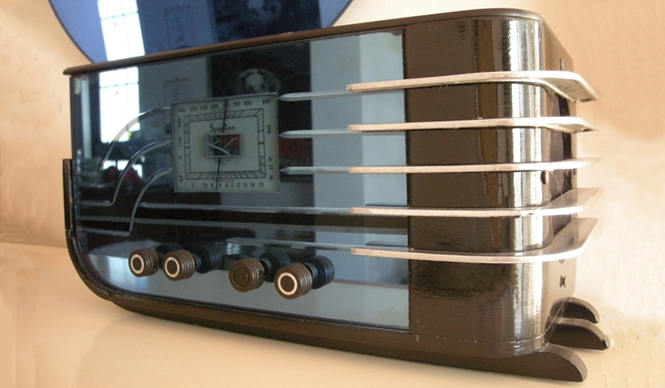
Tanikawa-san, a radio collector, was an old acquaintance of Suda-san. I had long desired the non-sale cobalt blue 1936 SPARTON radio in the shop (the photo at the top is it; purchased in Los Angeles 10 years ago for about 2 million yen during the bubble era!). I mentioned this to Suda-san, and it turned out Tanikawa-san happened to own two! Unbeknownst to me, he had told Tanikawa-san, "There's a person named Shimada at Men's Club who really wants this radio." Later, when another editor from Men's Club was interviewing Tanikawa-san, he suddenly asked, "Is there someone named Shimada in the editorial department?" The editor in charge must have wondered, "Why does he know about Shimada?" We met immediately and hit it off. Later, I found the radio Tanikawa-san was looking for in Los Angeles, where I was on a photo shoot, and immediately informed him. He promptly purchased it, and I visited his home to see his collection...
As someone who loved Tanikawa-san's poetry, such as "Staring at the Blue of the Sky," the time spent with him felt truly fulfilling, like a dream. However, when we actually met, we never discussed poetry or work (laughs). I only remember conversations about design and radios (laughs).
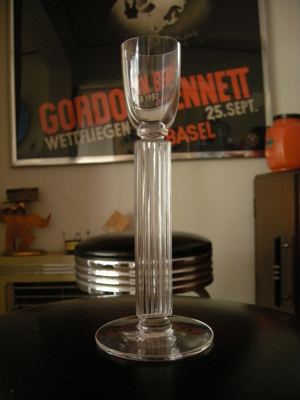
These are cocktail glasses made by Tye, a prized possession that is difficult to obtain.
The part that holds the liquid is very small, so you might wonder, "What are you supposed to
drink?" (laughs), but that's because the design is
COOL! The beauty, reminiscent of New York's skyscrapers,
made me sigh... I bought them in New York about seven years ago.
Thanks to my thorough study of Art Deco, it has been very useful in my current work.
Many fashion designers are invariably fond of Art Deco; it's almost a required area of knowledge. Tom Ford, Paul Smith, Thom Browne—they all went through a phase of collecting Art Deco or were greatly influenced by it in their clothing designs. During interviews, simply discussing Art Deco in some depth allowed me to convey a sense of "This person understands design." In essence, Art Deco can be used as a common language.
The keyword "Art Deco" also appears in various contexts within the world of watches. Due to their highly decorative designs, many masterpiece watches are influenced by Art Deco designs. Naturally, knowing the originals and their origins provides an advantage when discussing watches.
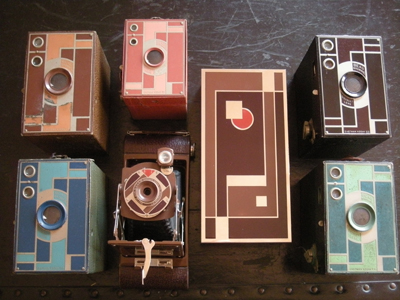
Also shown are Kodak cameras made by Tye: a Baby Brownie and a No. 1 A Gift Kodak (center).
I recently acquired the one in the center at a bargain price from an auction. The other Babies were collected over about three years, starting eight years ago, through persistent searching on online auctions.
The subtly varied color schemes
are beautiful when collected as a set. All were made in the USA in the 1930s.
The two designers I fell for
Writing about Art Deco is endless; I get carried away (laughs).
But there are two designers I definitely want to introduce: A.M. Cassandre from France and W.D. Tye from America.
Cassandre (1901-1968) was a graphic designer famously known for designing the graphic art for Harper's Bazaar magazine and the iconic YSL logo for Yves Saint Laurent. He not only designed numerous posters but also demonstrated extraordinary talent in designing commercial goods of the time, greatly influencing the design world. I love his clear and pop style, and I've been steadily collecting his work, despite the not-inexpensive market prices (due to the overwhelming number of collectors).
And it's not just his objects, but his philosophy and concepts that have captured my heart and never let go. They are—
The three problems a poster should solve
1. Visual problem: A poster is created to be 'seen'.
2. Graphic problem: A poster must 'speak quickly'.
3. Poetic problem: To create intellectual chains. To captivate the viewer with charm.
These words perfectly align with the concept of magazines, my profession, and still help me in page layout today.
And Tye (1883-1960). A designer symbolizing American Deco, who had a profound impact on American industrial design and was even called the leader of the design world. With his edgy designs and beautiful forms, he elevated industrial products into art. In front of Tye's designs, I become like a child again, similar to seeing a supercar (laughs).
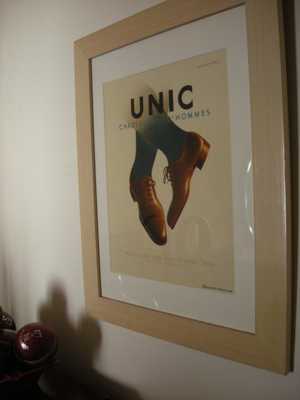
I'll never forget a winter day 17 years ago in Paris. I was captivated by this poster for UNIC shoes hanging in a poster shop in Le Marais. I walked back and forth in front of the shop many times, and after much deliberation, I bought it. I didn't realize it was by Cassandre at the time, so the joy was even greater when I found out later. Created in 1932.
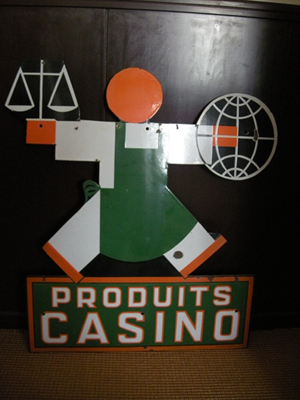
This is an iron sign for the CASINO liquor store, created by Cassandre in 1931. I purchased it directly from an American dealer, and since I didn't have much money, I paid in installments—a cherished item. I bought it about 10 years ago and kept it in storage for a while (laughs).
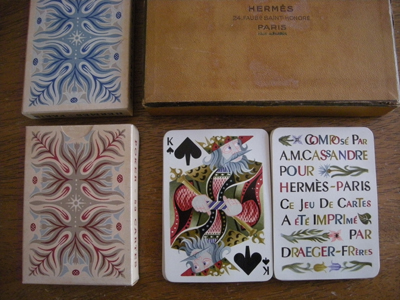
Cassandre left behind not only the Yves Saint Laurent logo but also outstanding works for Hermès. He designed scarves, but I own a deck of playing cards. The motifs and typography (known as Cassandre typeface) are catchy and perfectly balanced. I bought this in Paris 13 years ago. Made in 1937.
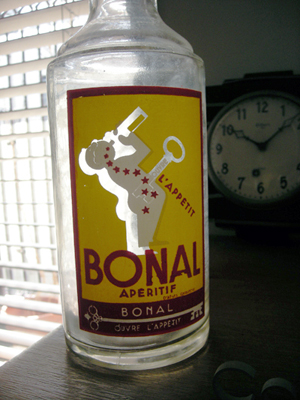
I saw this in the window of a Parisian antique shop about 12 years ago, but it was closed for the year-end holidays, so I couldn't buy it. The photographer Akahira-san, who lives in Paris, kindly bought it for me and even brought it to me during a watch assignment in Basel, Switzerland. Akahira-san mentioned that Cassandre items are now very expensive and difficult to obtain.
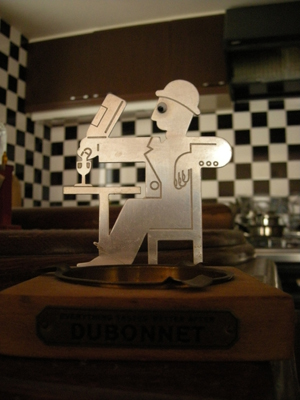
This is a rare DUBONNET ashtray (1937) that Cassandre himself used, complete with a photo from the era. In fact, it's a prized item I traded with Mr. Goto, the director of Conran Shop. I traded a rare Bibendum pen holder. Through this, Mr. Goto and I became good friends.
I simply love beautiful things
"Even if your fashion, car, or meals are wonderful, it's uncool to have no style in your home (i.e., your inner space)."
About 25 years ago, when I was a university student. In a special issue of Anan magazine, occasionally titled "Men's Anan," which focused on men, my fashion mentor Yukihiro Takahashi said something like that. Back then, as a poor student, I was greatly influenced by these words. I strongly vowed then to become a person with style in all aspects of life when I grew up. I feel that my inclination towards Art Deco was partly influenced by Takahashi-san's words.
Indeed, being surrounded by good and beautiful things makes people positive and refines their style.
Art Deco taught me the importance of living spaces, environment, and interiors in shaping one's life.
I believe the same applies to people.
Just as being in the same air and sharing the same space with people of good taste unknowingly influences you and improves your sense.
Just as talking with positive people energizes you and makes you more forward-thinking.
Although my collection has now shifted to modern art, particularly photography, I still live surrounded by the Art Deco pieces I've collected. It's an incredibly pleasant feeling. I have a deep attachment to all of them.
And my future dream is to own an antique shop (laughs).
This is a hypothetical scenario, assuming I retire from my current job...
Spending my days reading my favorite books, dressed stylishly, perhaps smoking a cigar in the shop, and serving delicious coffee to the occasional customer for a chat—with absolutely no commercial intent (laughs).
And finally, my dream is to have my collection auctioned at Christie's after my death. No, I'm serious (laughs).
I once asked a Christie's staff member, "If I have a solid collection of valuable items, is it possible to create a personal auction catalog?" They said it was possible. "AKIRA'S COLLECTION"—hmm, sounds wonderful (laughs). I won't be able to see it, of course, but isn't that the ultimate dream for any collector?
A single object transcends its category, attracting and captivating others, sometimes inspiring viewers, bringing comfort, and even making them feel positive.
For me, Art Deco is more than just an indispensable object; it is something more.