March 19, 2015
The 11th Kyoto Sento Tour (Part 2): "The Moving Sento, Funaoka Onsen"
Kyoto's Public Baths: An Invitation (Part 2)
The Moving Sento: Funaoka Onsen
Kyoto, it is said, possesses a unique sento culture.
But these are not just any public baths.
Some are said to exude a grandeur and nobility befitting the ancient capital.
Text by Takashi YanukiPhotos by Maki Arimoto
A Vermilion Ceiling, Yoshitsune and Tengu
Having grown up in Tokyo's old town, where public baths were a part of daily life, I've never been fond of bathing at home. I still frequent sento, and it was the same in Kyoto.
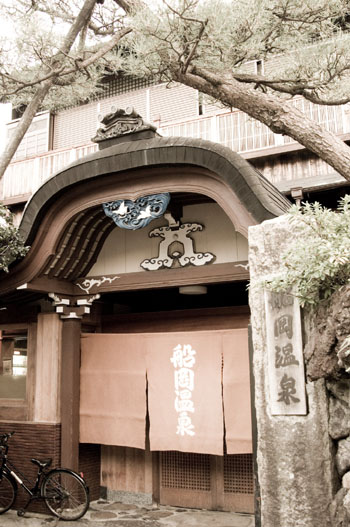
Funaoka Onsen
I used to visit the nearby Yamada-yu (which closed about a year ago), and on its closing days, I'd explore various other sento, always impressed by their distinctiveness.
I heard that Kyoto sento lack the iconic painted Mount Fuji murals common in Tokyo. Instead, the painted areas are tiled, often featuring tile art. Some sento are said to have Fuji depicted in tile.
The sento I know with a "tiled Mount Fuji" is Funaoka Onsen. Visiting this bathhouse moved me deeply. Funaoka Onsen is, quite simply, astonishing.
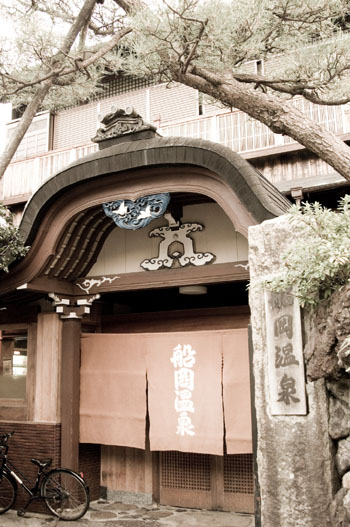
The building is a Tangible Cultural Property registered by the Agency for Cultural Affairs, its exterior so grand it could be mistaken for a Kabuki theater. Inside, the elaborate interior is even more surprising.
Look up at the ceiling. It's vermilion. A carving of a tengu immediately catches the eye. On closer inspection, it's Yoshitsune and Kurama Tengu, with a young tengu as well.
Furthermore, the transom surrounding the changing room features openwork carvings depicting scenes of war, which I recall reading in the Kyoto Shimbun were inspired by the Shanghai Incident. Despite being a changing room, it exudes an unexpectedly refined atmosphere.
As a side note, the day after reading that newspaper article, I visited Funaoka Onsen for the first time.
It's Impossible Not to Feature This One First
The bathing area is typical of Kyoto sento, equipped with medicinal baths, jet baths, and of course, a sauna. There's also an open-air cypress bath. Open-air baths are not uncommon in Kyoto's public baths.
After I started visiting various sento, I bought "Kyoto Gokuraku Sento Annai" (Guide to Kyoto's Paradise Public Baths), written by Hiroki Hayashi and published by Tankosha. The first sento featured in this guide, subtitled "A Guide to Kyoto's Historic Scenery," was Funaoka Onsen, with the following description:
"In a guide to Kyoto's public baths, it's impossible not to feature this one first..."
Funaoka Onsen
Address: 82-1 Murasakino Minamifunaoka-cho, Kita-ku, Kyoto City, Kyoto Prefecture
Hours: 3:00 PM - 1:00 AM; Sundays and Holidays 8:00 AM - 1:00 AM; Open daily
Phone: 075-441-3735
Website: http://www.geocities.co.jp/SilkRoad-Desert/6711/