May 11, 2015
Part 18: Tales of "Dwelling" - Lighting
Part 18
Tales of "Home" - On Lighting
Is it truly a good thing to be bright, anytime and anywhere?
For your off-duty relaxation, why not switch to candlelight to calm your mind?
Photo by Jamandfix
Is Light Meant to Be Enjoyed with Shadows!?
In modern Japan, where bright light in every corner is considered ideal, you can read a newspaper anywhere in the house – the entrance, the living room, the toilet, or the stairs.
However, in Europe, it's too dark to read without proper lighting. There's a contrast of light and shadow even within the home.
From an energy-saving perspective, fluorescent ceiling lights might be the most efficient form of lighting, but from an emotional standpoint, it's clear which lighting philosophy, Japan's or Europe's, holds more aesthetic value.
The role of lighting isn't just to illuminate a space brightly. What if your favorite bar was brightly lit? You wouldn't be able to enjoy a drink in peace, would you? It would ruin the atmosphere.
Also, being in a brightly lit place before bed can stimulate the brain, making it difficult to fall asleep. As humans are animals, we need a dimness where we can feel safe and hidden when resting. Creating the most comfortable brightness for each scene is also an important role of lighting.
So, why not try enjoying "candlelight" during your relaxation time after work?
Gazing at the shadows created by the small candle flame has a wonderfully calming effect on the mind.
Candlelight is effective for switching between on and off modes, not for any ulterior motives like creating a seductive mood.
Personally, I enjoy lining candles on my balcony and sipping a drink while watching the flickering flames. It makes drinks taste so much better (laughs).
I sometimes think that light is meant to be enjoyed with shadows. It is precisely because of shadows that the beauty of light stands out. If we are always under ceiling lights, we can never enjoy shadows. While being mindful of fire safety, I encourage you all to enjoy the light and shadow of candles.

Japanese People Have Always Been Skilled at Handling Light
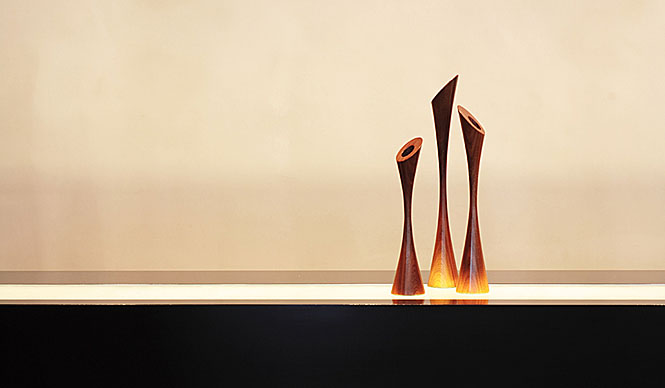
Incidentally, the solid wood candle holder in the photo (top) is an antique I purchased in New York seven or eight years ago. Judging by its design, it was likely made during the Mid-Century era. There are many such well-designed lighting accessories.
Japan had the 'Odawara Lantern,' a portable lighting device for travelers. It was a remarkably well-thought-out tool in terms of its structure.
During the day, it could be folded compactly for portability, and even if the washi paper tore due to wind or rain, it could be easily replaced. Furthermore, the light was amplified as it reflected within the washi paper. While it may be a souvenir today, it must have been an advanced tool during the Edo period.
Flipping through "Japanese Light," a book published by Yamagiwa Electric in commemoration of its 50th anniversary (1973), one can see numerous traditional Japanese lighting fixtures such as lanterns, andon (traditional Japanese lamps), and candleholders.
And what's surprising is that many of them are excellent products that combine practicality with stylistic beauty.
Japanese people were originally a people skilled in the use of light. Following the example of our ancestors who found elegance in the moonlight filtering into their rooms, we too should once again savor the sophistication of light.