May 1, 2015
Chapter 10: Morocco—A Space Beyond Time and Space
Chapter 10: Morocco – A Space Beyond Time and Space
Photos & Text by ASANO Noriko
In March 2001, I traveled to Ouarzazate and Fez in Morocco for location scouting for a PV. Actually, around this time, I had gone to the hospital due to feeling unwell and discovered elevated cancer markers, leading to daily tests and a period of significant distress.
My fiercely competitive nature, which makes me keep everything to myself and avoid relying on others when I'm struggling, meant I was shouldering it all alone (though in reality, I was quite overwhelmed).
So, I found it too difficult to stay in Japan while waiting for the results, and under the guise of location scouting, I flew to Morocco with Director Morosawa, who has been my best friend and work colleague for 23 years.
Morocco had been a place I'd wanted to visit for a long time. It was the filming location for my favorite movie, 'The Sheltering Sky,' and the place where the original author, Paul Bowles, moved from America and spent his life.
Incidentally, the music for 'The Sheltering Sky' was composed byRyuichi Sakamoto.
Kasbahs (Fortresses) and the Berber People
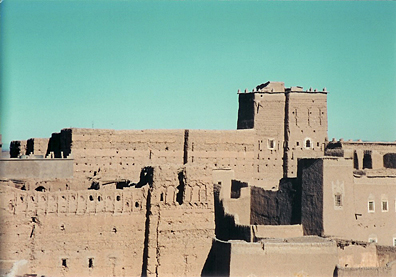
In Ouarzazate, Morocco, numerous "kasbahs" are scattered, offering a glimpse into the lives of the desert people. Within the large kasbahs, designated as World Heritage sites, eight families still live today.
Kasbahs were used as fortresses. Made of red earth, they have only small windows for light, making the interiors dark. Therefore, intricately crafted lamps are placed here and there, creating a truly magical atmosphere.
This region is home to many Berber people, and most of the women wear completely black traditional clothing and cover their heads with a burqa. Even when we visited, it was quite hot, yet the Berber women were entirely wrapped in their dark traditional attire.
While it may be due to religious reasons, I couldn't imagine doing that myself! However, for them, having lived this way since birth, it might be perfectly normal...
Afterward, I took a train from Casablanca to Fez. The first-class ticket granted access to a comfortable compartment with air conditioning and benches for three people facing each other, making the journey very pleasant.
For a while, Morosawa and I had the compartment to ourselves, but then a slightly suspicious Moroccan man boarded. This man, in his late twenties, started speaking to us in broken Japanese.
As expected, he asked, "Want to buy some chocolate?" In this context, "chocolate" refers to hashish, and there are many drug dealers in Morocco who target tourists. Of course, I didn't buy any, but he was quite persistent, so it's best to be cautious.
You Can't Generalize the African Continent
Fez was quite a large city. Morocco itself is over 99% devout Muslim, and the streets are overwhelmingly filled with men.
What was somewhat surprising was that in the evenings, the open-air cafes would fill with men dressed in djellabas, the traditional Moroccan attire.
What they were drinking was mint tea. Alcohol was not served at all. While places like Casablanca seem to have many establishments that serve alcohol for tourists, in Fez, it's difficult to find a place to drink alcohol outside of the major hotels.
In any case, for me as a foreigner walking around the city in ordinary Western clothes without covering my face, it meant attracting the attention of all the men, and honestly, it was a little frightening.
Morocco is the closest African country to Europe, and the people overwhelmingly have Arab features rather than Black African ones. It didn't feel like I was in Africa at all.
The food, such as couscous and tagine, was incredibly delicious, and I became completely hooked. The vegetables were abundant and simply tasted wonderful. Apparently, they export a lot of produce to various European countries.
I had never eaten such abundant vegetables in Africa before, so I was truly surprised. It's absolutely wrong to generalize the African continent.

A Time Slip to 1,000 or 2,000 Years Ago
The medina in Fez was, to say the least, astonishing. It's known as the world's most confusing maze, a place where countless narrow alleys are densely packed within high city walls, and hundreds of thousands of people live.
It's said that European spies trained in this maze in the 1950s. Donkeys walk down paths barely wide enough for two people to pass. Children on horseback transport goods. People in djellabas move about.
The Quran echoes from the mosques. Shops are crammed into the narrow alleys. Walking along the pure white stone-paved lanes, I felt as if I had slipped back 1,000 or 2,000 years in time. Or perhaps, more accurately, I felt a sense of being able to erase my entire past.
Just as I was overcome with the urge to hide myself away in this space, a voice suddenly broke through, "Carpets, cheap!" in broken Japanese, pulling me back to reality.
Happy Women
There are an overwhelming number of people who call themselves guides. It's no exaggeration to say that guides are everywhere, including unofficial ones.
We hired a young guide named Mohammed, who showed us around. Of course, we didn't buy any carpets. Mohammed, who makes a living in the medina, had a slightly dubious air about him, but he didn't seem like a bad person at heart.
We decided to ask Mohammed to help coordinate our filming. Capturing the medina in a short period depended on how effectively we could involve the local people.
We visited his home and were introduced to his family. His father, mother, and siblings were all truly wonderful people. We also visited the home of a Berber grandmother. The grandmother, with a tattoo on her forehead, lived alone in a traditional house on a hill.
Here too, women wear scarves on their heads and cover their faces when they go out. Even for a short trip just a little way away...
I had visited countries with a large Muslim population before, but this was the first time in Africa that I encountered a country with such devout Muslims.
From an outsider's perspective, it seemed like a strong patriarchy, with women appearing to have no freedom. Yet, Mohammed's mother and sisters seemed incredibly happy.

My Own Norms Are Not the World's Norms
Since the Gulf War, Islam has often been viewed with suspicion. However, for instance, I haven't studied the teachings of Islam, nor do I live in an Islamic society. The same can be said for Christianity, of course...
I studied Buddhism to some extent in middle school, as it was a Buddhist school, but in any case, I don't have enough knowledge about religion to criticize other faiths. However, I believe that even with different religions, there is much we can understand by engaging with each other as human beings.
My trip to Morocco reaffirmed that my own norms, and Japanese norms in general, are not universal.
Noriko Asano