Chapter 9: Côte d'Ivoire
Chapter 9: Beloved Côte d'Ivoire
I had returned to my apartment in New York (NY) for the first time in about six months. When I'm in Japan, things are so hectic that I can't settle down to write, so I thought I'd come here to work on my manuscript at a leisurely pace... but then I was hit by a terrible disaster.
Have you ever heard of "bed bugs"? These creatures, whose name sounds like a cute little animal, are actually bedbugs. These bedbugs, which are currently causing a stir across the US for the first time in 40 years, appeared in my apartment. Initially, I underestimated them, but I was thoroughly bitten all over my body, making it impossible to work. Ultimately, I was forced to move.
The apartment I rented was by no means a messy or unsanitary place. While there were people of various ethnicities, it was in a rather nice area, and I quite liked it... but seriously, bedbugs are the worst!
I had never been bitten by bedbugs, even in the poorest areas of Africa or in any hotel I stayed at... I never imagined I'd be bitten in NY... Oh well.
Now, for this installment of "Winds of Africa," as the season has arrived with a refreshing breeze and a sunlight reminiscent of West Africa, I'd like to write about my beloved Côte d'Ivoire!
By the way, the security in the capital, Abidjan, is not exactly good, so I couldn't take any photos. Please use your imagination to enjoy this.
Text & Photo by ASANO Noriko
August 1994: My First Time in West Africa

August 1994. My first time in West Africa. The scenery of Abidjan, the capital of Côte d'Ivoire, was completely different from Ethiopia, Eritrea, and Kenya, where I had been before.
This land was overflowing with color. The women wore traditional clothing made of the vibrant primary-colored fabrics I had only seen on television before. Their confident stride, carrying loads on their heads, was exactly the Africa I had imagined. I hadn't seen such sights in the African countries I had visited previously, so for me, a novice at the time, it was thrilling, like "This is Africa!"
Abidjan is a city where small islands are connected by bridges. There's Plateau, with its high-rise buildings, embassies, and business centers; Cocody, an affluent residential area with excellent security; and Treichville, where we stayed. Treichville is an area where local people live, and its security is worse compared to other areas. However, it offers a glimpse into the daily lives of Abidjan's residents and has many affordable and delicious eateries.
I particularly loved the market in Treichville, where all sorts of things were displayed in a jumble. ...Later, the market I visited in '94 burned down, and a new one was built... though I heard rumors it was arson.
I spent my birthday in 1995 in Côte d'Ivoire. It was the best birthday. I took a night bus for nine hours to Fakaha, a town near the border with Burkina Faso.
We arrived in Fakaha a little after 4:30 AM. As the sun began to rise in the east, a large, large full moon was fading in the opposite sky.
A full moon seen on African soil is deeply moving. This particular moon was truly enormous... The rising sun and the disappearing moon. It made me feel so alive, so grounded on this planet Earth within the vast universe. Truly moving!

From Fakaha to Korhogo
Fakaha was a lively town with a large market. The hotel was comfortable, and the food was delicious.
This place is famous for a fabric that is very popular in Europe. I visited the site where women spin cotton in a large square and men weave fabric. They then add simple yet elegant embroidery to this fabric. Everything is handmade. Normally, it's used for tablecloths, but at the hotel in Fakaha, they used this fabric for sheets and blankets. It was incredibly smooth and comfortable, perfect for a hot climate. I loved it so much that I bought a lot.
If I have the chance,rumorsI'd like to introduce it on.
However, my visit to Fakaha at this time was merely a stopover... or rather, it was truly on the way to my final destination.
My ultimate goal was to visit a village famous for Korhogo paint. Korhogo paint is a unique style of painting used on fabrics like tapestries, known to Africa enthusiasts. While there are now machine-woven fabrics with this paint, I desperately wanted to go to the source... to Korhogo itself.
Korhogo is a village of about 30 households, located about an hour's drive through unpaved roads... across the red earth savanna, after chartering a taxi from Fakaha. The journey to this place allows you to feel the African land up close.
Large baobab trees are scattered throughout, and cars drive between them. Occasionally, we passed women in colorful traditional attire, carrying bundles of wood on their heads. African women work incredibly hard. I wonder how many kilometers they walk each day... At any rate, it's safe to say they have zero body fat.
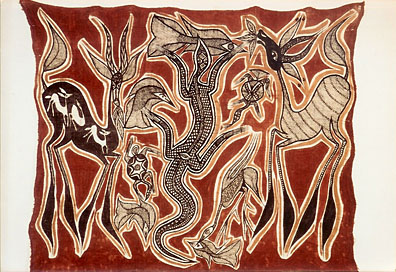
The village of Korhogo consists of just a few small mud houses clustered around a central square. It is in this square that the final stages of Korhogo painting take place.
...Or rather, it's just a place where hand-painted designs are hung out to dry on clotheslines, but these hand-painted Korhogo designs reach the level of art. They draw pictures on large, coarsely woven cotton cloths using a mixture of mud and special pigments. The drawings are truly fascinating. They mainly depict animals and people, but they have a cosmic, or perhaps primitive, quality... reminiscent of ancient cave paintings often seen on television.
The reason I went all the way to this village was because I heard I could buy fabrics I liked there... It was worth the full day's trip, as the Korhogo paintings available there were incomparable to those in the Abidjan market, with a powerful boldness of line and an exceptional use of space.
As expected, when you go to the source, you encounter the real thing. It was a truly blissful time.
An Unbearable Sense of Urgency
...However, soon after, I was overcome by an unbearable sense of urgency.
I have a pre-existing condition of asthma. Therefore, I always bring mineral water with me wherever I go.
Once, when I had an asthma attack at an altitude of 2,400 meters in Ethiopia, I ran into serious trouble because I didn't have water. A local person brought me water, but it was murky brown, and I couldn't drink it. I was immensely grateful, but...
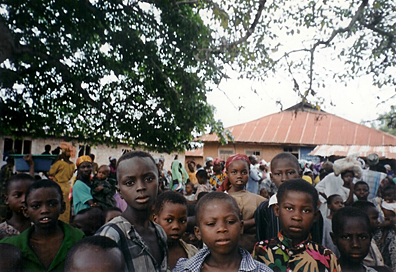
Since then, mineral water has been indispensable, no matter where I go. And at this time too, I had brought a 500ml bottle with me. Casually, I took a sip of the "clear water." Seeing this, the children around me all clamored for the clear water... I couldn't do anything. If I gave them the water, my own life might be in danger. The children could drink the brown water, but I couldn't... I had no choice but to convince myself.
But I was overcome with immense guilt. Certainly, giving them "clear water" for a moment wouldn't solve their long-term problem. But should I have given it to them...?
After that, cholera broke out in a wide area of West Africa. People drank contaminated water due to poor sanitation, leading to the deaths of many children with weak constitutions.
The "water" we drink so casually. Our daily lives, where we mistakenly believe it flows endlessly from the tap... ...But that's not really the case, is it?
I receive so much energy and learn so much from the people of Africa. ...Yes, the very fundamentals of life.
...And so, this time, I've written just a little about Côte d'Ivoire. I will write more about this beloved country on another occasion. Please look forward to it.
Since then, Côte d'Ivoire has experienced a coup d'état, and advisories for evacuation and deferral of travel remain in effect. I cannot help but pray for the swift return of peace to the beloved Côte d'Ivoire.