May 1, 2015
Chapter 3: African Rhythms
Chapter 3: African Rhythms
African rhythms shake the earth, connecting heaven and earth.
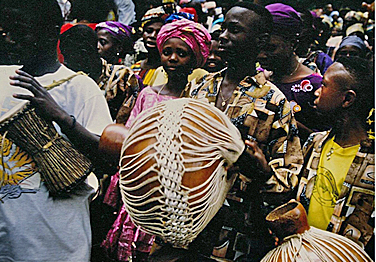
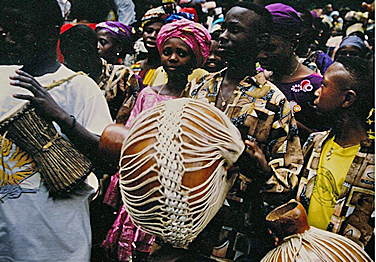
Scenes from the Osun Festival, held on the third Friday of August in Osun State, Nigeria.
South Africa
In South Africa, an elderly Black man, finally free after the end of apartheid, said, "We use these instruments to make music now, but in the past, they were used for communication." He then struck a powerful African beat on a large drum held between his legs.
Nigeria
The drum masters playing the talking drums beat out rhythms that have been passed down for ages, used to communicate with the gods. Rhythms for offerings, rhythms for communing with the thunder god, rhythms to celebrate a bountiful harvest... etc.
Those rhythms truly resonated with the red earth.
After a while, the sky turned dark, thunder rumbled, and heavy rain began to fall.
Nigeria
When the tone of the talking drum changed, so did the children's words.
The drum and the children conversed. The drum master grinned.
Come to think of it, a friend told me.
In Congo (formerly Zaire), what is a road in the dry season becomes a river in the rainy season. Paddling slowly up this river in a canoe, drumbeats could be heard from both banks. Listening to the conversation of talking drums on the canoe under a sky full of stars. He said the sounds were incredibly joyful.
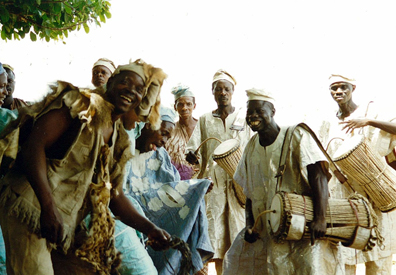
Ajani, a talking drum master from Okini village, Nigeria (right)
Senegal
Gorée Island is the westernmost island of Africa.
During the colonial era, European nations vied for control of this island. Many Africans were sent from this island as slaves to America and Europe.
The island still retains its slave houses.
Western tourists all visit these houses. Inside, they wear solemn expressions and shed tears. But the moment they step outside, they burst into loud laughter.
"That's just how it is," said my Senegalese friend with sad eyes.
Living on the highest hill of this island, the Biffal people, with their dreadlocks and patchwork clothing, strike the rhythm of the djembe at noon and 6 PM.
In the gentle sunlight, relaxed rhythms can be heard from various parts of the island. It is said that these rhythms carry prayers for peace.
Senegal
A club in Dakar created by Youssou N'Dour, a world-renowned musician representing Senegal.
Live performances can be enjoyed on weekends. That particular day featured a drum-only session. The artists were unknown, but their power was overwhelming. A call-and-response between two small talking drums and three djembe players. The audience was entirely Black... Ecstasy!!
Eritrea
The beat I encountered on my first trip to Africa.
It reminded me of Japanese Bon Odori. The faces of the people of this country, dancing to the rhythm of the 'ondo' itself, looked incredibly joyful.
Speaking of which, at a hotel in Ethiopia, for some reason, "Harumi Miyako" was playing.
Mali
The balafon, made from old wood, produces a very gentle sound.
Its shape is like a xylophone, but it has gourds underneath, filled with sand. The amount of sand is used to tune the notes.
When the dry wood was lightly struck with mallets wrapped in rubber on their tips, smiles bloomed on the children's faces.
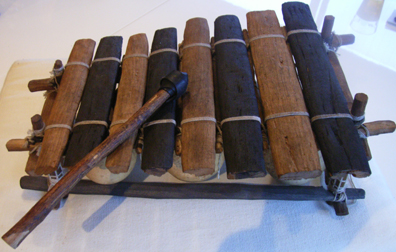
The instrument 'Balafon' (Mali)
Malawi
I was a little surprised. Why? Because the music of this country sounded very similar to Caribbean music. When I mentioned this to a Malawian, they cheerfully replied, "Surely, people from this country must have traveled to the Caribbean islands."
Malawi
A small village on the shores of Lake Malawi has no electricity or running water. Half of the villagers are afflicted with AIDS, leading to a large number of AIDS orphans. These orphaned children made instruments: they attached empty cans to trees, strung threads to them to create guitars, made xylophones from driftwood, and used cans as drums... They formed bands with these homemade instruments.
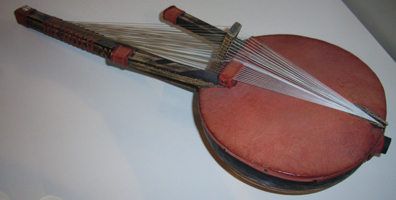
The instrument 'Kora' (Mali)
South Africa
Even though I didn't understand a word, when I heard her sing, I couldn't stop crying.
Her song was like a concentrated essence of soul. I learned it was a song she dedicated to her daughter, whom she left behind in her home country when she fled abroad during apartheid.
"You are not the only one who is lonely. Mama is lonely too..."
She said her dream was to sing this in her native language.
South Africa
The song, where Soweto youths used the new musical style of "rap," which entered after the end of apartheid, to convey their current situation to the world, had a haunting power that gave me goosebumps.
It was a dangerous town, once called a slum. But here, a genuine message existed. The eyes of the boys shouting "Soweto! Soweto!!" were serious, making me feel it was the hottest city in the world right now.
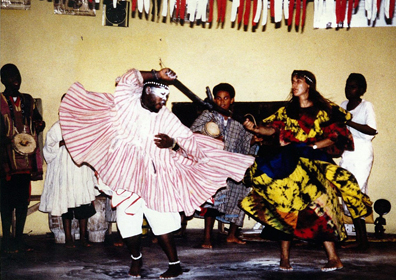
Dancing at the Jungle Communication Center (JCC) in Oshogbo, Nigeria
Africa
Wherever you go, music is at the heart of the people.
Drums echo even in places without electricity or running water. When the drums beat, dancing begins. From children to the elderly, everyone moves their hips to the rhythm. They are fine without television. No computers, no mobile phones, nothing. But even in the poorest places, there is rhythm, and there are smiles.
For the people of Africa, music and dance may be their language, their solace, their sorrow, a bridge between past and future, and perhaps the only "light" that allows them to achieve the African Dream through hard work, even in poverty.
It would be wonderful if we could one day realize a true African Dream: a contest where the No. 1 rhythm and dance from all 53 African countries is decided, and the winner gets to go on a world tour.