May 1, 2015
Chapter 2: African Colors
Chapter 2: The Colors of Africa
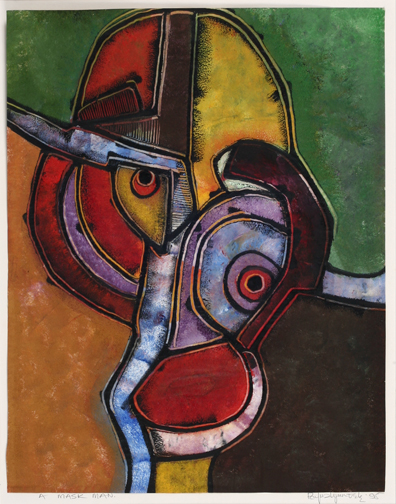
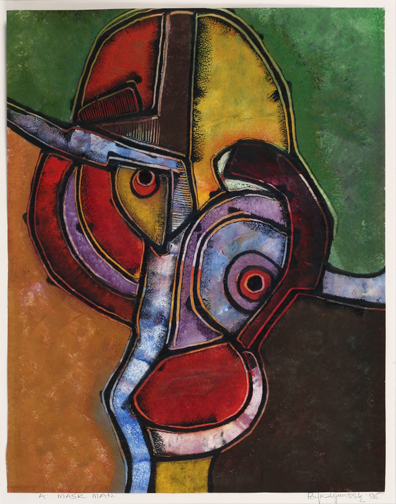
Rufus Ogundeji, "A Mask Man" (Photo 1)
My First Encounter with Africa's "Light"
It has been over 30 visits to 12 African countries since I first set foot on African soil in '94. What has always amazed me is the talent of the African people in music, art, dance, and more.
There is an originality there, un-Americanized and un-Europeanized, and astonishing talent exists in various forms everywhere. This talent is immeasurable. This time, I want to write about my first encounter with that African "light."
My initial shock came at "African Heritage," a gallery in Nairobi, Kenya, that gathered African art and folk crafts. Various African artworks were displayed in every available space.
Line art carved into gourds by "Lilang," the top disciple of Tanzanian artist "Mputa" (Photo 3). Works by "Afolabi" (Photo 4), a representative of the Oshogbo school in Nigeria, and Femi Arolo (Photo 2), among others... The numerous artworks and folk crafts, nearly indistinguishable from art, from all over Africa, beautifully told of their high quality.
While there are interesting items in the markets within the city, the works at Heritage, from an artistic perspective, transcended mere folk craft. The spatial display itself was superb, and the gallery, as large as a gymnasium, with its gentle sunlight and slow passage of time, elevated each artwork to an even higher level of quality.
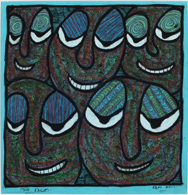
Femi Arolo, "THE FACES" (Photo 2)
Among the high-quality art, what particularly captivated me were the works of Nigerian artist "Femi Arolo."
How could anyone create such mischievous yet charming paintings... No matter how bad my day had been, if I were greeted by such a painting at my doorstep, I would surely burst out laughing... I felt an inexplicable urge to meet him.
I Imagined a Dreamlike Scene... But
The following year, I persuaded a friend, an expert on Africa, to accompany me, and we flew to Nigeria. All I had was that he was Nigerian and his name was "Femi Arolo." The staff at Heritage said he might be a student, but they weren't sure.
In the short time I spent in Japan, I learned that many artists lived in a place called Oshogbo. After liberation from colonial rule, an Austrian named Ulli Beier taught art there.
I arbitrarily pieced together information in my mind: "A settlement of about 30 households in a serene grassland, where young artists paint, enveloped by a leisurely flow of time... And when I visit Arolo, he will greet me with a wide, white-toothed smile and a slow wave, saying 'Welcome'"... I imagined such a dreamlike scene and assumed I could easily meet him if I went to Oshogbo.
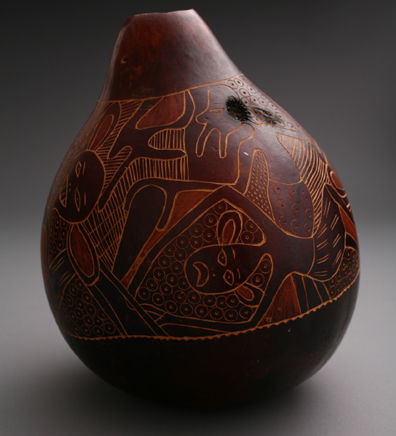
Lilanga's gourd line art (Photo 3)
However, what I arrived at was the third-largest provincial capital in Nigeria. People, people, people. Clunking cars, cars, cars. 30 households??? My own imagination was shattered in an instant.
And then the real challenge began. My stay in Oshogbo was five days. First, I looked for a gallery and asked the gallery staff, "Do you know Femi Arolo?" They all looked at each other and said, "No"... Silence. My friend asked me, "Is he really an artist from Oshogbo?" ... "I don't know. But I think so..." Since the scene I imagined didn't exist, that's all I could answer.
Artists of Astonishing Talent
The next day, I visited Twins77, a representative artist of the Oshogbo school. He was not there, but his staff gave me a glimmer of hope by saying, "We know Femi Johnson."
Again, I arbitrarily assumed, "Ah, Femi Arolo must be an artist's name, and his real name might be Femi Johnson!!" and decided to go meet this Femi Johnson.
The young artist politely offered me a handshake. I was sure it was him, but when I saw his work, it was completely different... It wasn't bad, but it wasn't the mischievous Arolo painting. As an apology, I bought a few of his pieces and was back to square one.
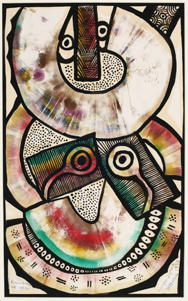
Afolabi, "Rainbow" (Photo 4)
My friend looked exasperated, and I was wondering what to do when Twins77's staff said, "Don't be too discouraged. We'll help you find him." They were truly kind people. In any case, I decided to meet as many Oshogbo artists as possible.
However, from then on, incredible encounters began. Every artist I met, and every artist after that, possessed astonishing talent.
Even within the same Oshogbo school, each artist had their own originality and different techniques, and their level of completion was astonishingly high. It was like a windfall, a storm of emotion.
By the third day, artists were even bringing their works to the hotel.
I thought to myself, "I'm not an art producer, though..." but I ended up buying a succession of incredibly stimulating works. Later, I learned that some of them were quite famous artists in America and Europe, and Rufus Ogundeji (Photo 1) and Afolabi, in particular, are representative African artists who have been introduced in Japan at museums like the Setagaya Art Museum.
Arolo Was in Oshogbo!
On the fourth day, I had to return to Lagos the next day. I wondered if Arolo really wasn't here...
I consider myself a positive thinker, but I was starting to feel anxious. My friend, with a hint of sarcasm, laughed and said, "Give up. But isn't it great that you've encountered so many amazing works?"
Just then, a young artist named Osaka, who created works using the batik technique (Photo 5), approached me and said, "I know Femi Arolo." "What!!" Unbelievable words. He immediately guided me to Arolo's home.
The place was a small apartment quite far from the main street. Ascending the stairs led to a dark corridor. At the end of it was a table where a small, thin man in a tank top was working on something.
"That's Arolo," said Osaka. My heart pounded. Although the situation was completely different from my own fantasies...
First, Osaka explained who I was to Arolo. When he finished speaking, Arolo approached me.
"Madame..." He shook my hand, seemingly deeply moved that I had come all the way from Japan to see him. At the time, I couldn't speak English properly, so this moving encounter was, embarrassingly, mediated by my friend's interpretation. But Arolo was in Oshogbo.
After that, I was shown Arolo's work. The same mischievous characters I had encountered at Heritage were there. Now it was my turn to be moved. I had really met Arolo! My friend smiled and said, "I'm glad for you, Madame."
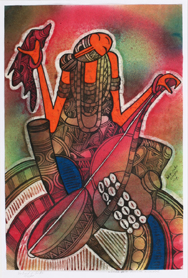
Osaka, "Woman with Musical Instrument" (Photo 5)
After that, I decided to support Arolo and Osaka, as well as the other artists in Oshogbo. Until Osaka's tragic death in a traffic accident at the age of 29 in '98, I visited Oshogbo 26 times. Arolo named his daughter Noriko.
African art is profound. Their sense of color and unique, powerful lines make it entirely understandable why Picasso and Matisse were influenced by it. I hope to continue introducing many African artworks on this page.
A Little Curiosity and the Courage to Take a Step Forward
Postscript: Thinking back now, it was a journey undertaken solely on reckless assumptions. It might have been a miracle, but I somehow gained a strange confidence that intentions can indeed be communicated. I learned that with a little curiosity and the courage to take a step forward, many encounters await.
Incidentally, at that time, Nigeria was politically very unstable, and it was said that a coup could happen at any moment. Also, I only found out later that Nigeria's population is 120 million. The fact that meeting Arolo was a 1 in 120 million chance is astonishing!!