May 11, 2015
Part 14: Tales of the Table - The Sommelier Knife (2)
Part 14
Tales of Food: The Sommelier Knife (2)
Photo by Jamandfix
Quirky, Yet Endearing
No matter what country or city I visit, there's always a hardware store, and I love peeking into these local shops. Small hardware stores often have a quirky owner who stocks his favorite, almost secret, items. If I ask, 'Don't you have a corkscrew (sommelier knife)?' he'll happily pull one out. Then I find myself thinking, 'Oh, I don't have one like this,' and I end up buying it. It's problematic how each encounter feels like a once-in-a-lifetime discovery.
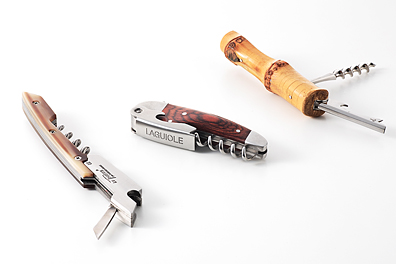
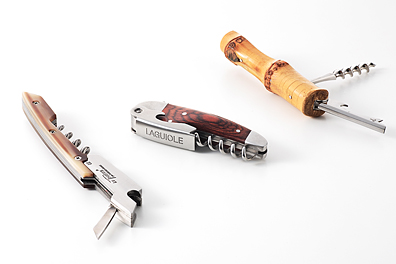
Anyway, for the second installment of this series, I'll introduce a slightly unusual type from my collection. The one with the sharp lines and buffalo horn handle (left) is French. Despite its decorative design, I was surprised by its unexpectedly excellent operability when I tried it. Normally, a blade has a knob to help pull it out, but on this sommelier knife, the back of the blade is made wider for an easier grip. It has a strong taper. You can see the ingenuity in simplifying the design while considering usability.
The sommelier knife in the center bears the ' Laguiole' engraving, as mentioned in the previous section, but given its bargain price and noticeably cheap texture, it's highly likely a fake from a certain country. The one on the right is French, but its material is likely Kyo-ne-dake, a bamboo sourced from Kyoto. Ne-dake, as the name suggests, is bamboo from the root area, characterized by its dense, non-hollow structure. While it may not be the most practical, I bought it because it was rare.
Ingenious Shape: The "Two-Stage" Mechanism
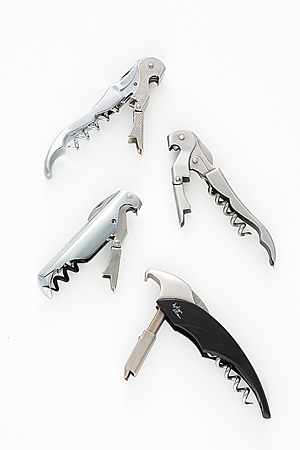
Next is another unusual one. When opening a cork with a sommelier knife, the more you tilt it—meaning, the closer you get to pulling the cork out—the more sideways force is applied to the cork, potentially causing it to break. This is a weakness, so to speak. However, these sommelier knives feature a two-stage fulcrum. By changing the fulcrum according to the tilt, they apply force almost vertically without strain, allowing the cork to be removed safely. It's an ingenious design. The shape resembles a tropical parrot. The item in the bottom right of the photo is designed with a bird-like form in mind. It's a bad habit of mine to be drawn to such peculiar items.
A Bit Too Elaborate!? The "Gear Type"
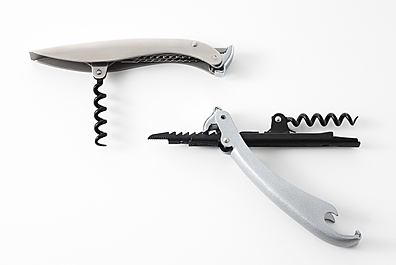
Even more elaborate than the two-stage type is this gear mechanism. It allows the fulcrum to extend steplessly, like a car jack, according to the tilt, enabling the cork to be pulled out almost vertically at all times. It's a truly logical approach. However, professional sommeliers would likely never use these. Just imagine: in a quiet restaurant, illuminated by soft tungsten light, you've bravely ordered an expensive wine in front of a beautiful woman, and then the sommelier starts opening the cork with a 'clack-clack-clack' sound. You'd want to rip the badge off his chest, wouldn't you?
High functionality can sometimes be rather unrefined.