April 17, 2015
39th Daido Moriyama Solo Exhibition: Hokkaido (Part 3)
Ratt Hole Gallery
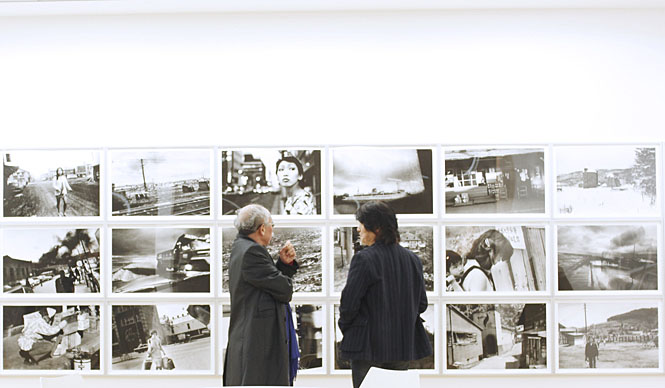
The 39th Daido Moriyama Exhibition 'Hokkaido' (Part 3)
This conversation with Daido Moriyama enters its third installment. Hearing his own words about his feelings at the time, I understood not only why these photographs were sealed away for 30 years, but also why they resonate so deeply now precisely because they had to be suppressed. (Nobuhiko Kitamura)
Nobuhiko Kitamura / HYSTERIC GLAMOURPhoto by Jamandfixedit by TAKEUCHI Toranosuke(City Writes)
Days of Dragging My Feet, Just Shooting, Day After Day
KitamuraMoriyama's photos are often compared to a dog's perspective, but these Hokkaido photos go far beyond a dog's range, don't they? I feel a much stronger, more 'on the road' kind of image.
MoriyamaHokkaido isn't a place where you shoot by relying on the senses of a dog or cat. In a way, it's a bit more dry.
KitamuraYou went to various places, mainly around Sapporo, right?
MoriyamaI'd go to the northern and eastern parts occasionally, but I was overwhelmingly in the central and southern areas. I'd leave every morning and come back at night, dragging my shoes. Thinking, 'This is so boring, what am I even doing...'
KitamuraWhat were your feelings when you decided to go to Hokkaido from Tokyo?
MoriyamaI wanted to change my life. I wanted to break free from the life I was leading in Tokyo, just drifting along without taking many photos. I thought I'd create a daily routine of taking pictures.
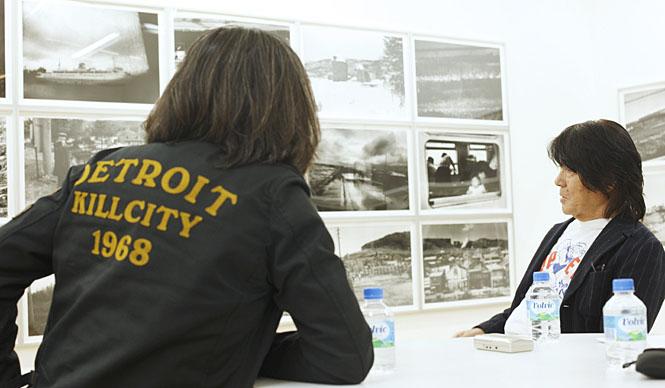
KitamuraHad you decided on the three-month period before you went?
MoriyamaYes, I could only rent that room for three months.
KitamuraSo, it wasn't so much a feeling of 'I'm going to Hokkaido!' but more like wanting to place yourself somewhere else.
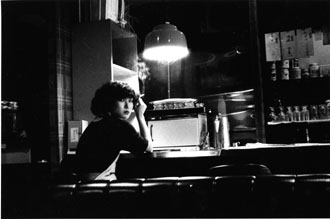
MoriyamaYes, it was a kind of escape. At the time, I'd try to justify it by saying I wanted to take photos like 'Kenzō Tamoto and the Northern Photographers,' but in reality, it was self-imposed isolation and self-escape.
KitamuraBut things created during happy times, whether it's songs or anything else, aren't usually that great, are they? I think words and songs that come from a place of deep despair, when someone feels they're at their limit, resonate more with a third party.
MoriyamaPerhaps so. Being told 'Look how good this is!' isn't very satisfying (laughs).
KitamuraA song that goes 'My life is so much fun!' is just a party song. In terms of music, I was exclusively into Western music from junior high, always listening to overseas sounds. But for the past few months, for some reason, I've only been able to listen to Japanese songs. I just can't stomach the 'lukewarmness' of recent Western music and don't know what to listen to. So, I realized I knew nothing about the history of Japanese rock, and started listening to Japanese songs from the folk and new rock eras, roughly from 1968 to the mid-70s. At first, it felt a bit embarrassing, but gradually I started to like it. After all, we express anger and sadness in Japanese every day, so Japanese naturally hits closer to home. Then, the boundaries of genres like rock, folk, and enka also dissolved (laughs). But when you think about it, those songs were born out of difficult experiences, including the student movement.
I Had a Vague Feeling That If It Was About Hokkaido, It Should Be Hysteric
—That's where it connects with your 'Hokkaido' series, isn't it?
KitamuraMore than anything, I used to be exclusively focused on overseas things, even with photography. But when I first saw your photos in the early 90s, I realized that Japan could also be captured so coolly.
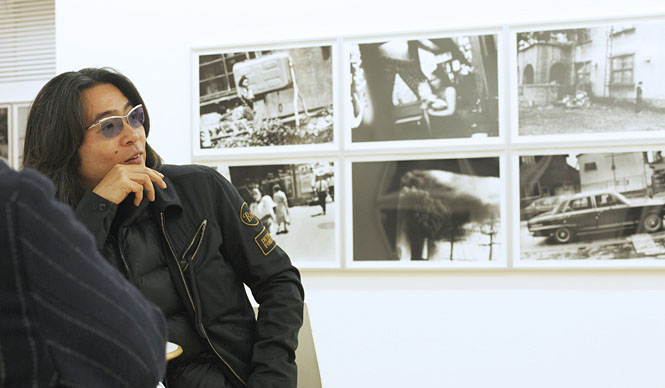
MoriyamaActually, for a while now, whenever I caught a glimpse of those cardboard boxes filled with film out of the corner of my eye, I had a vague feeling that if I were to make a book, it should be with Hysteric.
—Why did you feel that way?
MoriyamaThe impression of that first 400-page book you published has stayed with me immensely. The sense of pleasure I felt while making it, and the feeling of transformation within myself, have lingered, which is probably why I thought that. Honestly, if you hadn't approached me this time, I probably wouldn't have released them. It was just the right timing.
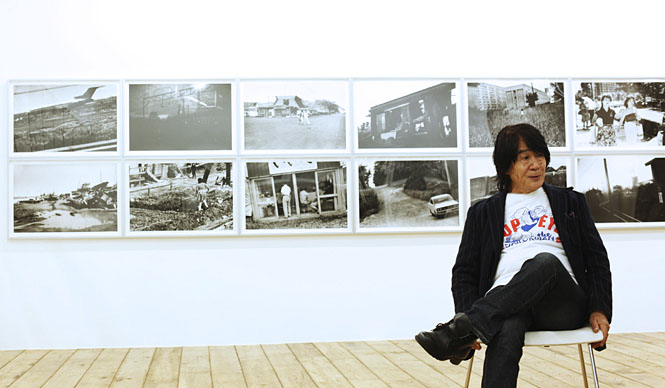
—I think it was good timing for the viewers too. For those who have seen 'Hawaii' or 'Buenos Aires,' seeing this will likely bring a new kind of shock, and conversely, I feel it might also reaffirm your signature style.
MoriyamaI hope so. It's strange for me to say, but seeing them printed like this, I feel anew that my origins are here. Also, it's strange for me to say this too, but I realized just how much I had shot. At the time, I just felt I was shooting listlessly, without any real sense of accomplishment.
KitamuraThinking about it that way, I really feel the power of silver halide. You couldn't do this if it wasn't film, could you? If it were digital, you probably wouldn't leave it untouched for 30 years, and even if you did, I feel it would become something different.
MoriyamaThe decisive difference between silver halide and digital is probably the presence or absence of a material quality. There's a material quality when printing, and a material quality to the film itself. Even glancing at those cardboard boxes of negatives has a material quality.
KitamuraPeople often compare silver halide and digital, but they are entirely different things and shouldn't be compared. That's precisely why I hope silver halide, as personal photography, will continue to endure.
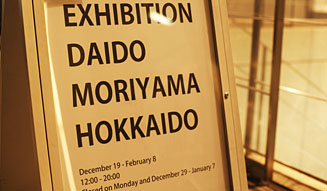
Daido Moriyama Exhibition 'Hokkaido'
On display until Sunday, February 8, 2009
Ratt Hole Gallery
12:00-20:00 (Closed Mondays)
RAT HOLE GALLERY & BOOKS
5-5-3-B1 Minami-Aoyama, Minato-ku, Tokyo
Tel. 03-6419-3581
http://www.ratholegallery.com