April 8, 2015
Ryuichi Sakamoto | How Ryuichi Sakamoto Enjoys "schola TV"
“Schola: Ryuichi Sakamoto’s Music School” to be Reruns During Summer Break
Ryuichi Sakamoto on Enjoying “schola TV” (Part 1)
“Schola,Ryuichi SakamotoMusic School,” which began airing on NHK Educational TV in April, concluded its run on June 19th with the final episode, “Drums & Bass – Part 4.” Due to numerous requests for reruns, it has been decided that the show will be broadcast again on BShi.
August 17 (Tue) 23:30 – Bach Edition, Parts 1–4
August 18 (Wed) 23:30 – Jazz Edition, Parts 1–4
August 19 (Thu) 23:30 – Drums & Bass Edition, Parts 1–4
Interview and text by Eiichi YoshimuraInterview photo by JAMANDFIX
Conveying the Joy and Fascination of Music to Children Each Episode
“The CD-accompanied music collection, commmons ‘schola,’ has been progressing smoothly. This spring, it was broadcast as a TV series on NHK, generating a significant response.”
“I wanted to use television, a major medium, to spread the word about schola and its appeal more widely, and the response was so overwhelming that I was quite surprised. Producing each volume of the CD-accompanied book series ‘schola’ is a challenge in itself, and then to delve into it again for television was an incredibly difficult task. Furthermore, each episode involved interacting with children to convey the joy and fascination of music. I imagine the viewers found it very engaging, but for me, the stress was immense… (laughs). The positive reviews were truly a lifesaver, given how demanding it was.”
“There are many voices hoping for a sequel, aren’t there?”
“I’ve been asked to create a sequel. As the head of commmons, I believe it’s naturally something I should do. ‘Sakamoto, stop dithering and just do it!’ (laughs). However, as an individual, I grapple with the thought of going through such a ordeal again! The truth is, I’m not suited for television. I feel a unique kind of pressure. I wonder what that pressure is.”
“The other day, I attended a public recording in Kyoto for a special autumn program of schola, and I saw you there. You seemed very lively and engaged?”
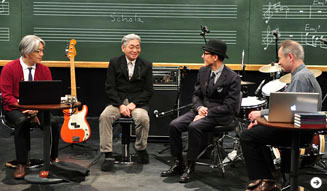
“That was fun. I don’t mind chatting with those older gentlemen (Akira Asada, Junichi Kounuma). The difficulty lies with the workshops involving children. It’s challenging to make it interesting for the children, for myself, and for the viewers. Depending on the subject matter, some topics might not resonate with children unless they have a certain level of musical knowledge, yet if they have too much knowledge, they might not experience that fresh sense of wonder. Therefore, I agonize from the planning stage about which children to target for the workshops. If I push ahead with something I find interesting, children without musical knowledge might not be able to keep up. But then, children with musical knowledge are already within established frameworks, which is also difficult.”
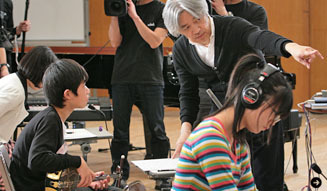
“Despite those struggles, the children participating seemed to be enjoying themselves, and the response from viewers, especially musically knowledgeable adults, was also significant.”
“Yes. The reactions from adults were also very positive. I received comments like, ‘If the music classes I had in school had been like schola, I’m sure I would have loved music more.’ Such feedback was gratifying. I feel we were able to convey the message that it’s never too late to learn more about and love music. I was also pleased with the strong reactions from parents and teachers. In the final series, we held a workshop with students from my alma mater, Soshigaya Elementary School in Setagaya. The children’s response was incredibly enthusiastic. They were eager to share their opinions and thoughts, so much so that it was hard to keep up. I was surprised, thinking, ‘Wow, are children this proactive now? It’s so different from when I was young.’
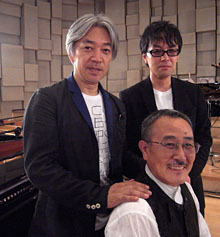
May 2010 Broadcast “Jazz” © NHK
“In what ways were they different?”
“When I was an elementary school student, I’d try to stay in a corner and be as inconspicuous as possible to avoid being called on by the teacher (laughs). To see such a change was astonishing. However, I’ve heard that children aren’t always that proactive in school. When I showed that I wanted to hear everyone’s opinions, they started speaking up. Children have various ideas and thoughts, and they really want to express them. Perhaps they want to speak up more in school too, but maybe they can’t in the educational environment? Still, it was wonderful to see the children so energetic. It gave me hope that Japan’s future is not bleak.”
“To light the way for the future, we must have a sequel! (laughs)”
“But it might shorten my lifespan (laughs).”
“Schola: Ryuichi Sakamoto’s Music School” to be Reruns During Summer Break
Ryuichi Sakamoto on Enjoying “schola TV” (Part 2)
Volume 6, “The Classical Style,” to be Released September 22
“ (laughs). On the other hand, the schola collection is steadily moving forward with its schedule.”
“Yes, first in September, Volume 6, ‘The Classical Style,’ will be released, followed by Beethoven. Historically, Beethoven is included within the Classical period, but he’s so substantial that he needed his own volume, so we separated him.”
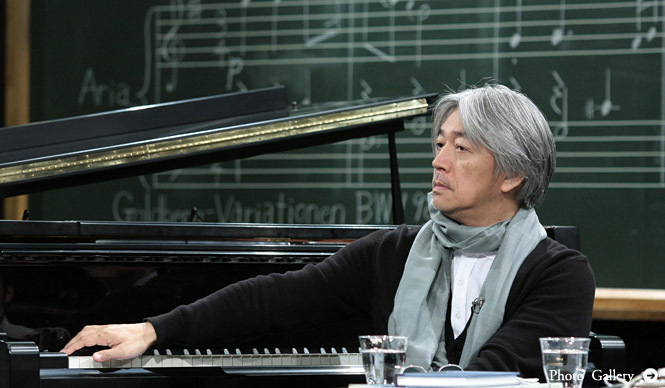
“The public recording in Kyoto was a special class on the Classical period and Beethoven, and it was truly fascinating, full of eye-opening moments.”
“I’m putting a lot of effort into the collection as well, so please read it while listening to the accompanying CD. After the two volumes on classical music, we plan to cover ‘The Road to Rock.’ This segment will trace the development of rock music. While there’s some overlap with the previously released ‘Jazz’ and ‘Drums & Bass,’ I want to ensure the consistency is well thought out. Several years ago, I hosted a special FM radio program where we explored the roots of rock with guest Eiichi Ohtaki, and it was incredibly interesting. Learning about Ohtaki’s perspective on the history of rock’s emergence, the flow of American music leading to Presley, was one of the initial sparks that led me to consider a project like schola. Based on that experience, I plan to shape this with the help of music critic Masakazu Kitanaka and others to supplement and elaborate.”
“That sounds very exciting too.”
“Doesn’t it make you excited? My own simple question was, why did this music called rock emerge in America during that particular era? In the case of Bossa Nova’s formation in Brazil, it might seem to have appeared abruptly, but there was actually a solid musical foundation in Brazil that led to its creation. It emerged out of a certain inevitability, and I believe rock was likely similar. This is true for all of schola, actually. ‘Why did that music emerge in that era?’ That’s what I want to learn.”
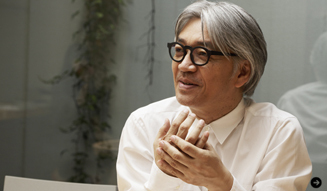
Regarding the upcoming Classical Era volume, while we now listen to Mozart and Haydn as a matter of course, there must have been inevitable reasons why such music emerged at the time. Studying and unraveling that history together as we create schola is a truly enjoyable process.”
“So, it’s not just about educating and passing on knowledge to the next generation, but also a learning experience for yourself?”
“As I mentioned in the panel discussion during the Kyoto public recording, the schola project, which I initiated, turned out to be one where I myself had to do the most studying. I studied a fair amount when I was a child and a student, but I’m studying much more now (laughs). Unlike in the past, there’s a wealth of material, and I need to re-learn not only classical music but also jazz and rock. It’s overwhelming, but incredibly fascinating. Without an opportunity like this, I wouldn’t be listening to Beethoven comprehensively again, for instance. In Kyoto, I played Beethoven on the piano for the first time in decades. It was impromptu, but I was surprised at how much I remembered, which was quite moving.”
“That part was one of the highlights of the TV broadcast, wasn’t it?”
“The more I study, the more preconceived notions are shattered. As you probably know, there’s a general image of Beethoven and Mozart as certain types of composers, and I had similar impressions. But upon re-examining them, I discovered so many things I didn’t know. Since schola aims to be a comprehensive music collection and encyclopedia, there must be no factual errors. We ensure the information is accurate and then freely layer our interpretations onto it. It’s a daily learning process. Nowadays, there’s so much material. Even with the same conductor and orchestra, on the same day, for the same performance, there can be differences in editing and mastering. There’s even information like, ‘The LP released in such-and-such year includes the sound of the conductor’s footsteps as he steps onto the podium’ (laughs). It’s demanding, but I’m enjoying the learning process while grumbling, ‘This is just too much!’”
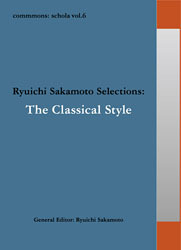
“Schola: Music School,” supervised by Ryuichi Sakamoto
Volume 6: “The Classical Style”
The sixth volume in the commmons: schola series, “The Classical Style,” is the fourth installment focusing on classical music. Composers featured in this volume include Mozart, Haydn, and C.P.E. Bach (son of J.S. Bach), among others. Ryuichi Sakamoto reinterprets the “Classical period,” one of the most significant eras in music history bridging Baroque and Romantic music, from his unique perspective, offering an engaging viewpoint for both classical music beginners and enthusiasts.
“Schola: Ryuichi Sakamoto’s Music School” Summer Special
Program Website | http://www.nhk.or.jp/schola/index.html
commmons
