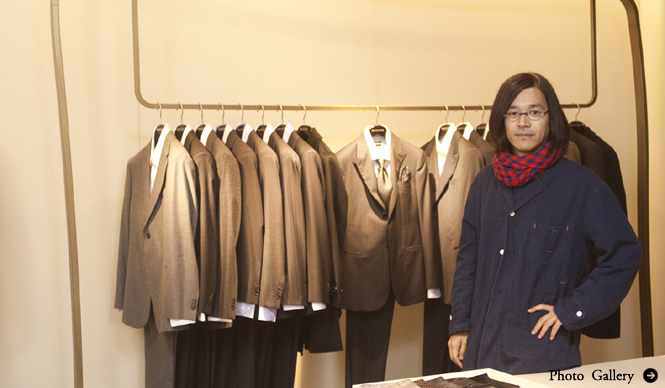
Stylist Tomoki Yuzan on My Armani Experience
Tomoki Sukezane on His Armani Experience
My Armani Experience
Tomoki Sukezane is a highly sought-after stylist, active across advertising and magazines, representing Japan and Asia. We sat down with him at Armani Ginza Tower, a concept shop, just before he departed for an overseas trip, to hear about his encounters with Armani and his impressions. Get ready for a wealth of rare anecdotes!
Photos by Kiyotaka HATANAKAText by Jun NUKUI
My First Encounter with Armani
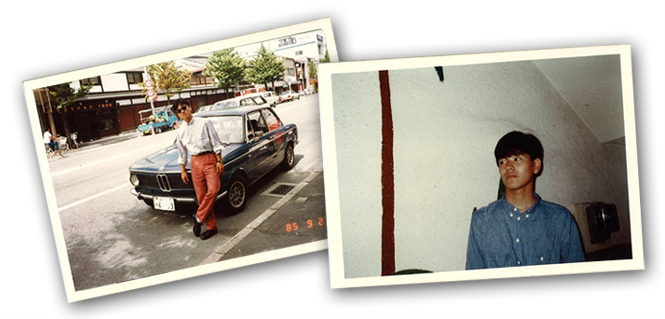
My memory is a bit hazy, but when I was asked to talk about this, I looked through my albums for photos from when I was younger. And then, I found a photo that I think might be an Armani shirt! It’s hard to tell if it was Unique or Armani (laughs). I was about 18, and it was taken when I was visiting Tokyo. It was a chambray button-down with a small collar. That was probably the first Armani I owned.
Then, when I was 19, on October 19th I believe, I had a motorcycle accident (laughs). I was hospitalized with a severe injury, a depressed skull fracture. I was unconscious for almost two months. Before that accident, my brother had gotten married and was on his honeymoon. He bought me two Giorgio shirts as souvenirs from Italy. I remember wearing them happily in the hospital after I regained consciousness and was discharged.
—What kind of shirts were they?
One was made of a silk jersey-like material, which was unusual at the time. It had a low collar band and slightly large buttons. It had a marble pattern of brown and beige. The other was a striped tab-collar shirt with a very big silhouette. This was back in 1984… I think the width at the base of the sleeves was wide, like a dolman sleeve. I have photos of the blue one, which I’m not sure if it was Unique or Emporio, and possibly the striped one.
—You were still in Kyoto then, before you started working with Popeye, right?
Yes, before that. Then, I’m not sure when. I bought a suit. I think it was the summer I turned 23, and I went to Hong Kong. Or maybe it was when I went to New York for Christmas that year, I’m a bit fuzzy on which it was (laughs). I bought a white label suit from the diffusion line, with black lettering on a white background. Not black. Actually, after I returned to Japan, people made fun of me. They said, “It’s white, that thing!” (laughs). I was like, “Huh? Is there a difference?” Well, it was the commercial line, I suppose. But the cut was still beautiful. I was quite surprised. I thought, “Wow, it’s so different from others.” I bought a regular navy suit, and I remember its quality well.
—Was the trip to Hong Kong for Popeye?
I went to Hong Kong for an assignment. The New York trip that Christmas was for pleasure. I think I bought Armani at places like Barneys in New York. That was in 1988.
—What was the cut of the navy suit you bought?
It was a standard two-button suit. The white label was probably aimed at businessmen, so the silhouette wasn't that loose. It wasn't as slim as it is now, but the shoulders were well-defined, and the pants weren't too tight. They weren't baggy, and the trousers had a proper center crease.
—When did you wear it?
Just normally (laughs). What do you call those times? I’d wear it out to places where I went drinking every night, and people would say, “What’s with the outfit?” And I’d be like, “Huh? Is something wrong? It’s Armani.” (laughs). But people who knew would say, “Ah, nice clothes.” And I’d be like, “Right?” Some people said, “That’s cool,” but at bars, they’d ask, “What’s up with you?” Like, “Did you change professions?” (laughs).
—What were your subsequent Armani experiences?
After that, I bought a coat. This coat was really cool. It had a distinctive Giorgio feature: a throat tab that extended way out. The silhouette was also very large, like a double-breasted, stand-fall collar coat. It was quite long, almost a maxi coat, and I really loved wearing it all the time. It must have been around 1989, before 1990. I probably bought it in New York. I wore it to clubs like Gold in Shibaura, and again, people would ask, “What’s with the outfit?” (laughs). “Why are you wearing that?” Everyone else was in T-shirts. They’d say, “Just put it in a locker.” And I’d be like, “No way.” (laughs). I wore a coat to the club. It was unnatural. I remember those times well (laughs).
—You were already working as a stylist then, weren't you?
Of course! No, I was already a stylist when I bought that suit. Perhaps my style wasn't very 'stylist-like.' I don't know what 'stylist-like' means, but back then, everyone was wearing black, weren't they? (laughs). That was the trend. Black T-shirts and such.
—What color was the coat?
It was ivory, or rather… between beige and white… it was beautiful. I wonder where it went. Since it was an era dominated by black, the color probably stood out. Especially at the club, people would say, “What is that?” (laughs). Around that time, I was wearing jodhpurs. I think they were Emporio. It was around 1993. I wore jodhpurs and Emporio long boots. I wore a Dolce & Gabbana vest. And then an Armani leather outer layer. Again, I was asked, “What’s with that?”
I was constantly bombarded with the “What’s with that?” questions.
—Were there people around you wearing jodhpurs?
No one like that. It was the vintage boom, so everyone was in jeans. It was the era of the Big E boom, up until around 1993. Everyone was wearing Herb Ritts T-shirts or Bruce Weber T-shirts. Tsuyoshi Noguchi saw them and said, “Where did you get those?!” “New York!” But that was earlier, wasn't it? Around 1988. My memory is a bit mixed up (laughs). Yes, the jodhpurs were quite interesting. I wore jodhpurs to early morning baseball games.


Tomoki Sukezane on His Armani Experience
My Armani Experience
—Jodhpurs for early morning baseball?
We formed a baseball team. People like Keisuke Baba and Tsuyoshi Noguchi. We’d go to Setagaya Park from 6 to 8 AM. After the game, we had to go for fittings, so I’d go straight from baseball to fittings. I lived in Nerima, so I didn’t have time to go home, and after the game, I’d take off my uniform on the bench, put on my jodhpurs (laughs). People would say, “Are you going to ride a horse next?”
Ah, that’s right, I remembered! I bought that coat in Milan. I got it! It was 1988. I went to Italy right after the New Year. It was my first time in Italy. I was in Florence or Milan around the time of the Torre di Pisa disco fire in January 1988, which caused a lighting rig to fall and the place to close. A friend called me from the hotel and said, “People died at Torre di Pisa!!” And I was like, “What?!” I had been hanging out at Torre di Pisa just before New Year's.
I went to Italy on January 2nd or 3rd. I think the order was Rome, Florence, then Milan. We were talking about how things were chaotic back in Tokyo. Then I went to the Armani store in Milan. That’s where I bought the coat. Ah, I remember now. It was an Italy trip with my friend Kio-o (Kiyotaka). We just decided on a whim, “Let’s go somewhere.” “Where?” “Italy, why not?” We were young. I was 22, and Kio-o was 21. Kio-o was meticulous and cautious, so he researched hotels beforehand. He told me, “Suke-chan, we can’t stay anywhere less than a four-star hotel. Italy can be dangerous.” I said, “Okay, let’s do that. Book it for me.”
It was quite an adventure. Even back then, Kio-o was incredibly interested in food. He’s even published a book about it now.
—Was the coat the only thing you bought then?
Hmm, I don’t remember… I think I might have bought a scarf. And sunglasses… I really liked Armani sunglasses too, I used to wear a round pair. I wonder if they still make them. The frames were tortoiseshell brown, and the lenses were green.
—What aspects of Armani caught your attention?
The most striking thing about Armani for me was the silhouette. Jackets, pants, shirts. What impressed me at first was that silhouette. The drape of the shirts, the line of the jacket shoulders. Looking back now. At the time, regular shirts just felt stiff and formal. But Armani felt almost like a blouse. It was surprising that a casual shirt could be like that. You don’t usually get surprised by a shirt. I was young, of course, but… the drape and softness of the shirts.
—You've been attending Milan Fashion Week for over 20 years now.
Yes, Milan shows usually start around January 12th, 14th, or 16th. I’ve been going every year since I was about 25 or 26. I started going to Paris first, around 24. I began going to Milan around 1991.
—You've been following Armani for a long time, I hear.
I’ve been watching it all along. It just keeps growing, doesn't it? What started as a clothing brand now has hotels. I'm interested in that expansion. I find it fascinating. It’s wonderful how someone who made beautiful clothes has gone on to create beautiful spaces. I also love the scents of his colognes. Ultimately, I think it shows that he has a total vision and has been creating products with that in mind.
The fact that he didn't just focus on clothes shows the scale of his vision, his aesthetic sense, and his philosophy. Martin Scorsese's 26-minute documentary about Mr. Armani, 'Made in Milan,' was also excellent. Of course, when new lines like Armani Exchange, Emporio Armani, and Armani Jeans debut, I try them all out.
—Have you actually met Mr. Armani?
No, I haven't. I often saw him at parties in Milan, though. I don't go out much now, but there used to be many parties hosted by magazines. I'd see Mr. Armani there, wearing a white suit, all by himself. I thought, “Wow, this guy comes alone.” I saw him at clubs too. That was about 10 years ago.
When I watch his shows, I always notice that when he comes out at the end to take his bow, he always looks so wonderful, so fresh. I really like that. I can’t quite explain it… but that feeling is very pleasant.
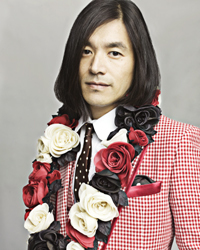
Tomoki SUKEZANE
Born in Kyoto in 1965. Began his career as a fashion editor in the POPEYE editorial department at Magazine House.
He currently directs fashion pages for magazines such as POPEYE, Casa Brutus, MEN'S NON-NO, ENGINE, and GQ,
as well as handling styling for advertisements featuring artists and athletes.
He has been attending the Paris and Milan collections for over 20 years.
Born in 1965 in Kyoto, Japan. He started his career as a fashion editor at POPEYE magazine of Magazine House.
Currently, he is working on various magazines such as POPEYE, Casa BRUTUS (Magazine
House), MEN'S NON NO (SHUEISHA), ENGINE (SHINCHOSHA), GQ (Conde Nast Japan) and
he is setting styling people such as artists and sport players in advertising.
He has been attending to Milan collection and Paris collection for over two decades.
GIORGIO ARMANI JAPAN
Tel. 03-6274-7070