Yasuhiro Mihara | Japanese Craftsmanship: The 6th Installment: MIHARAYASUHIRO x KANETA ORIMONO x CENTO COSE
MIHARAYASUHIRO | Yasuhito Mihara
Part 6: MIHARAYASUHIRO × KANETA ORIMONO × CENTO COSE (1)
Fashion designer Yasuhito Mihara visits Japan's proud factories and artisans for "MEANING MADE IN JAPAN MIHARAYASUHIRO," or "MMM," a groundbreaking series that creates new things only possible in Japan. Cotton weaving is a popular fabric for clothing. Mihara visited a weaving factory in the Enshu region of Shizuoka Prefecture, one of Japan's leading cotton textile production areas, and encountered fabrics that set themselves apart from ordinary textiles, fabrics that could only be made in Japan.
Photos by jamandfixComposition and text by Yasuhiro Takeishi (City Lights)

Enshu, Kakegawa: A Global Hub for Cotton Textiles
Did you know that the textile industry was once one of Japan's most important core industries? "MADE IN JAPAN" yarns and fabrics, renowned for their high quality worldwide, were exported in large quantities to Europe and America after the war, becoming a driving force behind the high economic growth of the 1950s and '60s. Supporting this textile industry were production centers for weaving, knitting, and spinning across the country. Kaneta Ori-mono, which Mihara visited this time, is located in Enshu, Kakegawa, an area famous for its textile production.
Enshu is an old name for the western part of Shizuoka Prefecture, located between the Oi River and Lake Hamana, and was called Totomi Province during the Ritsuryo period. Its warm climate year-round fostered the development of cotton cultivation and weaving from ancient times. Furthermore, leveraging the geographical advantage of abundant rivers like the Oi and Tenryu River, which were ideal for transportation by boat, it became known nationwide for high-quality cotton textiles such as "Enshu-jima" from the mid-Edo period to the Meiji era. Its prosperity continued through the period of high economic growth, and Kaneta Ori-mono was founded in Kakegawa in 1957, right in the midst of it. The company is currently managed by the third-generation president, Minoru Ota.
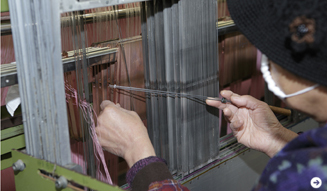
The process of threading warp yarns one by one
MiharaThat's nostalgic. It's the he-otoshi, warp threading process, isn't it?
OtaYou know it well. Do you visit weaving factories often?
MiharaI'm a factory enthusiast, so I visit them often (laughs). I originally studied textile design at Tama Art University. So, I used to do this kind of work when I was a student.
OtaIs that so? There might not be many designers with your level of experience.
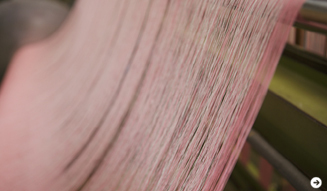
Warp threading is the process of attaching warp yarns to the loom. Artisans must attach each thread by hand, and some looms have over 5,000 threads. It's a painstaking and demanding task, but a skilled artisan can attach about 3,000 threads a day. Mihara, impressed by such craftsmanship, was then guided by Ota to the weaving floor where the looms were in operation.
The Value of Shuttle Looms Still in Operation Today
MiharaThere are many old shuttle looms here.
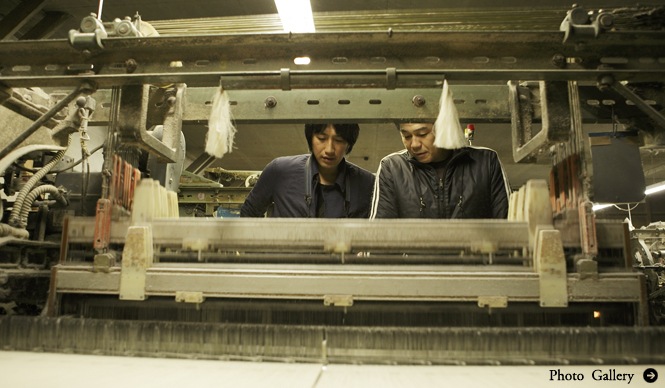
OtaThey are all shuttle dobby looms manufactured in 1973, and we currently have 25 in operation.
MiharaHow much can they weave per day?
OtaAbout 50 meters. The latest high-speed looms weave about three times that, so the efficiency isn't great. However, shuttle looms weave without putting excessive tension on the warp yarns, resulting in fabric that is dense yet has a unique, soft texture. Since they are old machines, they require constant maintenance. A dedicated technician with over 50 years of experience performs maintenance work without fail.
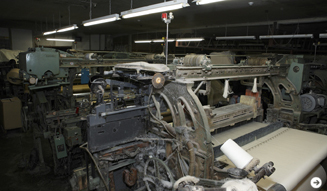
MiharaI secretly touched the warp yarns earlier (laughs), and they don't have the tension of high-speed looms, so it seems like it would produce fabric with a nice texture. But this is the first time I've seen a factory with so many shuttle looms. Please show me the fabric woven on these looms.
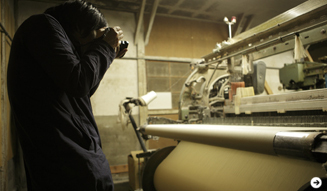
Mihara observed the rare shuttle looms being operated and maintained by dedicated technicians. Since the manufacturers of shuttle looms no longer exist, the company acquires used looms from closed factories for parts or makes replacement parts themselves to maintain them. However, upon seeing the fabric woven on these looms, Mihara became convinced of their value.
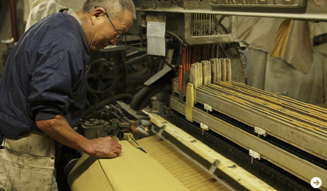
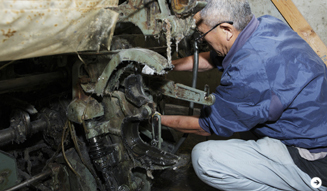
A craftsman performing maintenance on a shuttle loom

MIHARAYASUHIRO | Yasuhito Mihara
Part 6: MIHARAYASUHIRO × KANETA ORIMONO × CENTO COSE (2)
Fashion designer Yasuhito Mihara visits Japan's proud factories and artisans for "MEANING MADE IN JAPAN MIHARAYASUHIRO," or "MMM," a groundbreaking series that creates new things only possible in Japan. Mihara experienced Kaneta Ori-mono's rare shuttle looms and their unique original fabrics. His conversation with third-generation president Ota delves into the manufacturing of Enshu, which is also attracting global attention, and the issues facing the region.
Photos by jamandfixComposition and text by Yasuhiro Takeishi (City Lights)
The Appeal of Unique Original Fabrics
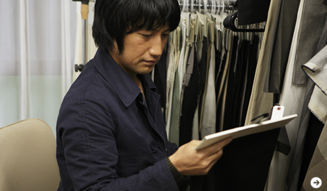
After touring the factory, Mihara began examining samples of fabrics woven by Kaneta Ori-mono. Mihara had used the company's fabrics in his collections several times before, but the samples before him were of a higher quality than anything he had seen previously.
MiharaThese all have such unique textures and expressions. By the way, are these samples original?
OtaYes. We started creating original fabrics about 10 years ago. Before that, we were mainly doing commission work (receiving raw materials from fabric wholesalers and weaving fabrics according to specifications for a fee). Even so, the 1950s and '60s were called the "Gachaman Era," a prosperous time when it was said that each time the loom went "gachan," you'd earn 10,000 yen. However, due to the influence of inexpensive Chinese textiles, textile factories in Enshu have been in decline in recent years. The global recession has had a particularly significant impact, and the number of textile factories, which was about 500 ten years ago, has now decreased to less than 100. To survive in this situation, I realized that developing original fabrics was the only way.
MiharaI knew that Enshu fabrics were high quality, but I've actually heard more about their reputation overseas than domestically. There's a gap between that reputation and the current decline. Italy and Germany no longer have good looms, and China's textile history is too short to produce fabrics with good texture. In Italy, the samples can be completely different from the finished fabric (laughs). Cotton textiles, in particular, are of much higher quality in Japan, and many high-end brands overseas use them, don't they? But right now, the speed of decline is outpacing the speed of promotion.
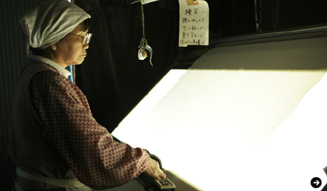
The inspection process, checking each bolt of woven fabric
The Capabilities of Japanese Textile Factories That Compete Globally
OtaThat's right. Our original fabrics have been adopted by overseas luxury brands. I can't disclose the brand names due to confidentiality agreements (laughs). However, Enshu has many subcontracting commission jobs, so the region's name recognition is still low. In that sense, I believe it's necessary to develop original fabrics and promote them more actively at trade shows, both domestically and internationally.
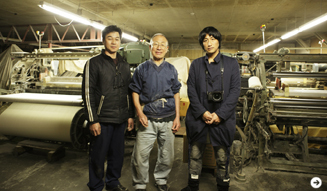
From right: Mihara, Mr. Gi Suzuki (a craftsman with 50 years of experience), and Ota
MiharaExactly. Japanese designers, in general, underestimate Japanese fabrics. They tend to focus on fabrics from Italy and other countries due to a peculiar fascination with foreign goods. However, by promoting the fact that these fabrics are used by overseas brands, we can not only halt the decline of Enshu but also help solve the succession problem faced by many factories and artisans in Japan. Currently, due to the recession, there is an abundance of labor, but young people won't move without a dream. The idea of their own fabric being used in an overseas brand's collection could be a big dream for them.
Having discussed the future of manufacturing in Enshu, Mihara carefully selected Kaneta Ori-mono's original fabrics developed by Ota. This was also for the Kakegawa select shop "CENTO COSE," another objective of this visit.
MIHARAYASUHIRO | Yasuhito Mihara
Part 6: MIHARAYASUHIRO × KANETA ORIMONO × CENTO COSE (3)
Fashion designer Yasuhito Mihara visits Japan's proud factories and artisans for "MEANING MADE IN JAPAN MIHARAYASUHIRO," or "MMM," a groundbreaking series that creates new things only possible in Japan. The day after visiting the Enshu textile factory Kaneta Ori-mono, Mihara headed to the select shop "CENTO COSE" in Kakegawa to participate in a talk show. The three individuals involved in creation discuss Japanese manufacturing from their respective standpoints.
Photos by jamandfixComposition and text by Yasuhiro Takeishi (City Lights)
A Conversation Across Industries Realized in Kakegawa
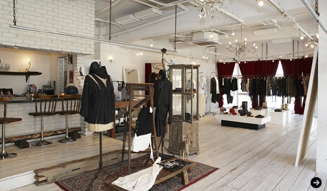
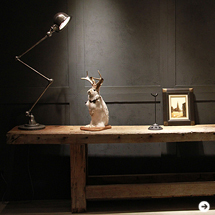
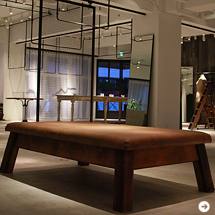
Inside "CENTO COSE." The latest collection from MIHARAYASUHIRO is displayed for the talk show.
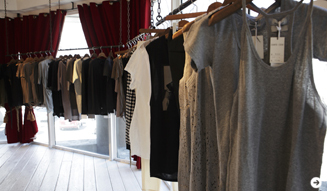
"CENTO COSE" is located near JR Kakegawa Station and is the premier select shop in Enshu, with stores in Hamamatsu and Kakegawa. Since its opening, it has consistently carried Mihara's brand "MIHARAYASUHIRO" and is celebrating its 10th anniversary this year. The special talk show, planned to commemorate this milestone, features Mihara, Kaneta Ori-mono's Ota, and CENTO COSE's store manager, Yasuhiro Isobe. The previous day, Mihara and Isobe visited Kaneta Ori-mono and learned about their advanced technology and the current situation in Enshu. This valuable dialogue among three individuals from different perspectives—designer, manufacturer, and retailer—discussing Enshu textiles and Japanese manufacturing aligns perfectly with the purpose of this series, and a portion is excerpted here for publication.
IsobeMr. Ota, thank you for showing us the factory yesterday. It was my first time, and it was a very valuable experience.
OtaNot at all. But it was the first time an outsider stayed in the factory for such a long time (laughs). The staff were nervous, but I was struck by how happily Mihara was taking photos.
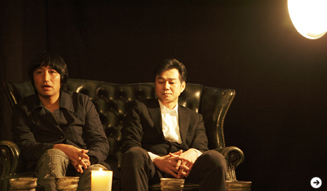
MiharaYour factory, Mr. Ota, is fascinating with its collection of very old shuttle looms still in operation. The weaving speed is slow, but the motors were also old, so the yarns don't get tensioned, allowing for the creation of fabric with a unique texture.
OtaYou noticed all that? (laughs)
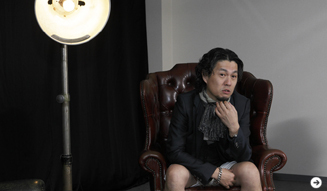
Mr. Isobe, President of CENTO COSE
MiharaActually, I secretly touched the reed (osa/a comb-like part that beats the weft yarns) when it came down (laughs), and the torque wasn't too strong, so it didn't hurt. I felt that this wouldn't put stress on the yarns. After the high economic growth period, Japanese weaving mills introduced high-speed looms from Germany and other countries, eventually weaving fabrics at high speed and in large quantities with computer-controlled looms. But this was the first factory I'd seen in a long time without a single computer in sight.
OtaI'm embarrassed (laughs).
MiharaNo, no (laughs). But I think factories like Kaneta Ori-mono are very valuable globally. They are decreasing because they don't make economic sense, and it's a miracle that so many still remain. That's why I had so much fun yesterday. It was the most low-tech weaving factory I've ever seen.
OtaThank you. The fact that you were so interested and observed the details makes me realize you are truly a professional designer.
IsobeIn my line of work, I meet and talk with foreign designers, and they all know about Shizuoka. They say, 'Isn't that the place famous for cotton and Mt. Fuji?' It seems they use a lot of Enshu fabrics. They say fabrics from Italy and other countries are soft and have a good texture, but lack durability. In contrast, Japanese fabrics are flexible and have good texture, as well as high durability. Since hearing these things, I've been able to say things like, 'This is a Shizuoka fabric, isn't it?' at overseas exhibitions. When they reply, 'Yes, it is,' I feel compelled to place an order (laughs). Cotton is often associated with 'cheap,' but the fabrics you make, Mr. Ota, are like silk. I believe that's a testament to the old looms and high technology.
The Significance of an Unprecedented Connection Between Three Parties
MiharaIn that sense, I think Japanese designers are fortunate. They can choose from high-quality fabrics domestically. In Japan, if the fabric you want doesn't exist, you have to order it from a factory, but the fabrics proposed by fabric suppliers are also reliable. Another great thing about Japan is that standard fabrics are kept in stock. This is basically non-existent in Europe.
OtaHowever, there are very few opportunities for designers and people like us at factories to talk directly. I believe that if we could create more points of contact, we could produce better fabrics with a more focused approach.
IsobeWhen you develop original fabrics, Mr. Ota, do you have a specific product in mind? For example, 'I want this fabric to be used for a coat.'
OtaYes, I do. I have a vague image of clothes I'd like to wear myself, and from that, I consider the yarn count, weave structure, and density. In that sense, I think it would be better to be closer to the designers.
IsobeThe quality of fabrics and materials is a major factor when buying. For me, I often look at it from the perspective of the wearer, considering things like how it feels to the touch, whether it shrinks or fades. Therefore, the experience of seeing the fabric production process is invaluable and will be a future asset. Above all, it was a great discovery to have a master like Mr. Ota so close by. It's rare for retailers and manufacturers to connect.
OtaNot at all. But it's the same for us. We rarely get to see the finished products made from the fabrics we create. The fact that it's available locally is very significant. What I feel when I see the finished products in stores will surely be reflected in the next fabric I create.
MiharaIndeed, these points of contact are very important. Designers should visit production areas like Enshu more often. I always think that we must meet and talk directly with the people who make the materials. The more time we spend doing that, the better things we can create. There are no downsides, and I feel the necessity for this is increasing. However, the biggest problem is still the succession of craftspeople. The artisans I met yesterday were all in their 60s and 70s. This is not just an issue for weaving, but also for shoe and sewing factories. The challenge is how to revitalize the entire industry.
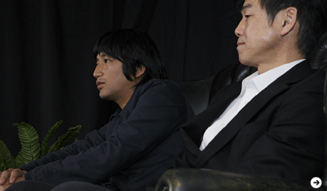
Mr. Ota, President of Kaneta Ori-mono
IsobeThe retail industry I'm involved in has a glamorous image, and young people often say, 'Please let me work here.' How about your factory, Mr. Ota?
OtaActually, I do occasionally get inquiries from young people. They say, 'I love weaving and want to work in the field,' and some even approach me from outside the prefecture. For now, I've had to turn them down because I don't have the capacity.
MiharaThat's not good! (laughs)
OtaYou're right (laughs). But times are changing, and I've recently felt that young people are starting to re-evaluate craftsmanship.
MIHARAYASUHIRO | Yasuhito Mihara
Part 6: MIHARAYASUHIRO × KANETA ORIMONO × CENTO COSE (4)
Fashion designer Yasuhito Mihara visits Japan's proud factories and artisans for "MEANING MADE IN JAPAN MIHARAYASUHIRO," or "MMM," a groundbreaking series that creates new things only possible in Japan. The "CENTO COSE" 10th-anniversary talk show, where three individuals from different perspectives—designer, manufacturer, and retailer—discuss Japanese creation in front of local Kakegawa customers. For the customers who enjoyed the passionate discussion of the three, a special gift, truly made only in Japan, was prepared.
Photos by jamandfixComposition and text by Yasuhiro Takeishi (City Lights)
Issues Facing Japanese Factories
IsobeChanging the subject, are brands reluctant to disclose information about where their materials are made? For example, putting 'MADE IN KAKEGAWA, JAPAN' on the fabric. You know how produce nowadays has producer information, like 'Made by Mr. XX.'
MiharaI've thought about it, but it's quite difficult to put on a product, so I've never actually tried to do it.
IsobeWith such labeling, I want young people to know that there are people like Mr. Ota in Japan and to become interested in this kind of work. Otherwise, I fear that in 10 or 20 years, the skills will be lost.
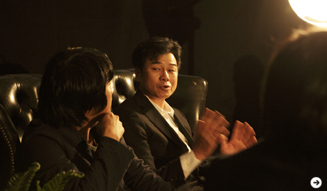
MiharaExactly. The "MMM" series in O.P.E.N. is precisely a project to make the world aware of this. Japan's production areas are still largely unknown to consumers. Japan has many excellent production areas, but they all face the same problems. We have truly wonderful production capabilities remaining, but they are all like the last flicker of a candle about to go out. How can we convey this and gain understanding? And how can we get young people interested? For me, these activities are a lifeline.
If things continue like this, in 30 years, we'll have to produce everything in China. The reason I established a shoe factory last year is partly to train young artisans. We can't expect politicians to do this. For example, if you ask a politician which is better, Japanese socks or Italian socks, they'll definitely say Italian. There are no politicians who understand the difference, are there? That's why we need to make the industry more accessible for young people ourselves.
IsobeDo you have similar concerns, Mr. Ota?
OtaYes, I do. Perhaps it was a mistake to turn down those young people (laughs).
MiharaBut if they don't give up after being rejected once and inquire again, it shows their motivation. I think young people today give up too easily. Is it the influence of 'yutori kyoiku' (relaxed education)? (laughs)
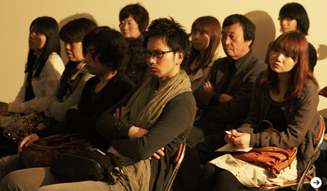
Kakegawa customers gathered for the talk show, listening intently to the conversation of the three.
IsobePerhaps there's a gap between ideals and reality. Once they start working, it might be tougher than they imagined, and they quit.
MiharaThat's also true. I've introduced young people to shoe factories I know, but about 8 out of 10 quit. I myself didn't have any ideals to begin with (laughs). After all, my generation entered society after the bubble burst, so we couldn't afford to have ideals. In that sense, I think the current situation is similar. Today's younger generation has only known recession since they were children, so they must be mentally quite strong. A primary school teacher told me that when asked 'What is the opposite of a dream?', children today answer 'reality.' It should really be 'despair,' but they have to mark 'reality' as correct (laughs). But that shows how bad the image of dreams and reality has become. Dreams aren't something that just fall into your lap; we live in an era where we have to 'self-generate' our dreams.
Continuing to Create What Can Only Be Made in Japan
IsobeThat's certainly true. By the way, Mr. Ota, did you train at other companies when you were younger?
OtaNo, I don't have that kind of experience. But now that I'm out in the world, perhaps this is my training.
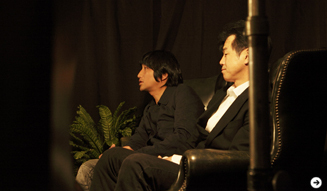
MiharaBut what you're doing now, Mr. Ota, is incredible. A weaving factory planning its own fabrics and selling them directly, bypassing wholesalers. Japan has a rigid distribution system, so this is not easy to do. I believe further development will come from this. It provides a foundation for young people to move freely and express themselves when they join. This was unthinkable before.
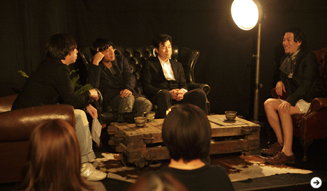
IsobeWhen we source imported brands, we also go through trading companies. In that sense, Japan has too many intermediaries. When you go overseas, you're shocked by the price differences. Because of this system in Japan, people in each end of the industry don't get to know each other. It's rare for people on the sales floor to visit factories, and vice versa. This is important, and it's something that should have been done.
MiharaHowever, we are starting to be able to do it. The issue of succession must be resolved urgently. I don't think it's enough for us just to plan, produce, and sell anymore. We want to continue doing this, don't we? People like me in the brand business have the option of producing overseas if production in Japan becomes impossible, but I still want Japan to remain a country that can produce high-quality goods that are second to none. I want to make it a country that can create wonderful things, like the fabrics made in Mr. Ota's factory that I saw yesterday, where you can feel the human touch.
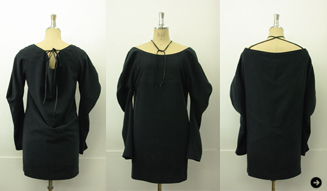
Thus concluded the 10th-anniversary talk show at "CENTO COSE." The show, which lasted over two hours, covered everything from Japan's unique high technical capabilities, which are attracting global attention, to its problems. It was a lively event in front of numerous local Kakegawa customers. The three participants in the talk show had actually planned a special item the day before. Based on items from the "MIHARAYASUHIRO" 2010 Autumn/Winter collection, a limited edition collaboration model for the "CENTO COSE" 10th anniversary was created, tailored with original fabrics from Kaneta Ori-mono chosen by Mihara and Isobe. The fabric is a smooth cotton-cashmere blend developed by Ota, and the items are men's pants and a women's dress. These are truly world-class garments that embody the essence of Japanese creation.
CENTO COSE Kakegawa Store
2-7-1 Minami, Kakegawa City, Shizuoka Prefecture
Nakamura Bldg. 2F
Tel. 0537-21-6501
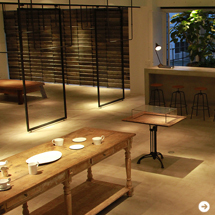
The interior of "CENTO COSE," renovated for its 10th anniversary.