November 23, 2016
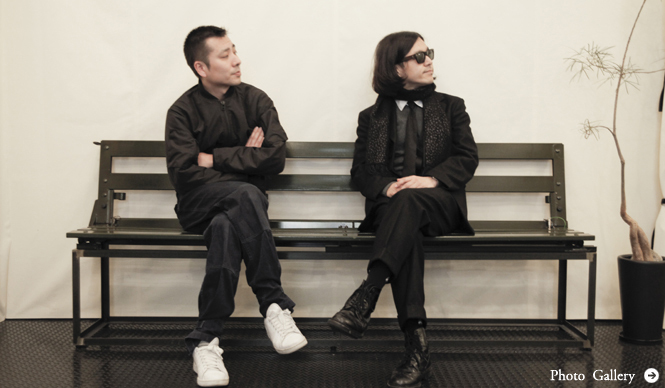
Tomoki Yuzuka | In conversation with Daisuke Obana, designer of N.HOOLYWOOD!
Tomoki SUKEZANE
New Series: "On Location: Craftsmanship"
Episode 2 Guest: N.HOOLYWOOD Designer Daisuke Obana
Tomoki Club's new series, "On Location: Craftsmanship." Featuring designers, artisans, shop owners, chefs, and more—fashion director Tomoki Sukezane interviews the people he wants to meet. For our second guest, we welcome Daisuke Obana, designer of N.HOOLYWOOD!
Interview & Text by Tomoki SUKEZANEPhoto by Takahiro IGARASHI
N.HOOLYWOOD Decides to Stage Shows in New York
We spoke with Daisuke Obana about his reasons for the decision and his future creative process.
SukezaneTo start, this season is all about the military, 100 percent. That's quite a bold move.
ObanaIt is (laughs). Well, anyone who's known me for a long time probably understands my deep love for military wear.
SukezaneHmm, I see. And,this collectionyou're taking a break from Tokyo Fashion Week, is that right?
ObanaA few weeks before the show, I impulsively decided I wanted to go to America. After about two days of not sleeping, everything just clicked into place for me. For someone as cautious as I am, always checking the bridge before crossing it, and then checking it again, this was an unprecedented decision.
SukezaneAh, so that's why you're moving to America next...
ObanaI've only shown in Paris for six seasons, butthe "COMPILE" dress suit lineI've been presenting the "COMPILE" dress suit line, and it's true that I was reaching a limit in various ways. I remember you saying when we were drinking in Paris, 'Isn't it time you expressed yourself differently? For Paris too?' I felt that very strongly myself. Presenting large collections four times a year, twice in Tokyo and twice in Paris, might become unsustainable in terms of time and creative energy.
I felt I was reaching a limit.
SukezaneThat's tough.
ObanaI considered showing in Paris, but I just couldn't envision it for my brand.
Initially, the dress line here was presented by hanging pieces on a rack for individual viewing,
and while we improved it over time, I felt we were deviating slightly from my original vision. I was starting to feel that.
SukezaneI see.
ObanaAll these factors contributed to my decision to move to America. In fact, I had already sketched out about half of the Paris collection.
SukezaneFor the January collection, I really felt like a runway show was possible, and the theme was moving towards something more mature, wasn't it?
ObanaYes. I found that very interesting myself. So, I thought that by pausing the Paris and Tokyo shows and consolidating in NY, I could create something with more depth. By combining what I learned in Paris with the essence of what I do in Japan, and focusing on one theme twice a year, I believe I can create something more profound.
SukezaneYes. That's a great idea. So, NY.
ObanaYes. So I thought, 'Let's do it somewhere I like.' In Paris, I meticulously planned my strategy to sell and promote my brand, but within that meticulousness, I couldn't envision the next step. It wasn't wrong, but it was too safe, lacking any spontaneity. As you said, 'Isn't there something different?'
SukezaneI see. I've been attending NY Collections for the past two to three years because I found Paris and Milan a bit uninspiring. I've been going to Milan and Paris for about 20 years, but when I went to NY, I felt a sense of freedom among the people showing there. In Milan and Paris, I felt an atmosphere where you couldn't do anything interesting without the backing of major houses, which I found rather dull.
ObanaI see.
SukezaneHowever, what I feel in NY is that ultimately, if Paris doesn't have talented people, the fashion industry as a whole won't be interesting. Paris acts as a balance, you know? If the most talented people in Paris don't do something, this industry won't move. That's what I thought. And that doesn't necessarily mean it has to be from Paris itself.
ObanaThat's true.
SukezaneParis has the best environment for creators.
ObanaI originally came from a vintage clothing background in America, and before going to Paris, I used to research NY Collections. About five years ago. But I got tired of the sheer sloppiness of it all. The construction was terrible, the presentation was awful, and I thought, 'NY is not for me,' so I went to Paris. However, after quite some time, as I gained more perspective, I started to see that roughness in a positive light. I do love American things, after all. Before going to Paris, I was simply thinking, 'Let's aim higher.' But now, when I look at mass retailers I used to love, like 'Target,' 'J.C. Penney,' and 'Sears,' I feel incredibly motivated. Of course, I want to aim high with my collection pieces. But I also genuinely want to create clothes that could be sold at 'Target,' and if I could achieve that, it would be amazing.
SukezaneI think that's amazing. Truly amazing.
ObanaIt's incredibly difficult in practice, though.
SukezaneWhen I spoke with Hedi Slimane in NY years ago, he said, 'America is about uniforms.'
ObanaAh.
Sukezane'America should make uniforms,' he said. 'And Italy is macho, so they should show skin.' And he always said, 'Paris is the most difficult.' I listened, thinking, 'Maybe he's right,' and indeed, America is about uniforms. But being able to create that is, in a way, like an invention, isn't it?
ObanaThat might be true.
SukezaneReaching everyone, you know?
ObanaThat's a bit different from 'appealing to everyone' in Japan today.
SukezaneIf the only reason is 'affordability,' that's a bit tough.
ObanaIn America, for example, are products supplied to the military based on technical capability, or is there some other idea behind it?
SukezaneLike military T-shirts, things that were truly functional have permeated into the wider market, right? There's something interesting about that in American products.
ObanaExactly.
SukezaneI'm looking forward to NY.
ObanaI have so many dreams, but right now, it's completely unplanned (laughs).
SukezaneWell, you can't do anything without dreams first. So, it's fine, isn't it?
The Final Tokyo Collection: An All-Out Military Parade
A Lineup Showcasing Daisuke Obana's True Strengths
SukezaneSo, for this Tokyo Collection, was it a case of 'Let's just do military since it's the last one'? Did the decision to move to NY have no impact onthis collection?
ObanaThe collection itself was developed without any consideration for that.
SukezaneSo it wasn't a 'let's do this because it's the last one' situation.
ObanaNo, it wasn't. We intended to create something like this from the beginning. The reason I decided to do a 'military' show this time is that as we reached our 10th anniversary, I felt it was a good time to be more honest with myself. To do what I do best.
SukezaneI see, I see.
ObanaAnd among that, I focused on the Vietnam War, which is often considered a taboo subject. While wars like WWI and WWII, or the Civil War shown in Paris, can be viewed as 'apparel' without delving too deeply into their essence, the Vietnam War, perhaps due to its proximity in time, doesn't offer many positive aspects to consider. Therefore, I believe a straightforward approach like this hasn't been done before.
SukezaneYes.
ObanaAmerica, within ten years of the Vietnam War ending, produced films like 'Apocalypse Now,' which were such realistic documentaries of the war. I've always felt that was remarkable. And I thought that perhaps, as Mr. Hollywood, it might be my role to create and present clothing as if I were an American during that era.
SukezaneYou like military wear, and that's why.
ObanaYes. Also, I was interested in the gear from the Vietnam War. I felt I had seen a lot regarding apparel, so
I wanted to express it.
I wanted to convey a direct sense of strength, so for the show's casting, I street-casted almost exclusively individuals with American backgrounds.
For the runway production, we received technical assistance from the Self-Defense Forces, who helped us build sandbag barricades.
SukezaneWow, that's an interesting approach.
ObanaNormally, in fashion, we think of military wear as something to be worn in urban settings. I felt that contradicted the theme I wanted to convey this time, so I deliberately incorporated
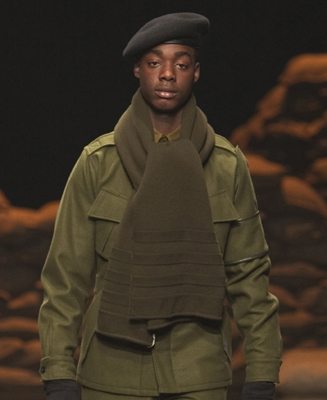
the way berets are worn and how boots are laced, according to military definitions.
Of course, the clothes themselves are not actual military issue, but I designed them with the idea of 'what if I were supplying to the military?'
You know, Tomoki-san, when you go to a store that sells authentic military items, you might feel, 'This is military wear, but it might actually look good on me.'
I hope customers will pick up items with that kind of feeling when they see them in stores.
I'm not thinking about people wearing the entire look.
I think people are drawn to these looks because they represent a certain past. Of course, military enthusiasts might 'arm themselves' with the full ensemble. But for me, having people engage with the clothing in that way holds significant meaning.
SukezaneI see.
ObanaIt feels like this season, with all these elements converging, was the one where I was able to convey what I wanted to say most effectively.
SukezaneSo, when you go to the store, it will be like this season's theme? Like an army surplus store?
ObanaIt will be (laughs). But if you look at it calmly, I don't think it looks entirely like an army surplus store.
SukezaneAh. Well, it's like, 'This is also an option.'
ObanaThe theme this time is "Coverage," meaning "reporting." During the Vietnam War, civilian photographers and television cameras were introduced, and the war situation was reported to mainland America and the rest of the world in a completely new way. Because of that, this war, which was expected to last much longer, is said to have been shortened by ten years due to media coverage. Ten years... that's incredible.
SukezaneHmm.
ObanaEven now, we can see images of wars and conflicts worldwide on television, but the Vietnam War was the precursor to that. What I wanted to convey most was that the end of this war was "peace brought about by reporting." I believe both the soldiers fighting on the ground and those watching the news in America thought, 'This needs to end soon, and we need peace.' That's what I wanted to focus on. Therefore, as the show progressed, the outfits became more disheveled, deviating from military discipline. I wanted to express anti-war sentiment through that.
SukezaneI see.
ObanaI also drew inspiration from veterans who participated in anti-war movements. The idea that declining morale influences fashion.
Sukezane'Born on the Fourth of July,' 'Rambo'... 'Rambo' is different, though?
Obana'Rambo' is also like that.
SukezaneI see.
ObanaSo, initially, the military wear was neatly pressed, but in the latter half, it featured graffiti and washing... As a side note, the Vietnam War was also the first war where Black soldiers fought as equals to white soldiers, so I included Black models.
SukezaneYes.
ObanaIt's conceivable that friendships transcended racial lines between Black and white soldiers. You can imagine that.
Sukezane'Good Morning, Vietnam,' right? That movie is great too. Oh, have you seen 'Tropic Thunder'? It's not set in Vietnam, though.
ObanaNo, I haven't seen it.
Sukezane'Tropic Thunder' is a comedy starring Ben Stiller. It's a perfect parody of 'Apocalypse Now' and is incredibly funny.
ObanaIs it one of those comedies that comes out two or three years after the original film (laughs)?
SukezaneNo, but the cast is serious. Robert Downey Jr. plays a Black character perfectly. It's a wild premise, isn't it? It mocks the dedication of actors, and he's in the jungle saying to a Black person, 'Don't mock Black people!' while having his face painted black (laughs).
ObanaWow (laughs).
SukezaneSorry, I've gone way off topic (laughs).
ObanaNo, no.
SukezaneI really love 'Tropic Thunder.' Also 'Apocalypse Now,' 'Good Morning, Vietnam,' 'Born on the Fourth of July,' 'Fandango'... that's about all the Vietnam-related films I know. But there are more, aren't there?
ObanaYes. 'Full Metal Jacket,' 'MASH'... As I delved into these, various political issues became intertwined, and I thought, 'How should I approach this?' Then I decided, 'Let's just do something real.' I wanted everything associated with the show—the models, the set—to be authentic. But for the clothes themselves, I wanted to express a 'reality' that encompassed not only the actual battlefield but also the feelings of those watching the news back home and the veterans who joined the anti-war movement.
SukezaneI see.
ObanaAnother important theme is "gear." During the Vietnam War era, various organizations conducted extensive research and produced a vast amount of gear. However, much of it was not actually mil-spec (military specification), and some items were so complex that you needed an instruction manual to use them.
SukezaneHmm.
ObanaSince many items were created based solely on data, there were also many 'discarded items' that were unusable in Vietnam due to the extreme heat. I wanted to incorporate those aspects into the details.
I wanted to reflect that in the details.
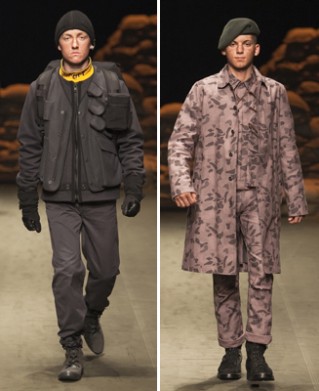
For example, pockets whose purpose is unclear, or an abundance of superfluous details.
SukezaneLike these? (Top left photo)
ObanaThese are usable. There were also actual life-saving devices. For example, items used by SEALs. There are things where pulling a lever inflates a buoyancy device, allowing you to float on the water. Many items were difficult to understand when viewed individually, so I wanted to transform them into fashion details.
SukezaneI see.
ObanaThis one (top right photo) would suit you, Tomoki-san.
SukezaneThis one?
ObanaThe whole outfit (laughs).
SukezaneOh, that's difficult. I don't think I'd suit a battlefield, but maybe a kitchen... Ah, this person looks like they're in charge of the kitchen (right photo). They look kind of cute.
The Brand's Pride Shines Through Meticulously Crafted Details
Fascinating Behind-the-Scenes Stories of Details
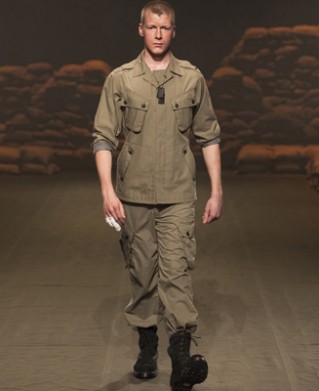
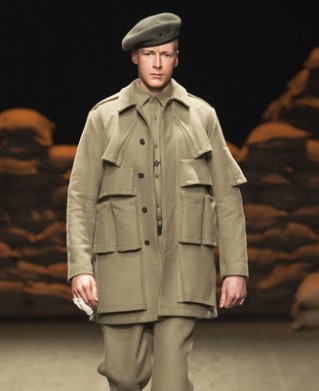
ObanashowThe first look in the show is a "Tropical Fatigue" set (right photo).
SukezaneWhat is "Tropical Fatigue"?
ObanaFatigue means work clothes or labor clothes. So, "Tropical Fatigue" refers to lightweight field uniforms used in tropical rainforests. It's inspired by an early set of parachute troop uniforms, and it's somewhat similar to that.
SukezaneOh, wow. The pocket placement is cute. And this?
ObanaThis is the shape of the flap on actual field uniforms... It would take about 20,000 hours to explain (laughs). I've incorporated a lot of details.
Sukezane(Laughs) I see.
ObanaAlso, since it's for autumn and winter, I've double-lined the thin fabric to enhance warmth. I've packed a lot into the less obvious areas.
SukezaneAnd this part here, it's V-shaped...
ObanaYes, there's a placket.
SukezaneRight? That's really nice.
ObanaWind seals. This was a feature found in early models of the tropical fatigue jumper, but it turned out to be impractical, so it was omitted in later versions.
SukezaneHmm. Did they think it was useful for something at first?
ObanaEssentially, it acts as a windbreak. To block the wind.
SukezaneHmm. That's nice. And this model looks incredibly authentic.
ObanaYes. He's authentic. From the US Navy.
SukezaneUS Navy.
ObanaAnd his finger wasn't a deliberate staging...
SukezaneHe came like that on the day?
ObanaYes. He suffered a complex fracture when heavy equipment fell on his finger during a mission...
SukezaneHe still came, though.
ObanaHe did. He came.
SukezaneThat's cool.
ObanaIt really is better when real people wear the clothes. You can feel the 'person' coming through.
SukezaneThe sizing wasn't adjusted for them, was it?
ObanaNot intentionally, but ultimately, if I were involved with the military, I'd want to create something that allows for easier movement. It's simple to just make military-style clothes slimmer, but I also find the way military garments naturally drape at the shoulders quite cool. I want to incorporate that coolness into my designs while retaining functionality. And it turns out that it fits real people perfectly.
SukezaneHmm. It fits so perfectly, it looks like it was tailored specifically for him.
ObanaI can't do what Hedi Slimane does (laughs).
SukezaneHahaha. 'I chose the models first' (laughs). I was shocked when I heard that.
ObanaIt's wonderful.
SukezaneHe said the clothes were already done in his head by the time the previous show ended. 'Really?!' (laughs).
ObanaHe creates clothes based on the models he meets. But that kind of honest approach is good, isn't it?
SukezaneWell, there are many ways to do things. But this really fits perfectly.
ObanaYes.
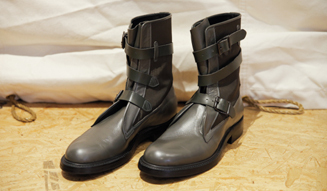
SukezaneI really liked these boots (left photo).
ObanaThank you. Similar boots were actually worn in Vietnam.
SukezaneWere they wearing gray boots like these?
ObanaNot gray, but there were boots with straps around them, and I based these on that concept.
SukezaneThese looked really cool.
ObanaThey come in both gray and black. To convey the initial high morale, I styled them with "sturdy belts."
And in the latter half, I loosened the laces to express the decline in morale.
And in the latter half, I loosened the laces to express the decline in morale.
I expressed the anti-war sentiment.
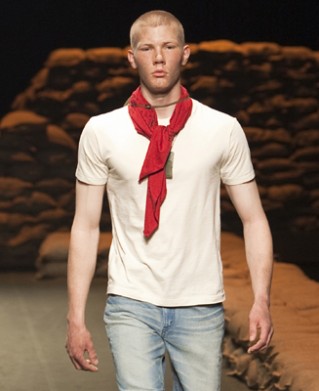
SukezaneI see. This coordination, the scarf (right photo), is cute.
ObanaThank you. I made this from a cashmere towel.
SukezaneA towel?
ObanaI knitted it with loops, like a towel. And it's a very oversized size. I made it the size of a sports towel because soldiers would sweat in Vietnam, right? They must have worn towels around their necks or hung them.
SukezaneIt must have been very humid.
ObanaYes, the humidity is extremely high.
The Movie "Apocalypse Now" Was an Idea Source for This Collection
SukezaneSpeaking of which, I went to Vietnam just once.
ObanaReally?
SukezaneI used to do the catalog for 'TUBE' twice a year for about eight years. Mr. Saito from TUBE said, 'Let's go somewhere with an interesting place name!' (laughs). He seemed to like the sound of 'Saigon.' He said, 'Yuu-chan, let's go to Saigon next.' Saigon is Ho Chi Minh now, isn't it?
ObanaYes.
SukezaneBut 'Ho Chi Minh' sounds a bit weak... I don't know why (laughs). Anyway, we decided, 'Let's go to Saigon!' (laughs). So we went, and I picked up a girl to be a model. This was about 12 or 13 years ago. When we arrived, there was no coordinator, just a rental car. And I was driving, really fast.
ObanaWas Mr. Saito with you?
SukezaneYes, together. And he asked, 'What about models, Yuu-chan?' I said, 'Let's go to a school!' We drove up to a school, and just walked in. There was one person on staff who spoke English well, so I approached them, but the girls we approached looked terrified (laughs).
Obana(Laughs) Yes.
SukezaneThey were probably thinking, 'Who are these guys?' (laughs). The girl I picked up had parents who were teachers and she was very bright. She seemed to like a Japanese girl who was helping out from London at the time, and during the shoot, she gave her an album with photos from her birth to the present, saying, 'Please take this.' She said, 'This is my most precious possession' (laughs). We all told her, 'You shouldn't give something so precious to someone you just met yesterday,' but she said, 'Okay,' and then invited us to her home to meet her family. So we all went (laughs). It was a very proper home, and her parents were teachers. The shoot was completely guerrilla-style, the models were street-cast, we were short on time, and we were in a rush to finish... but when we went to their house and were led into the living room for tea, I suddenly felt the essence of Vietnam. I was moved.
ObanaA "Ulun Stay" experience (laughs).
SukezaneI thought, 'Vietnam is a nice place.'
ObanaI debated whether it was best to actually go to Vietnam for this project. After much thought, I decided against it.
SukezanePeople say various things about military uniforms, don't they? Like, 'The base is Swiss,' or 'Italian military wear is really interesting.' ... In that context, what is the Vietnam War's significance for you, Obana-kun?
ObanaHmm, rather than the Vietnam War itself, I'd say Vietnamese military uniforms are like a fascinating, inexhaustible dictionary for me. For example, World War II or Korean War items, or MA-1 style jackets are easy to understand. But with the wear from the Vietnam era, if you trace each detail, you realize that a single different button means 'this is a test sample.' It's hard to describe, but it's military clothing from an era that, while diametrically opposed to fashion, is brimming with fascinating details.
SukezaneSo, combat uniforms from an era of trial and error?
ObanaYes. Things that could be handled with a single garment today were broken down into various functions back then, and the entire ensemble was necessary. It's also the last era where they were made that way.
SukezaneI see.
ObanaWhen fully equipped, the weight could reach 30 or 40 kilograms. Nowadays, unnecessary elements have been stripped away, and that functional beauty is also good, but back then, carrying everything, even the superfluous items, with a sense of bulkiness, is something unique to that era.
SukezaneA dream for detail enthusiasts.
ObanaYes. But I wonder if it was right to do a fashion show about it (laughs).
SukezaneNo, no, I see. Watching 'Apocalypse Now' vaguely, I never noticed these things.
ObanaRight? But for military enthusiasts, they might pause the movie and say, 'The Colonel is wearing a First model something-or-other,' and so on (laughs). There are many things you can appreciate by pausing.
SukezaneThere's the "Complete" version, right? I saw that in the theater, and what was quite interesting was when the Playmates arrived...
ObanaAh, yes. That really happened too.
SukezaneAnd that surfing sergeant, not Robert Duvall, who was it?
ObanaThat sergeant was real too. Amazing, isn't it?
SukezaneI always wondered why Dennis Hopper carried so many cameras.
ObanaIn the latter half of the show, I reference Dennis Hopper too (laughs).
Sukezane(Laughs) That's interesting. The latter half was very impressive.
ObanaIt was a film structured to clearly show the passage of time.
SukezaneDo you know there's a documentary about the making of that film? A documentary about Coppola's struggles. It covers all the difficulties they faced. It's fascinating.
ObanaI'd like to see it.
SukezaneWhen Coppola asked Marlon Brando to take the role, the contract included a clause about losing 20 kilograms, or something like that. Brando promised to lose a lot of weight before filming began and come to Vietnam. So, Coppola agreed. Then, he went to pick him up at the airport. The moment they met, Coppola froze. He was like, 'You haven't lost any weight!' (laughs).
Obana(Laughs) The filming time was also very limited, wasn't it?
SukezaneYes, it seems they had a lot of difficulties. But Marlon Brando is amazing, isn't he? (laughs).
ObanaHe must be.
SukezaneNo one could say anything to him, right?
ObanaHe's turned down all sorts of awards, like the Academy Awards. Like Johnny Depp.
SukezaneOh, really? But he's a great actor.
ObanaYes.
SukezaneHis role in 'The Godfather' is too strong, though.
ObanaAh, truly.
SukezaneHe was interesting when he was young, but 'The Godfather' is a great story.
ObanaWhen I'm explaining my ideas to the younger staff at my company, or teaching them something, I sometimes quote lines from 'The Godfather' (laughs).
SukezaneReally (laughs)? At the company?
ObanaYes, at the company (laughs). Like when Marlon Brando tells Pacino, 'A liar is always...' He says things that are truly logical.
SukezaneHe can say that! It's very easy to understand. Like, 'The person who comes to tattle is...'?
ObanaYes, yes, yes, yes. If I said that, everyone would be killed (laughs).
Sukezane(Laughs) But you understand, right? Like, 'That happens...'
ObanaI don't kill anyone, though (laughs).
SukezaneHahaha. So, this camouflage pattern (left photo), is it faithfully reproduced from something?
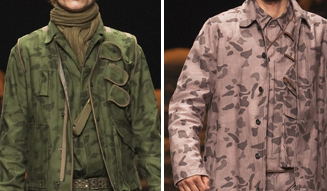
ObanaActually, I made a lot of camouflage patterns at first. But I thought it would be counterproductive to have a fake camouflage pattern when I was trying to be so serious about this. So, I thought, 'What else?' And I remembered the "Duck Hunter" camouflage from the Vietnam War, also known as "Beo Gam."
It was introduced around '65 and wasn't used for long, so it's a rare item. I own one myself.
I've incorporated graphics into the pattern, but I've kept the pattern itself as faithful as possible. I used five colors, more than the original, but I deliberately chose colors that would appear flat.
I combined them.
By doing so, I thought it would be interesting if it leaned more towards a textile rather than just camouflage. So I made various versions.
SukezaneI see.
ObanaThis is the finished product.
SukezaneIt doesn't really look like camouflage. It looks like a 'pattern.'
ObanaI'd be happy if it came to be seen as just a pattern.
SukezaneIt does look like a single pattern. Especially this one (right photo).
ObanaBut I actually extracted the colors from actual military colors.
SukezaneYou're very detailed. There are so many stories.
ObanaFor seniors like you who are interested in such details, I always prepare something that can answer those questions (laughs).
Endless Stories About Military Functionality...
And Finally, a Glimpse into the Future in New York
SukezaneAnd these accessories (right photo)... they look a bit like angels.
ObanaGrenade pins. In other words, the pins from hand grenades. In Vietnam, there were two types of grenades used, the "Pineapple" and the "Apple," each with its own specific pin. Soldiers would apparently wear them on their helmets, one for each grenade they threw. It's a kind of fashion coordination born on the battlefield... I created this by referencing that.
SukezaneThey were called Pineapple and Apple grenades?
ObanaYes.
SukezanePineapple makes sense, it looks like a pineapple.
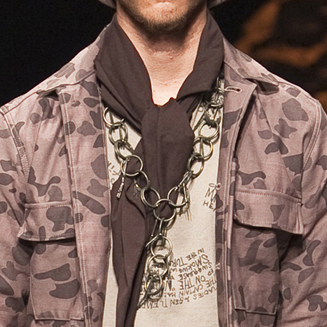
ObanaIt's a bit bumpy, right? The Apple was rounder and smoother. Those were the two main types. The Pineapple had higher lethality. The Apple just exploded with a 'boom.'
SukezaneYou know a lot (laughs).
ObanaIf I talk too much, I'll just sound like a dangerous person (laughs).
SukezaneBut it's interesting.
ObanaIt is interesting. I hope this can be an opportunity to share that interesting aspect.
SukezaneTalking about military items is interesting... And this (bottom photo), it's cute too, simple.
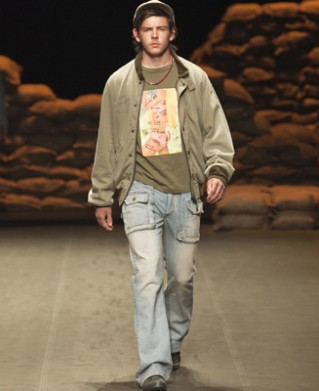
ObanaIn reality, rather than wearing all of this, just a T-shirt, suspenders for equipment, and a belt would suffice. For the DM, instead of just an image of war, I used a pin-up girl. Towards the end of the war, as soldiers' morale declined, they found solace in things like Playboy centerfolds and pin-up girls... I wanted to convey that comforting aspect. So, I created a DM with a somewhat detached perspective.
SukezanePin-up girls are always associated with the battlefield.
ObanaYes. Male desire (laughs). There was a free paper called 'Grant Magazine' back then, which was apparently widely distributed in the war zones. It contained messages from young people saying, 'I want to go home soon,' or 'This is tough.' And there were also nude photos of women. Soldiers would cut them out and paste them on their tent walls. I wanted to capture that atmosphere in the latter half of the show.
SukezaneI see. Also, this pocket... it doesn't fit anything?
ObanaIt's a game pocket, but nothing fits. It's mischievous.
SukezaneIt doesn't fit (laughs). It's fake.
ObanaThe BDU (Battle Dress Uniform) I'm currently making has a lining that matches the current official color used by the US military.
SukezaneThis shape is also... slightly different (left photo).
ObanaIt is different. I think it's a bit slimmer. Slimmer than the vests used by special forces called Gunships.
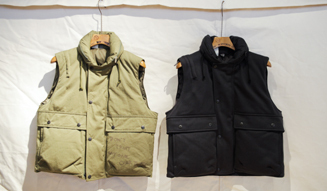
SukezaneThe puffiness of the pockets is nice. Cute.
ObanaPuffy. The way the gussets are constructed is unique. According to one theory, it's called a "moisture pocket." In humid environments, patch pockets that are close to the skin can cause the contents to sweat due to body moisture. So, by making the gussets large like this, you can avoid moisture...
SukezaneOh, so that's why it's called a moisture pocket.Obana(Looking at Sukezane wearing it) When you wear it, Tomoki-san, it doesn't look like camouflage (laughs).
SukezaneI have no intention of fighting.
ObanaNo intention (laughs).
SukezaneThis one (right photo) is amazing too, it's all bumpy. This is cute too. (Wearing a khaki jacket with many pockets facing downwards) This looks like it's asking to be messed with, or rather, 'Please mess with me!' (laughs). All the pockets are from the bottom. Won't people customize them?
Obana(Laughs) 'Sew it from the bottom so it can be used.'
Sukezane tries on a blouson with tubular elements on the sleeves.
ObanaI actually love naval uniforms.
SukezaneIs it related to the Navy?
ObanaIn the Navy, there are these blousons that are completely impractical. I love them and wear them all the time. There's a pipe-like thing attached, and I don't know what it's for. I decided to incorporate that most inexplicable part into a wearable item, the
mod parka.
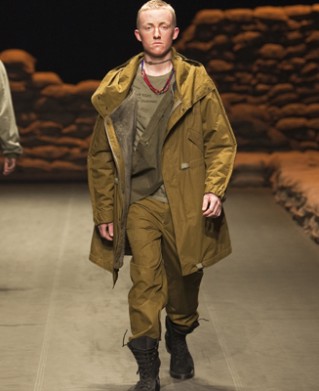
SukezaneThis one (left photo) is nice, and warm. And the straight back is good.
ObanaYes. I've made the tail softer.
SukezaneThis looks mature. It looks authentic.
ObanaSpeaking of which, I visited the Ministry of Defense last time.
SukezaneYou did?
ObanaYes. They told me, 'You have a good physique' (laughs). I also went to NASA.
SukezaneYou went to NASA too? During the moon landing collection?
ObanaI tried to sneak a photo, so I ran off the bus, but they got really angry. About four or five people restrained me (laughs).
SukezaneGood thing they didn't shoot you.
ObanaThe immigration procedures were as strict as entering some countries.
SukezaneReally, good thing they didn't shoot you... So, to ask about NY again, what about"COMPILE", the concept you were working with in Paris, what will happen to it?
Obana"COMPILE" will basically remain "COMPILE." It was originally created based on the "product" rather than a specific theme, starting with "interesting individual items" with various gimmicks. So, I plan to restart that. For the past few years, I've presented "COMPILE" exhibitions in Paris and held "N.HOOLYWOOD" runway shows in Tokyo, operating two separate lines. However, going forward, rather than thinking of them separately, I want to find a way to combine them effectively. By mixing the experiences from Paris and Japan and presenting them twice a year in NY, I believe I can create something with more depth.
SukezaneI'm looking forward to it! I have high expectations!
Daisuke OBANA
Born January 28, 1974, in Kanagawa Prefecture. Dropped out of vocational school in 1992 and worked as a buyer and shop manager at a vintage clothing store. In 1995, he was involved in the launch of "go-getter," a select vintage shop. Amidst the vintage boom, he curated highly designed vintage clothing from the 70s and 80s, creating numerous trends. In 1999, questioning the value of vintage clothing being solely based on condition or age, he began developing remakes and original items within "go-getter." In 2000, he established "N.HOOLYWOOD." In December of the same year, he opened "Mister Hollywood" in Harajuku to fully develop original collections. In 2002, he presented his first collection at a club. In September 2004, he relocated the shop from Harajuku to Jingu-mae. In June 2007, he presented his first exhibition in Paris, "N.HOOLYWOOD COMPILE." On November 1, 2008, the first N.HOOLYWOOD flagship store opened in Hong Kong. He announced his decision to move his presentation venue to NY after the 2010/11 AW collection.
Mister Hollywood
Tel. 03-5414-5071