March 13, 2015
Yasuhiro Mihara | Japanese Craftsmanship: "The 4th Installment: Wada Meriyasu x Shin Naigai Cotton Sweat Parka" (3)
MIHARAYASUHIRO × Wada Meriyasu × Shinnaigai Textile
Vol. 4: Sweat Parka by Wada Meriyasu × Shinnaigai Textile (3)
Fashion designer Yasuhiro Mihara visits Japan's proud factories and artisans in this groundbreaking series, "MEANING MADE IN JAPAN MIHARAYASUHIRO (MMM)," which creates new value unique to Japan. Mihara encountered a loopwheel knitting machine for sweat fabric at Wada Meriyasu in Wakayama Prefecture. Seeking even higher quality, he now heads to a spinning mill in Gifu Prefecture.
Text and Composition: Yasuhiro Takeishi (City Lights)Photography: jamandfix

Meiji, Taisho, Showa, Heisei──A Spinning Mill That Survived Tumultuous Eras
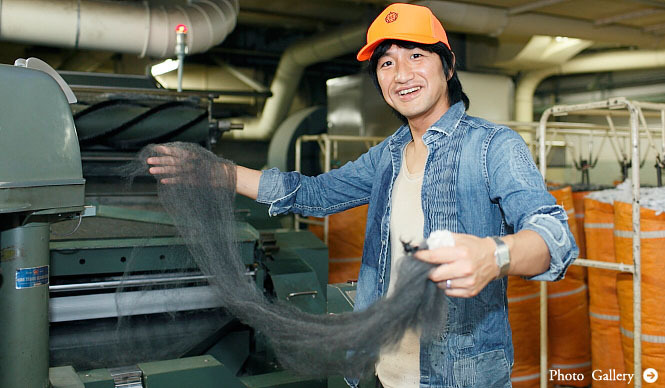
About 30 minutes by car from JR Gifu Station. Naigai Textile, a production plant of spinning manufacturer Shinnaigai Textile, is located in Komano, Kaizu City, surrounded by the gentle flow of the Kiso, Nagara, and Ibi rivers, and abundant greenery. Mihara, who visited Wada Meriyasu in Wakayama Prefecture last time to find the ideal sweat fabric, now visits Naigai Textile to explore the yarn for sweat fabric, guided by Shinnaigai Textile's Susumu Hasegawa and Ikuhiro Node. At the factory, which exudes a sense of history, they were welcomed by Factory Manager Hideji Ogawa and Site Manager Koji Sugimoto.
MiharaThis seems to be a very historic factory.
OgawaOur factory was established in 1948, but its predecessor, Naigai Cotton, was founded in 1887. Naigai Cotton, a key player in Japan's main industry at the time, cotton products, was one of the top companies in Japan and even owned factories in China by the late Meiji era. However, most of its facilities were confiscated after World War II, and Shinnaigai Textile and this factory were newly established in the postwar period.
MiharaThe Japanese textile industry, including spinning, has become a declining industry, with China taking market share. Why has your company continued for such a long history?
OgawaWe have several hit products. The first was "mou-ito" (heathered yarn), developed in the 1950s, which became a huge hit. Mou-ito, which recorded explosive sales in the 1970s, originated in America and is also used in sweat fabrics. Mou-ito was eventually overtaken by China, but we made a comeback in 1991 with Tencel (a cellulose fiber made from wood pulp), which we were the first in Japan to develop.

Development Capability That Carved Its Own Path
MiharaI see. Continuously developing new things has led you to where you are today. I believe that the companies that still exist today are those that have done things that can only be done there.
OgawaSpinning, in particular, once pursued only quantity and efficiency. However, we couldn't compete with major players or China in that regard. So, we decided to leverage our unique technologies and switch to a strategy of small-lot, high-mix production.
MiharaI think moving away from mass production was the right decision. This applies not only to yarn but also to garment production; mass production will no longer be competitive. In the future, domestic factories should move towards producing unique, small-lot items like yours. Still, when I tried to use mou-ito jersey in Italy before, they told me they didn't have it. I thought it was a basic fabric until then, but that's not the case, is it?
OgawaMou-ito requires uniform mixing of fibers of different colors, which is a special technique. For example, it's very difficult to evenly mix 1% into the remaining 99%. Such special blended yarns are one of our unique technologies, and we can blend any fiber, not just mou-ito. The process is highly confidential, but please visit our factory.