March 5, 2015
Yasuhiro Mihara | Japanese Monozukuri: "Wada Meriyasu" (1)
MIHARAYASUHIRO × Wada Meriyasu × Shinnaigai Textile
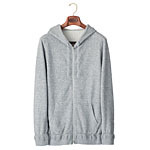
The 4th: Wada Meriyasu × Shinnaigai Cotton Sweat Parka (1)
Fashion designer Yasuhiro Mihara visits Japan's proud factories and artisans in a groundbreaking series, "MEANING MADE IN JAPAN MIHARAYASUHIRO (MMM)," creating new things that can only be made in Japan.
Among the sweat-producing factories worldwide, those in Japan that still operate vintage circular knitting machines are said to offer the finest texture and feel. This time, Mihara visited a meriyasu (knitted fabric) factory in Wakayama to create such precious sweat fabric.
Photos: Kaoru Mizobe (Hawk Eye Visual Works), jamandfixComposition & Text: Yasuhiro Takeishi (City Lights)With cooperation from: Hiroshi Hagino

Vintage Circular Knitting Machines Remaining in Wakayama
Knitted fabrics, known for their elasticity, are used in a wide range of garments, from underwear to everyday wear, making them indispensable in modern life. Wakayama Prefecture boasts the largest share of domestic knit production. The history of knitting in Wakayama is said to have begun in 1907 with the introduction of five Swiss knitting machines.
Subsequently, the production of circular knitted fabric rapidly expanded, and by 1919, Wakayama surpassed Osaka in production volume to become number one. Today, Wakayama still accounts for about 40% of domestic circular knit fabric production, with the circular knitting machine being its origin.
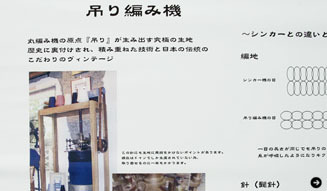
As the name suggests, a "circular knitting machine" is a circular knitting machine suspended from the ceiling (pictured above). Special needles called "beard needles" are arranged in a circle on the cylindrical machine, and a part called a "sinker wheel" rotates slowly along them to knit the fabric. The knitted fabric hangs down due to gravity, which prevents excessive tension. Furthermore, the beard needles' shape does not stress the yarn, allowing for a texture akin to hand-knitting.
However, due to their extremely low production efficiency compared to modern "sinker knitting machines," they declined after the 1960s. Currently, only two companies worldwide still operate them, one of which is Wada Meriyasu, visited by Mihara this time.
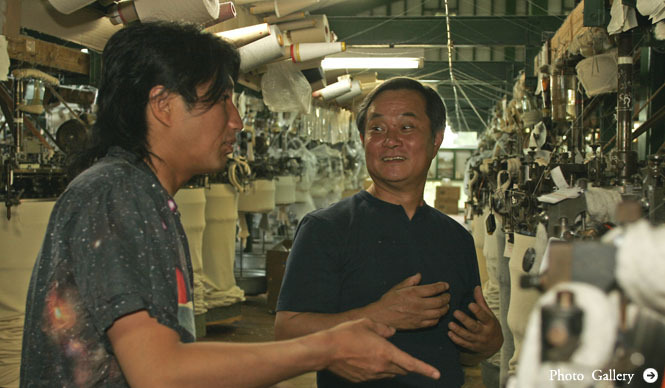
The company was founded in 1957, and its current president and craftsman, Yasushi Wada, operates the circular knitting machines.
The Succession Problem Inherent in Craftsmanship
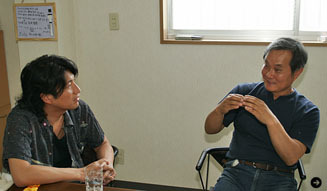
WadaAll knitwear in Wakayama began with meriyasu (knitted fabric, mainly for underwear), but during the period of high economic growth, production shifted to mass production, and circular knitting machines fell into disuse. Operating a circular knitting machine requires specialized skills and a good sense; unlike modern machines that can be operated automatically, it takes time to become a skilled craftsman. Consequently, few successors are being trained to take over the few machines still in operation. I'm probably the youngest craftsman here.
MiharaIs that so? The issue of a lack of next-generation successors is the same in the Japanese footwear industry, which I am involved in. I believe it's challenging to become proficient in any craft, but through this series, I hope to convey the sense of fulfillment that comes from making things to the younger generation.
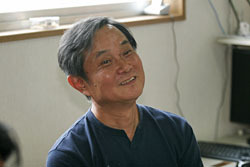
Yasushi Wada
The challenges facing Japanese craftsmanship, a national strength, cast a shadow over the circular knitting machine factories as well. However, Wada Meriyasu, which has survived in this industry, has accumulated unique know-how.
Wada has succeeded in knitting fabrics that are impossible on conventional circular knitting machines by implementing his own modifications, such as combining them with computer control.
The Endless Potential of Circular Knitting Machines
WadaOur company was founded in 1957 as a circular knitting factory. At that time, we produced materials for rubber boots and rags for cars. Later, we produced fleece (sweat fabric with a raised pile lining) and pile fabrics, but their production volume was unstable as it depended on the season.
It was then that my wife suggested, "Striped patterns sell well every year, regardless of season or trend." This inspired me to start modifying the circular knitting machines. While we are still the only ones who can knit striped patterns on circular knitting machines, we also create many other fabrics that only we can produce.
MiharaSo, modifications have expanded the possibilities of circular knitting machines. Even so, I didn't realize that so many fabrics could be produced on vintage circular knitting machines. You develop and propose original fabrics, don't you?
WadaThat's right. We develop original fabrics because we don't create them based on requests from clients. While some aspects are best left as they were, we should actively change what needs to be changed. Old circular knitting machines consume a lot of electricity to run the motors, so they weren't exactly eco-friendly. However, by introducing the latest inverters and gear motors, we've managed to keep electricity costs down to around 30,000 yen per month.
MiharaYou are constantly thinking of new things and putting them into practice.
WadaOthers probably see me as eccentric (laughs). Anyway, please take a look around the factory.