March 13, 2015
Yasuhiro Mihara: Japanese Craftsmanship, “Wada Meriyasu” (Part 2)
MIHARAYASUHIRO × Wada Meriyasu × Shinnaigai Textile
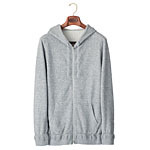
The 4th Wada Meriyasu x Shinnaigai Cotton Sweat Hoodie (2)
Fashion designer Yasuhiro Mihara visits Japan's proud factories and artisans for "MEANING MADE IN JAPAN MIHARAYASUHIRO (MMM)," an innovative series exploring the creation of new products unique to Japan.
Wada Meriyasu uniquely modifies old-fashioned "loopwheel knitting machines" to create original fabrics. Upon touching a loopwheel machine for the first time in the factory, Mihara begins to explore ideas for a sweatshirt that can only be made here.
Photos: Kaoru Mizobe (Hawk Eye Visual Works), jamandfixComposition & Text: Yasuhiro Takeishi (City Lights)Cooperation: Hiroshi Hagino

Innovative Technology That Made the Impossible Possible
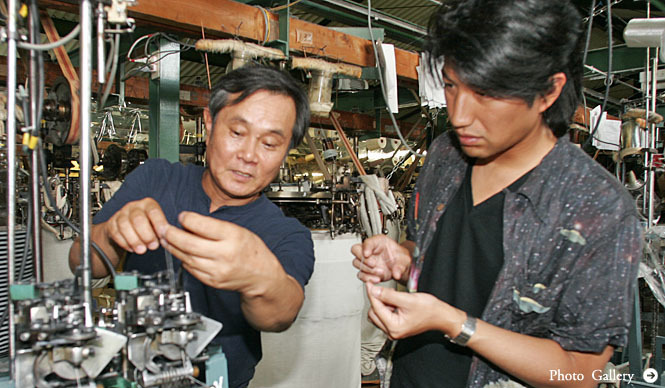
Inside Wada Meriyasu's spacious factory, loopwheel knitting machines hang neatly from beams. Approximately 200 loopwheel machines are said to exist today, and the company owns 150 of them. 100 are in constant operation, with the remaining 50 dedicated to new project development.
This unique development has borne fruit in the form of striped fabric, made possible by incorporating a "knitter," a thread-switching machine for socks, and computer control. After touring Wada Meriyasu's factory, where traditional loopwheel knitting machines merge with cutting-edge technology, Mihara seems to have discovered new possibilities in the expressive power of these machines.
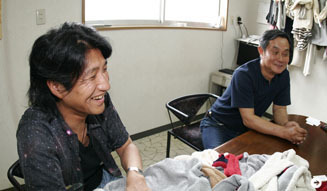
MiharaI always thought loopwheel machines were analog, so I was surprised to see you use computers.
WadaOur company has focused solely on loopwheel machines since its inception and has never introduced a sinker knitting machine. To compete with sinkers, which boast about ten times the production speed and one-third the operating cost, we had no choice but to introduce the latest technology and compete with originality. We introduced computers in the 1980s and taught ourselves programming.
MiharaTo have introduced them since that era, you are not only a craftsman but also skilled in high-tech matters.
WadaI don't usually carry mobile phones, though. They're cumbersome, and I don't want to touch them with oily hands while looking at the machines (laughs).
Innovative Fabric Made Only Here
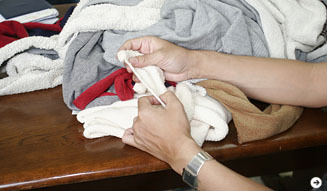
After finishing the factory tour, Mihara's attention was caught by a particular fabric while he was checking Wada's original sample fabrics.
At first glance, it appeared to be a standard terry cloth, but to someone who understands knitting structures, it was astonishing. The fabric had a terry structure not only on the surface but also on the reverse side.
Terry, where yarn remains in loops on the fabric surface, cannot have tension applied to the yarn, making the structure particularly unstable in knitted fabrics. To leave loops on both sides would be even more so. The double-sided terry knit fabric that solved this problem can only be knitted on Wada Meriyasu's loopwheel machines, let alone the latest knitting machines.
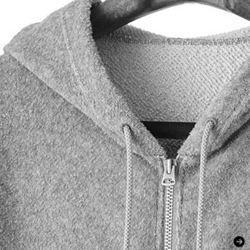
MiharaWhat is the structure of this fabric? How is the structure stable?
WadaOccasionally, designers visit the factory, but none have been as knowledgeable about knitting as you, Mihara-san. This fabric is...
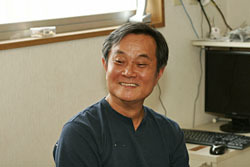
Yasushi Wada
The Strength of Made in Japan, Seen on Site
Afterward, the two engaged in an enthusiastic, technical discussion about the fabric's structural composition. Mihara then chose this fabric for the sweat hoodie they would create. It was a fabric that could undoubtedly only be made there, possessing the soft texture of hand-knitting, characteristic of loopwheel fabric, and an astonishing lightness brought about by the double-sided terry.
MiharaMy impression of loopwheel machines has changed after this visit. I feel like I can now create a high-quality sweatshirt that can be worn daily.
The purpose of this series is to explore the theme of "What is Made in Japan?" but this can often become vague when viewed as a whole. However, by focusing on one company and delving into it, as we have done this time, its meaning becomes crystal clear. I sincerely hope you will continue with your current system.
WadaI have to maintain our loopwheel machines myself, but my son is now helping me. Also, there are still many new ideas using loopwheel machines. Once one technology is perfected, it can be applied to various things. I've never had the impression that loopwheel machines can only do 'this much.' Even if our company were the only one left, I would want to continue with loopwheel machines forever.
Mihara, having experienced Wada's unflagging passion and spirit of inquiry regarding loopwheel machines, felt a new desire to explore even the yarn used to knit this sweatshirt fabric.
On a different day, he headed to Naigai Textile, a spinning mill in Gifu Prefecture, renowned for its production of mélange yarn, essential for sweatshirt fabrics.