Yasuhiro Mihara’s Japanese Craftsmanship: “Le Monde Socks” (Part 3)
MIHARAYASUHIRO x Le Monde
Part 3: Socks from Le Monde (3)
Fashion designer Yasuhiro Mihara embarks on a groundbreaking series, "MEANING MADE IN JAPAN MIHARAYASUHIRO (MMM)," visiting Japan's proud factories and artisans to create new, uniquely Japanese products.
Yasuhiro Mihara visited a sock factory in Koryo Town, Nara Prefecture, one of Japan's leading sock production areas. In conversation with Takeshi Matsumoto of Izuru Socks and Rokuro Minami of Minami Sock Factory, he witnessed the operation of precious sock knitting machines and learned about the depth of sock manufacturing through exchanges with the artisans.
The original socks, born from the passion and craftsmanship of those dedicated to sock making, are finally complete.
Photos: Kaoru Mizobe (Hawk Eye Visual Works)Composition & Text: Yasuhiro Takeishi (City Lights)Cooperation: Hiroshi Hagino

Encountering Artisans Who Keep Precious Knitting Machines Running
MatsumotoI understand your passion for Mihara's vision. With 60-gauge knitting machines, you can use various yarns like heathered or knit-specific ones, making it easier to express your creativity and quite interesting. Now, we have a factory that actually operates these knitting machines, so allow me to show you.
Mihara was then guided to Minami Sock Factory, founded in 1977, which manufactures socks in collaboration with Izuru Socks. The factory is managed by Rokuro Minami, a veteran with over 40 years of experience in sock manufacturing.
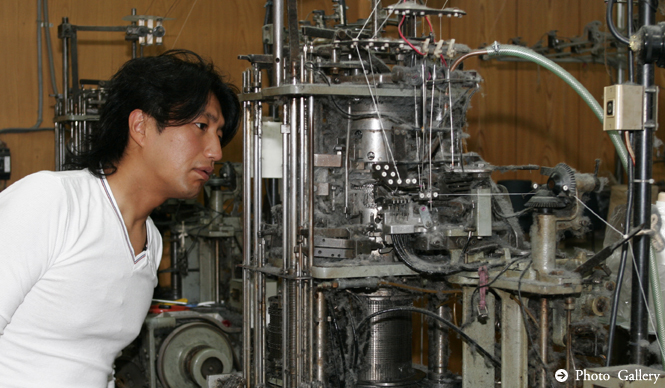
Although small in scale, producing about 80 pairs a day, precious 60-gauge knitting machines, all over 25 years old, are still in operation. As Minami explained the structure of the knitting machines and the manufacturing process, Mihara was captivated by the machines he was seeing for the first time.
MinamiCurrent common socks use 170 to 180 needles, but these machines have only 60 needles, a third of that. They are old, and very few remain in Japan, but this is the only way to achieve such a coarse knit.
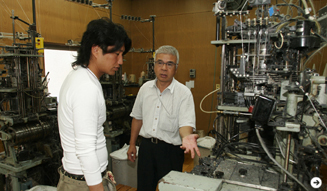
Rokuro Minami of Minami Sock Factory (right) and Mihara
MiharaEven though they are old, the structure is quite complex. Are there still manufacturers who can maintain them?
MinamiNo, not anymore. There are hardly any artisans left who can work on these machines. I do all the maintenance and adjustments myself.
MiharaBy making adjustments, you can change the size of the knit and the thickness of the yarn, right? You do all of that yourself?
MinamiThat's right. By changing the blend ratio of materials, thickness, and knit size, we can enhance the functionality of socks. Even with these machines, I believe we can still produce high-quality socks that meet modern standards.
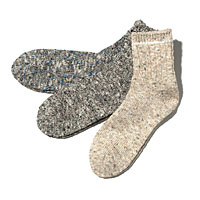
Having experienced the world of Japanese sock manufacturing firsthand during this visit and glimpsed its depth, Mihara commissioned socks that would fully leverage the skills of the three individuals he met in Koryo Town.
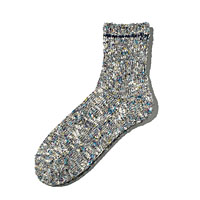
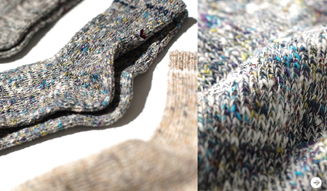
For the material, he chose a blend of cotton and hemp, prioritizing both functionality and natural fibers for moisture-wicking and quick-drying properties. Using heathered yarn with a unique blend of colorful threads and uneven neps, he applied custom color adjustments and embroidered the series' brand logo on the heel to create a stylish accent. The 60-gauge knitting machines would then be used to create socks with a relaxed, comfortable fit.
The resulting socks became a masterpiece, embodying the passion and dedication of those who continue to pursue high-quality socks that can only be made in Japan.
Furthermore, a portion of the proceeds from the sale of these socks, available exclusively on the web shopping site "rumors," will be donated to welfare facilities in Tokyo through the Tokyo Charity Bank, operated by the Tokyo Council of Social Welfare, as per the intentions of Mihara and OPENERS.