March 9, 2015
Yasuhiro Mihara's Japanese Craftsmanship: "Visiting Tomoi" (Part 1)
MIHARAYASUHIRO×TOMOI
Part 2: A Visit to Tomoi (1)
This groundbreaking series, "MEANING MADE IN JAPAN MIHARAYASUHIRO (MMM)," features fashion designer Yasuhiro Mihara visiting factories and artisans across Japan to create new products that can only be made in this country.
For this installment, as the project truly gets underway, Mihara visits Hiroshi Tomoi, the proprietor of a long-established button factory in Nara Prefecture. What kind of buttons will be created? Please look forward to it.
Photography: Kaoru Mizobe (Hawk Eye Visual Works)Photography: Kaoru Mizobe (Hawk Eye Visual Works)Collaboration: Hiroshi Hagino

A Shell Button Factory Japan Boasts to the World

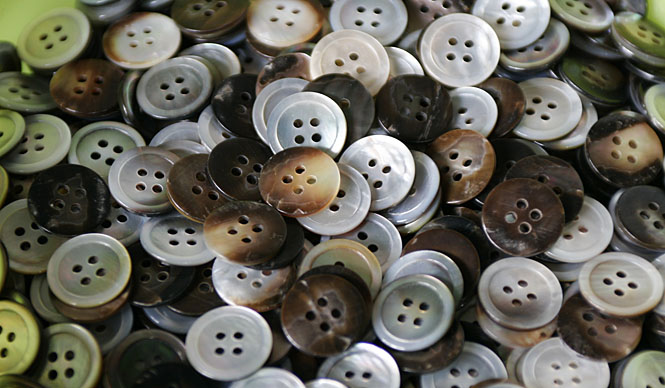
Kawanishi Town, Nara Prefecture. Located in the central part of the Nara Basin, this town is Japan's leading producer of shell buttons. Shell buttons were introduced to Japan in the early Meiji era along with Western clothing. The manufacturing technology first arrived in Kobe from Germany, then passed through Kawachi, Osaka, before reaching Nara.
In the village of Tōin in Kawanishi Town, which was once agricultural land, shell button production spread as a source of income during the farming off-season. During its peak, just over a decade after the war, an astonishing 200 out of 300 households were involved in shell button manufacturing. Facing pressure from inexpensive Chinese-made and polyester buttons, many factories have since closed. However, the long-established shell button factory "Tomoi," founded in 1913, which Mihara visited this time, still boasts approximately 70% of the domestic market share.
MiharaWhere do you source the raw materials for your shell buttons?
TomoiMainly from the South Pacific. Previously, we imported all shells in their raw form, but now much of it comes semi-processed. About 200,000 to 250,000 buttons can be made from one ton of shells. Our company manufactures approximately 70 million buttons annually, so we import over 300 tons of shells per year.
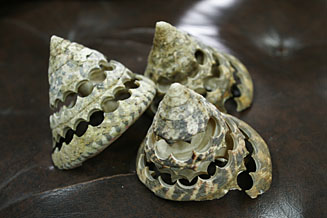
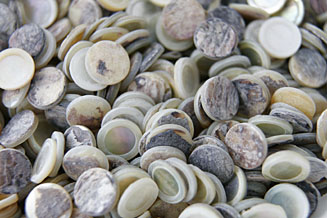
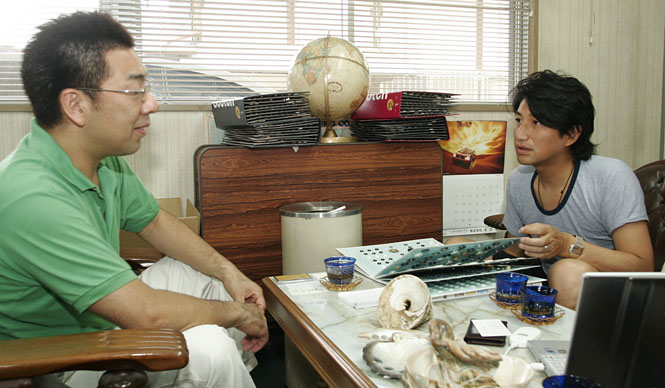
Hiroshi Tomoi, the third-generation president, answered Mihara's questions, who was fascinated by his first visit to a shell button factory.
Tomoi has inherited the factory and techniques passed down through generations, expanding to receive orders not only from within Japan, where he holds overwhelming market share, but also from top European and American brands, including those in Italy, the home of shell buttons. His equipment and technical expertise are undoubtedly world-class.
MiharaAre there other shell button factories in this region?
TomoiThere are about 15 now, but they are all small, individual workshops. Our company is the only one operating as a corporation. There are few young people willing to inherit the techniques, so the number has decreased considerably.
MiharaIt's the same situation with the shoe factories I'm involved with. As young people don't join, the numbers are dwindling. Perhaps it's because the status of manufacturing industries in Japan just isn't high enough. In Italy, for example, it's very high. In this series, I want to convey the wonderfulness of Japan's manufacturing industry, as well as the unique joys of working in manufacturing to young people. By the way, what is the most difficult aspect of shell button production?
TomoiSince shells are natural materials, strictly speaking, their shapes are all irregular. Finishing these natural shapes uniformly is indeed challenging. High-quality shell buttons are made from materials like Takase shells, mother-of-pearl, and black-lip mother-of-pearl. Mother-of-pearl is particularly rare and expensive. Thicker pieces are considered high-grade, but because all shells are curved, achieving both thickness and a beautiful, right-angled finish simultaneously is the most difficult part. Please take a look around the factory to see the process of how shell buttons are made.
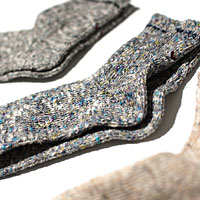
The socks created by fashion designer Yasuhiro Mihara are made from a blend of cotton and hemp, chosen for their functionality and natural properties, offering both moisture-wicking and quick-drying capabilities. Utilizing a nep yarn with a unique, uneven mix of colorful threads and slubs, the socks feature custom color adjustments and the brand's logo embroidered on the heel to serve as a stylish accent. They are knitted on a 60-gauge machine, resulting in a comfortably loose fit that conforms well to the foot.
These socks, sold exclusively through the web shopping site "rumors," will have a portion of their proceeds donated to welfare facilities in Tokyo through the Tokyo Charity Bank, operated by the Tokyo Council of Social Welfare, in accordance with the intentions of Mihara and OPENERS.
