
ato | Designer Matsumoto Yo Interview (Part 2)
ato
Designer Matsumotoyō Interview (Part 2)
I want to hear from designers who are shaping the future of fashion.
While Omotesando and Ginza have become meccas for international brands, it’s precisely now, when the voices of Japanese designers are rarely heard, that I feel the time is right. What are fashion designers, breathing the same air of our era, thinking, presenting, and striving to overcome?
For the first installment of FASHION DESIGNER'S FILE, we feature Matsumotoyō of “ato,” who participates in Tokyo Collection, garners high praise from domestic and international buyers, and has also been appointed director of WORLD’s core women's brand “INDIVI” starting this season. Although he requested no photograph, this is an interview where you can truly get to know the person.
TEXT by KAJII Makoto (OPENERS)


the other side fashion vol.1
interview with MATSUMOTO ato
Matsumotoyō, Designer of "ato"
Trends and sentiments are shifting towards strong women.
—Could you tell us about the theme for the 2007-08 Autumn/Winter collection?
The theme for menswear is “Functional Beauty.” For example, the interesting shape of a hood for warmth, or the unique functionality of detachable pockets – while focusing on the functionality of details, we’re mixing opposing elements like formal and casual, or hard and feminine.
—Looking at the collection photos, the layering seems meticulously crafted, down to the millimeter, leaving no room for error.
That’s a habit of mine. Just like with origami, some people fold it roughly, while others fold it precisely. I might be a bit sloppy in my daily life (laughs), but when it comes to creation, I can see the difference of a millimeter or two, and I tend to obsess over it.
—And the theme for womenswear?
The theme is “She wants to be harder.” This time, I wanted to express women’s strength. We’re expressing power by transforming masculine items like rider’s jackets, military wear, and sweatshirts into something for women. While last season felt more feminine, reflecting the mood of the times, I believe both sentiments and society are now shifting towards stronger women.
—Then, could you introduce the “best look” from this collection?
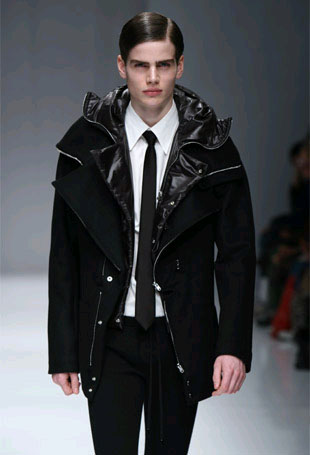
For menswear, the best look is a coordination where the blouson, designed with a feature to fasten the inner and outer layers, has a mask-like, upward-projecting silhouette that I find functionally cool. The bottoms are leggings, and the nerdy styling feels fresh. This is also my approach to newness.
—The volume of the footwear also catches the eye.
While overseas gardens are often designed with near-perfect symmetry, Japanese gardens frequently feature asymmetry. Perfect symmetry doesn't feel human. I always want to break away from it somewhere. If I try too hard to be stylish, I feel embarrassed. So, I consciously break away from it. I think we have fewer symmetrical elements compared to other brands.
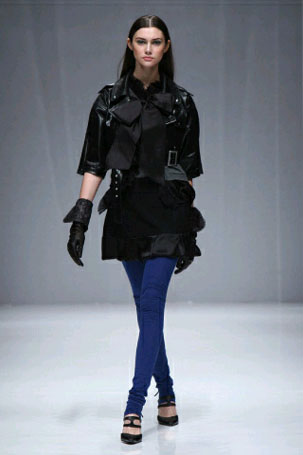
—And the best look for womenswear?
It’s the look with the short leather rider’s jacket. While using tough leather, the design incorporates roundedness, balancing strength and femininity.
I wanted a pop of color, so I added it with the leggings. The inner layer is a combination of knit and blouse.
—The textures also seem to coexist, with the tension of leather and the softness of woven fabric.
The fascination of fashion lies in combining, for example, hard and soft, or artificial and natural elements. Music isn't interesting without counterpoints. Newness is hard to establish without a certain sense of dissonance.
—It was quite a topic that you were appointed director for womenswear at “INDIVI.”
It started with the 2007 Spring/Summer season, but I began the work around last summer.
—Why do you think they approached you?
Well, perhaps there was a similarity in the essence of what I do with “ato” and what “INDIVI” aims for. I believe they were looking for something sharp and menswear-inspired.
—It’s a super brand with sales exceeding 10 billion yen; do you feel any pressure?
It’s certainly clothing for the masses, with a large staff; even during fittings, there are over ten people involved (laughs). I like to think we’re a positive influence on each other. Creating clothing for a different segment, in a way, builds new drawers for myself, allowing me to discover various things, which is refreshing. I’m sure “ato’s” womenswear will also be influenced and change.
Why do young people want to wear such small-sized vintage clothing?
—How do you perceive Tokyo today?
As a market for clothing, I think it’s wonderful. To have this many shops in one city, and so many that buy avant-garde designs, is unparalleled. “ato” holds exhibitions in Paris every season, but only a handful of shops there carry our brand. From a fashion business perspective, international brands would be in trouble without Japan’s consumption.
—However, the speed of information is incredibly fast; don’t you wonder if it’s truly reaching the consumers?
We are in an era of creation and presentation. Although I dislike it, information is powerful, and products sell based on how they are presented. According to my principles, I’d rather not focus too much on that.
—Shops in trendy new spots are exactly about presentation, aren't they?
Ideally, I want people to see something on a hanger, not know the brand, and think, “This piece is cool!” and I want to pour my energy into that.
But in reality, things are heading in the opposite direction. However, since that has also become a valid form of business, I can’t ignore it.
—I see. Then, to the question I most wanted to ask in this interview: how do you perceive the creations of designers like Rei Kawakubo, Yohji Yamamoto, and Issey Miyake?
First, I believe we have great predecessors in Japan, and we are competing on the same stage. However, I think their work originated from the Japanese people’s complexes about their physique.
Silhouettes with broad shoulders that conceal the body are close to the culture of kimonos, and I feel it stems from a desire to hide our weaknesses. It’s the difference between flat Japanese paintings and Western paintings with shading and depth.
—That’s true. Seeing how Kisho Kurokawa, who recently ran for governor, dresses, I feel that too.
So, how can we make Japanese people look stylish? In my interpretation, our generation, with improving body silhouettes, represents the beginning of seeing being Japanese as cool. And from the start, we’re eating hamburgers and listening to Western music. We’re breathing the same air through the internet.
—Indeed, information and knowledge are universal.
Therefore, if we are to have a distinct style, we should show off our bodies. I believe the body itself has individuality. When you wear Kawakubo’s clothes, you become Comme des Garçons; when you wear Yamamoto’s, you become Yohji Yamamoto. I believe that with tight clothing, a person’s individuality stands out more. Why do young people compete to wear such small-sized vintage clothes? It’s probably because they want to express their individuality through sizing.
—That applies to you as well, doesn’t it?
Yes. I respect Kawakubo and Yamamoto’s creations, but our starting points are different. That’s why I think we stand in different places. We are in an era where the wearer is the protagonist.
—I understand completely. Lastly, what are your thoughts on the internet?
I also buy books and CDs frequently, and I’m certain that fashion and the internet will become even more intertwined, increasing opportunities for shopping. As a result, shops will likely become showrooms where one can experience fashion. Such places are absolutely necessary, but the speed of receiving something bought online the next day will also become important. I’d like to try that with “ato” as well.
—Thank you very much. We’d love to speak with you again then.