ato | Designer Matsumoto Yo: Interview (Part 1)
ato
Designer MATSUMOTO Ato Interview (Part 1)
I want to hear from designers who are shaping the future of fashion.
While Omotesando and Ginza have become meccas for international brands, Japanese designers' voices are rarely heard. I believe now is the perfect time.
What do fashion designers, breathing the same air of our times, think, what do they present, and what do they strive to overcome?
For the first installment of FASHION DESIGNER'S FILE, we feature Ato's MATSUMOTO Ato, who participates in Tokyo Collection, receives high praise from domestic and international buyers, and has also been appointed director of WORLD's core women's brand "INDIVI" starting this season. Although he requested no photograph, this is an interview where you can truly get to know him.
TEXT by KAJII Makoto (OPENERS)

the other side fashion vol.1
interview with MATSUMOTO ato
MATSUMOTO Ato, "ato" Designer
What people want to see now is the designer's individuality and way of life.
—We're speaking with you at the venue for your 2007-08 Autumn/Winter collection. Both the men's and women's lines feature a lot of black.
I do like black and gray. The reason is that they make the shape easy to see. I want to win with form, so I put particular effort into the patternmaking. "ato" clothes even have a tag with the patternmaker's name on it.
—That's a wonderful idea.
Garment creation is like a game of catch. Rather than creating with a fixed image from the start, you can achieve a stronger design by throwing in a design with some flexibility and shaping it.
Since I entrust a part of the creation to the patternmakers, I put their names on the tags. The names of the people at the sewing factory are included on the invitations.
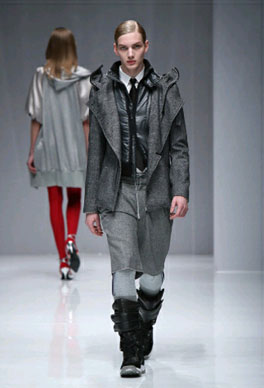
—"ato" has a strong image of menswear since its debut collection, and looking at the Autumn/Winter collection, it gives the impression that you have an "ideal man" in mind.
Yes. I went to fashion school, but I didn't follow the orthodox way of making clothes, so I've been finding my own path through various challenges.
For menswear, I do the fittings myself, but I also want an objective eye, so I might take a Polaroid of myself wearing it and judge it from a third-person perspective. I have my own know-how.
—Looking at the items lined up, it feels like a wardrobe that a single man would favor.
Fundamentally, it's the clothes I like. Consumers today have an enormous number of choices, and when you boil down what people want to see in fashion, it's the designer's individuality and way of life.
Those who want to see such things look to "ato" for the clothes I like, as I envision them, and for suggestions like, "How about wearing it this way?" or "Isn't this stylish?" I believe I'm finding customers who appreciate that.
—In other words, "Here is a man like this."
I chose this profession because I wanted to question my own philosophy and way of thinking with the world through my work.
I want to convey my way of life and feelings through my clothes. It's embarrassing to say "I am here" directly (laughs), so I think expressing it through clothes suits me.
I believe that clothes themselves and the meaning of wearing them are constantly changing, but what we like and dislike is decided when we are young. For example, the taste of your mother's miso soup – the fundamental liking for it doesn't change. What changes is the approach and the way it's presented.
—Hearing that, the tension you feel in the design of your outerwear, for instance, seems to be your preferred domain.
I probably like it without consciously thinking about it. I like things that are tense or taut.
—What influences your creative process?
Energy, I suppose. For example, when I see a painting and think, "Humans can create something this amazing," it motivates me. Painting, music, and film are sources of that kind of inspiration.
I do look at other designers' collections, but I'm not particularly inspired by them.
Logic to support intuition is important. That's how I create.
—Could you tell us about what led you to become a designer?
I majored in electronic engineering in university, and while I had hoped to become an engineer, I happened to get an opportunity to study abroad. I liked clothes even then, so I thought it would be good to study fashion while also improving my English. I went to a fashion technical college affiliated with a state university in New York, and while studying, I grew to love making clothes, then returned to Japan.
—Your major and fashion seem like polar opposites.
After returning to Japan, while working as a salaried employee, I wanted to do something on my own, so I started a graphic design business with a friend. We worked on things like movie posters, but it was always a passive job dependent on clients. The desire to "express something myself" grew stronger... So I thought about what I could do, and it led me to clothing. Initially, a friend was the designer, I handled the business side, and another person was the patternmaker. The three of us created the "ato" brand.
—So it was "ato" from the very beginning?
I was managing the company's finances, and since "ato" isn't a person's name, I thought it was fine (laughs). That was in 1993. Later, our directions diverged, and I started designing myself.
—What does design mean to you?
Fashion design is often thought of as intuitive, but for me, it's something that only emerges when I draw at my desk every day. Relying solely on intuition works well when it aligns with the times, but if the rhythm is off, it becomes incredibly difficult. Therefore, I work on consistently thinking and striving to keep the fluctuations of my personal rhythm as flat as possible.
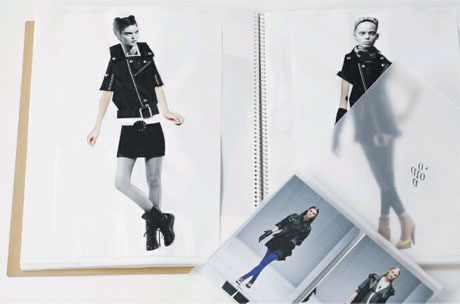
—You sit at your desk every day to maintain that daily rhythm.
I create an "image book." My designs start from there.
—How long have you been making these image books?
Since the 2003 season, when I started the women's collection. First, I create the image, and then I translate it into a design.
—It's a unique method, but it must be very time-consuming.
For menswear, I do the fittings on myself. I can cut and alter it myself. However, with womenswear, I can't wear it, so I don't know about the sizing or how it feels to wear. I felt that I needed to go through more steps than with menswear to reach the intended outcome, so I started creating the books.
—They are very elaborate, and their level of completion rivals the actual garments.
I now have three design assistants, and this kind of thing became necessary to convey what I'm thinking to them.
—Why did "ato" start with menswear?
Menswear has many traditions, rules, and accumulated knowledge in clothing creation. So, I thought, let's tackle the difficult things first (laughs). For womenswear, you can compete with sensibility, like with "cuteness."
—I see. However, the impression of "ato" as a menswear designer is still strong.
It was difficult when I started the women's line, but it's gradually becoming more recognized. When designing womenswear, I do imagine "what if I were a woman," but women's sensibilities are clearly different, so if I create womenswear in my own preferred style, it becomes extremely difficult to wear. That wouldn't be commercially viable, so I discuss it with my staff and research women's physiological aspects.
—Have there been any changes in the women's line since its debut in 2003?
Yes, the debut collection had the same masculine, all-black, and very slim aesthetic as "ato" menswear (laughs), so there were mixed reviews. Women, in particular, are more concerned about being "slim" than men. Showing very slim clothes leads to discussions about whether they can be worn or not. I've gone through considerable trial and error, and it's still an ongoing process. Conversely, when I first started designing menswear, slim-fitting clothes weren't common in the market. Then, as you know, Hedi Slimane emerged, and suddenly "slim fit" became a trend, leading to demand for slim clothes.
—Womenswear must be challenging.
The challenge lies in the gap between what I find satisfying to create and what the market perceives. With menswear, I can state my vision definitively. When the designer asserts their vision, it gains credibility. With womenswear, if a woman says, "This isn't right" the moment she puts it on, I can't argue back because I'm not a woman. That's the difference. Bridging that gap is the most significant task for me.
—Has that gap been bridged?
It's something that can only be built day by day. I enjoy building things incrementally. Logic to support intuition is very important, and I strive to create in that manner.