March 12, 2015
Yasuhiro Mihara's Japanese Craftsmanship: "The 3rd Installment: Le Monde Socks" (2)
MIHARAYASUHIRO x Le Monde
Part 3: Le Monde's Socks (2)
Fashion designer Yasuhiro Mihara embarks on a groundbreaking series, "MEANING MADE IN JAPAN MIHARAYASUHIRO (MMM)," visiting Japan's proud factories and artisans to create new products that can only be made in Japan.
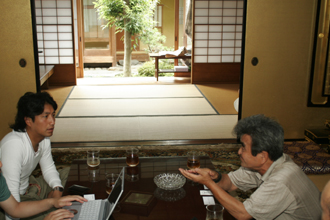
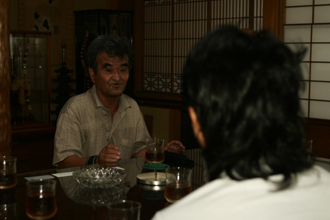
Yasuhiro Mihara visited a sock factory in Koryo Town, Nara Prefecture, one of Japan's leading sock production areas. In conversation with Takeshi Matsumoto of Le Monde and Hi Hisa Idei of Izuru Socks, who are passionate about sock making and concerned about the decline of Japan's sock industry, he explores the possibilities of creating unique socks.
Photos: Kaoru Mizobe (Hawk Eye Visual Works)Composition and Text: Yasuhiro Takeishi (City Lights)With the cooperation of: Hiroshi Hagino

A Declining Industry and a Passion for Sock Making
MiharaActually, the reason I asked Mr. Matsumoto about this was because I've been a long-time fan of the socks from my friend Hagino's brand, "Shape of my heart," and I learned they were made at Le Monde. I have flat feet, but they fit my feet well and feel very comfortable.
MatsumotoThank you. All of the "Shape of my heart" socks are made by Mr. Idei. We use a 60-gauge knitting machine, which is a rare piece of equipment that is almost no longer found in Japan.
The conversation quickly turned to the topic of manufacturing, as expected. Even with different perspectives, it's a natural flow when people involved in manufacturing come together.
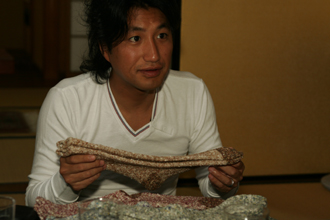
At this point, Idei began explaining sock making, taking out various samples, including the L-shaped socks for which he holds a joint patent with Matsumoto.
IdeiSocks are knitted in a tubular shape, and due to the characteristics of the knitting machine, the diameter is constant. Therefore, there are limitations to achieving comfort through patterns, and the stitch and yarn thickness become important.
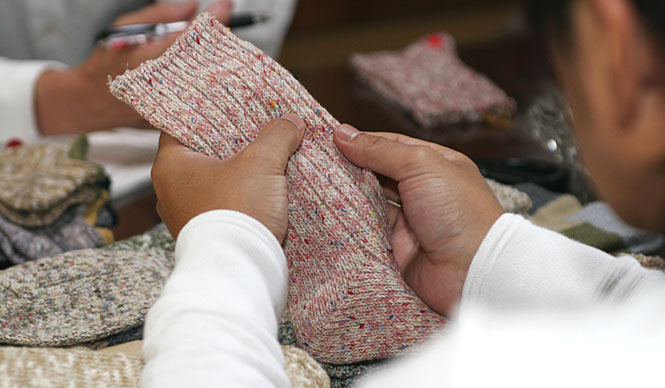
The 60-gauge socks made with Mr. Matsumoto have more room in the stitches than a typical 180-gauge machine, and we can use thicker yarn than usual. This means the relaxed stitches conform to the shape of each foot, resulting in very comfortable socks.
While 60-gauge knitting machines still exist in places like the US, the length and thickness can vary subtly between left and right. However, a Japanese factory would never produce such products.
MiharaI see. For the socks we're making this time, I want to focus not only on the design but also on the comfort.
IdeiDuring the designer boom era, I clashed with designers many times on that front. Design was prioritized above all else, and comfort was secondary. There were even designs that were impossible to wear (laughs).
MatsumotoNowadays, designers themselves rarely try to create socks, so those kinds of requests have mostly disappeared.

IdeiIn that sense, the sock industry could be said to be in a structural recession.
MiharaIs that so? By the way, are young people entering the industry?
MatsumotoCurrently, very few are. It seems like there are many young people in sock factories in China. However, I don't think large factories in China can produce meticulously crafted socks. The 60-gauge knitting machines require skilled artisans to operate them with care.
MiharaThat's what interests me. Today's consumers have grown up with mass-produced goods since birth. But precisely because of that, I believe they will perceive meticulously crafted items as something fresh.
While good design is essential, I want people to feel the "hand" of the maker in the overall presence and texture of the material. To achieve that, I felt the slightly rough texture unique to the 60-gauge knitting machine would be perfect.