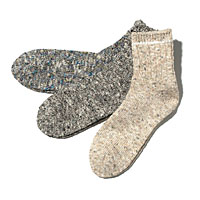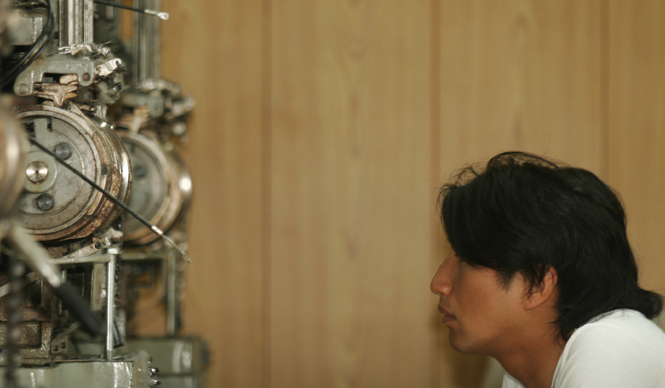
Yasuhiro Mihara's Japanese Craftsmanship: "The 3rd Installment: Le Monde Socks" (1)
MIHARAYASUHIRO x Le Monde
Part 3: Le Monde's Socks (1)
This is "MEANING MADE IN JAPAN MIHARAYASUHIRO (MMM)," a groundbreaking serialized project where fashion designer Yasuhiro Mihara visits Japan's proud factories and artisans to create new products that can only be made in Japan.
Socks are something we wear almost every day, yet it's hard to find ones that truly satisfy. Yasuhiro Mihara apparently shared this dissatisfaction and wanted to create high-quality Japanese-made socks. This time, he visited a sock factory in Koryo Town, Nara Prefecture, one of Japan's leading sock production areas.
Photos: Kaoru Mizobe (hawk eye visual works)Composition & Text: Yasuhiro Takeishi (city lights)Cooperation: Hiroshi Hagino

High-Quality Manufacturing in the Town of Socks
Socks began to spread in Japan, a country with a culture of tabi socks and bare feet, during the Meiji era. With Westernization, Western clothing became common, and socks were worn with leather shoes. In response to this demand, sock production began to flourish in Koryo Town, Nara Prefecture, from the late Meiji period.
Koryo Town, which had been a cotton and cotton fabric producing area since the Edo period, leveraged this background to introduce hand-cranked knitting machines for socks from overseas. In the Taisho era, automatic knitting machines were also introduced, and sock making spread as a side business for rice farmers during their off-season. At its peak after the war, over 200 sock factories were affiliated with the local cooperative.

Even today, Koryo Town boasts a 40% share of Japan's approximately 600 million pairs of socks produced domestically, the highest in the country. However, facing pressure from inexpensive imports from overseas, the number of affiliated factories has plummeted to just over 70, and production volume is said to be decreasing year by year.
Le Monde, based in Osaka, is involved in the manufacturing and sales of high-quality socks that can only be made here, working with sock factories in Koryo Town. Mr. Takeshi Matsumoto, the representative of Le Monde, served as our contact for this project. Mr. Matsumoto then guided Mihara to the workshop of Mr. Yuhisa Idei, the founder of Izuru Socks, a long-established company founded in 1977 with whom he has had a long-standing relationship.
IdeiIn Koryo Town, we imported knitting machines from America before the war, and after the war, sock manufacturing truly spread among farmers. During the period of high economic growth, everything sold well. Because production volume was high, we could even place custom orders for yarn and create things that couldn't be made elsewhere. However, eventually, inexpensive goods began to be imported in large quantities from China and South Korea, and the domestic share, which was once 60%, has now fallen to just over 10%.
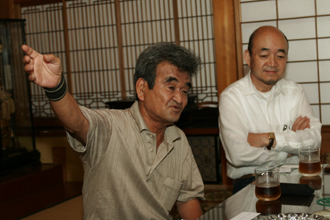
Takeshi Matsumoto of Le Monde (right) and Yuhisa Idei of Izuru Socks (left)
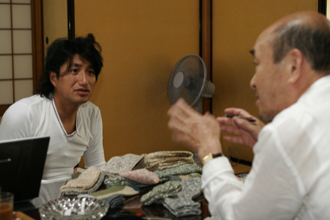
A Lively Conversation with Mihara
MiharaIs the situation that dire? However, I don't think we're in an era anymore where people buy three pairs of socks for 1,000 yen and throw them away when they get a hole. With the diversification of sock needs, such as a focus on natural materials, aren't we entering an interesting era?
MatsumotoIndeed, in Europe and the US, organic cotton socks are already popular among people with high environmental awareness. Japan will eventually see a rise in such discerning tastes.
While there are now synthetic fiber socks that claim moisture-wicking and quick-drying properties, these merely replicate the functions that natural materials inherently possess. With wool or hemp, comfortable socks can certainly be made by effectively controlling their properties.