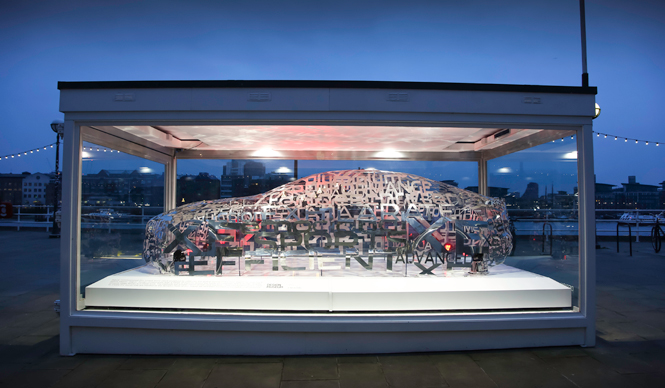
Understanding Design and Automobiles Today Through Milan Salone | Milano Salone
MILANO SALONE
Feature: Milano Salone International Furniture Fair 2015
What Milano Salone Reveals About Design and Automobiles Today
While known as the world's largest furniture fair, Milano Salone is increasingly seeing a stronger presence from automakers, as we've already reported, with Lexus even winning an award. Fumio Ogawa deciphers the "now" of each brand from the installations presented by various car manufacturers.
Text by OGAWA Fumio
Automakers with a Growing Presence
Though it began as a furniture fair, Milano Salone and Milan Design Week have grown into design events that attract international attention.Lexus won Best Entertaining Award in 2015Within this context, the presence of automakers has become significant.
In 2015, several automakers presented installations, primarily in Milan's Tortona district. In addition to Lexus,Mazda,Audi, which have already been covered, many other notable exhibits were on display.
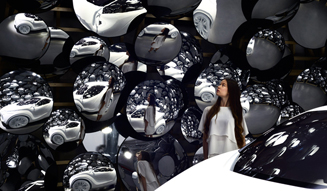
"LEXUS – A JOURNEY OF THE SENSES"
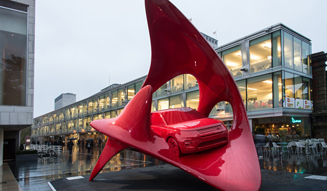
Land Rover "Unstoppable Spirit"
"Brands must be global, but to have a unique identity and presence within that is what truly defines a global brand. That's why we believe it's important to demonstrate appeal at Design Week,"
says Tsuneo Fukui, President of Lexus International. While Mazda showcased its manufacturing technology related to cars, MINI humorously presented its connection to the city, among other diverse exhibits.
If the underlying goal for all is brand appeal, then conversely, examining the distinct differences in each brand's presentation, which appear (in a sense) on the surface, is fascinating. Are they aiming to sell an image, or directly promote the car? This reveals the "now" of each brand.
MILANO SALONE
Feature: Milano Salone International Furniture Fair 2015
What Milano Salone Reveals About Design and Automobiles Today (2)
Peugeot: Centering the Automobile
Broadly speaking, the trends can be divided into three categories. The first is exhibits that center on the car itself. The second focuses on car manufacturing or related technologies. The third is about communicating cultural image. At Design Week, with its wide range of installations from furniture and fashion brands, there is room for diverse forms of expression.
Mazda and Audi are prime examples of exhibits that center on the car. Citroën also falls into this category. Within a space showcasing excellent contemporary French products under the theme "French Design," the Citroën Cactus was displayed alongside furniture and sports gear.
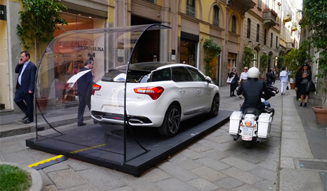
Citroen DS 5 Hybrid
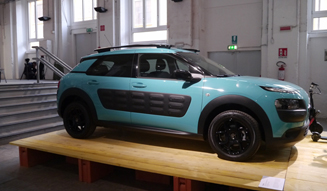
Citroen C4 Cactus
Its styling, stripped of aggressive elements, the refined interior with its sofa-like seats and hidden storage compartments, and the side panels with air bumps were all praised as creative design.
Concurrently, the DS5 Hybrid was displayed on Via Spiga, drawing the attention of passersby. The subtle lighting, enhanced by sunlight, beautifully highlighted its sharp character lines.
MINI: Proposing an Extension of the Car
MINI, in collaboration with renowned Spanish industrial designer Jaime Hayon, created a humorous concept for a future urban environment titled "Urban Perspectives." In front of the exhibition space stood two MINI 5-door models. Visitors drawn by curiosity were invited into the world of MINI beyond the gate.
Hayon, also known for his work with the luxury porcelain brand Lladró, presented a MINI installation brimming with the joy of "what if this city existed?" It featured buildings, connected by roads, and even kick scooters for personal mobility.
"MINI proposed a smart and stylish way for urban explorers. It doesn't necessarily have to be a car."
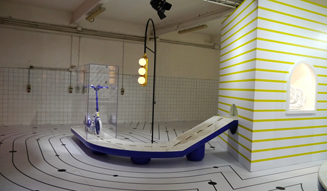
MINI "Urban Perspectives"
These are the words of Adrian van Hooydonk, who oversees design for the BMW Group, including MINI.
MILANO SALONE
Feature: Milano Salone International Furniture Fair 2015
What Milano Salone Reveals About Design and Automobiles Today (3)
Hyundai's Dynamic Display, Peugeot's Sonic Showcase
South Korean automaker Hyundai Motor Company linked advanced technology with its brand image in its installation, "Helio-Curve." This work was created by the Hyundai Motor Design Center, led by Peter Schreyer (formerly of Audi), in collaboration with kinetic artist Reuben Margolin, known for his dynamic sculptures.
"Helio-Curve" features 400 wooden pieces moving in a wave-like motion, reaching a height of three meters. The display, which fills the expansive space with a sense of slow yet powerful movement, is overwhelming. Hyundai explains that "recreating natural movements connects with Hyundai's design concept of fluid sculpture."
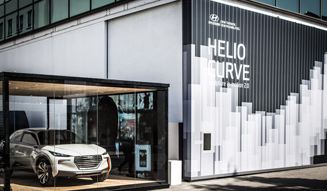
At the entrance, the concept car Hyundai Intrado
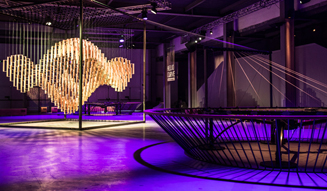
Hyundai "Helio Curve"
Hyundai accompanied the "Helio-Curve" with music composed by its sound design researcher, Love. Audi Design and Peugeot Design Lab also showcased musical instruments, with the former designing a Bösendorfer and the latter a Pleyel piano, both exhibited in Milan.
Pleyel is a French piano manufacturer founded in the early 19th century, having once built pianos for Chopin. Despite facing financial difficulties in recent years, Peugeot Design Lab has created a piano with a wooden body but FRP legs for lightness and reinforced hinges using automotive components for strength.
Notably, the internal structure, including strings and hammers, is aligned at the same height as the keyboard. "This allows the audience to see the pianist's finger movements from any angle. The pianist can also hear the sound more directly," according to Peugeot Design Lab.
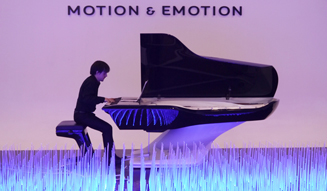
Peugeot Design Lab for Pleyel Piano
This piano prototype was first unveiled at the Paris Motor Show in autumn 2012, and was also exhibited at Milan Design Week in 2014. This year's presentation, however, featured a new installation by Swiss artists Fabian Oefner and Simon Heijdens called "Field of Sound." Within a 36-square-meter space, 5,000 plexiglass "blades of grass" swayed subtly in response to the Pleyel piano's melodies.
MILANO SALONE
Feature: Milano Salone International Furniture Fair 2015
What Milano Salone Reveals About Design and Automobiles Today (4)
Mobility as a Central Theme
Peugeot is also known for its contributions to the culinary world. Their pepper mills, first produced in 1874, continue to be a strong seller under the Peugeot brand. At the 2015 Milan Design Week, Peugeot Design Lab exhibited a "food truck" alongside the piano, directly linking food and automobiles.
"We designed the food truck not for chefs, but to offer restaurant and dining experiences to the general public. Peugeot's product development always centers on the user," says Cathal Loughnane, head of Peugeot Design Lab.
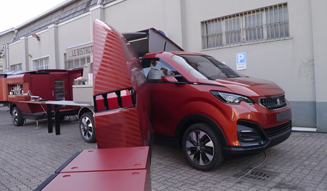
Peugeot Design Lab's "Food Truck"
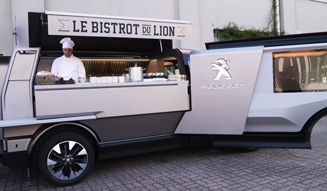
A chef at work in "Le Bistrot du Lyon"
The "food truck," composed of the main unit and a trailer, opens widely from the cabin backward, allowing for the serving of freshly prepared meals, much like the truck in the movie "Chef" (2014, USA). The name "Le Bistrot du Lyon," referencing Lyon, a region in southeastern France known for producing excellent chefs, is also notable. However, the specific dishes to be served remained unclear. Despite inquiries over three days asking, "Are you open today? Can I have something to eat?" the response was always, "Maybe later."
Aisin Seiki, part of the Toyota Motor Corporation group, which handles drivetrain, body, brake & chassis, engine, information, and also living and energy-related businesses, proposed a means of transportation for the near future. It was a serious exhibit, akin to those at the Tokyo Motor Show, but highly significant.
One such proposal is "ILY-A," described as a future personal mobility device equipped with safety features utilizing robot technology. Aisin Design was responsible for planning and design, while fuRo (Chiba Institute of Technology, Future Robot Technology Center) handled development.
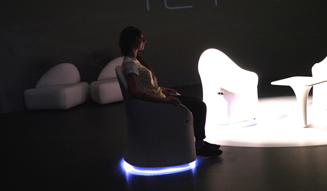
Aishin "ILY-I"
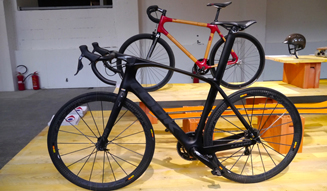 Mobility is an important design theme
It can move forward, backward, left, and right with a single button on the thumb, and can be used in four modes: a seated riding mode, a kickboard mode for standing, and more. Rather than being a toy, it was designed "with the mobility-impaired in mind" (according to an Aisin Seiki representative). Its ability to move freely makes it easier than a bicycle and more convenient than a car, suggesting it could be well-received in the market.
Aisin Seiki also exhibited a concept for an indoor, seated mobility furniture called "ILY-I." It is powered by battery energy, with direction controlled by a handheld controller and speed regulated by sensors. It is an "intelligent armchair" (according to the company), reflecting Aisin Seiki's involvement in the caregiving sector.
There were also many bicycle exhibits. While Design Week tends to focus on visual proposals, there weren't many cutting-edge technology displays. However, mobility will undoubtedly become an important theme everywhere.