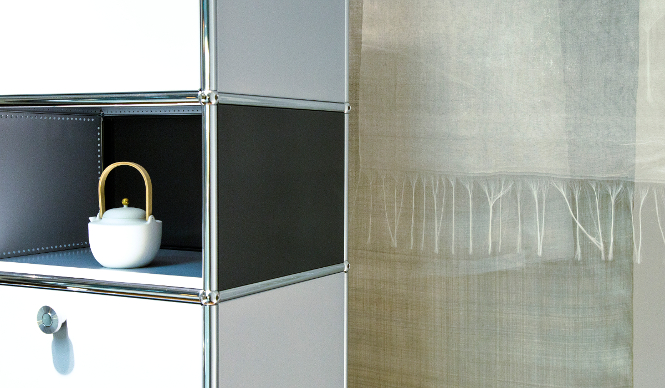
USM: Hirotoshi Maruwaka and Sara Yoshioka Discuss "USM Color Renaissance – The Equation of Beauty –"
USM
Maruwaka Hiroyuki x Yoshioka Sara: "USM Color Renaissance – The Equation of Beauty" (1)
<INTERSECTION> The Equation of USM's Beauty
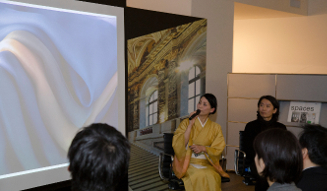
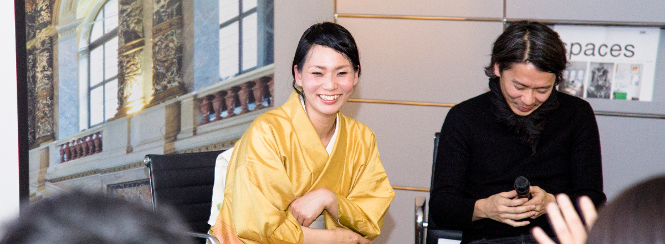
"USM Modular Furniture Showroom" 5th Anniversary "USM Color Renaissance"As a culmination of this program, a cross-talk was held on February 18th with Mr. Hiroyuki Maruwaka, representative of Maruwakaya, who directed the program, and Ms. Sara Yoshioka of Sometsukasa Yoshioka.
Photographs by Keisuke AsakuraText by Miho Tan (OPENERS)
USM Furniture Lets You Experience How Color Changes Life
Hiroyuki MaruwakaMs. Yoshioka, how do you consider beauty in your daily craft?
Sara YoshiokaEveryone has their own definition of beauty, don't they? An equation sounds rigid, but in my work, I focus on bringing out vibrant colors.
MaruwakaThe reason I wanted to collaborate with you on this project was precisely because I wanted to think about the essence of how colors are perceived.
YoshiokaMy primary goal is to draw them out in the most natural way possible. Expressing the sense of season is also very important. The theme of this project, "Color Renaissance," means the reconstruction of color. For each of the four seasons, I responded to Mr. Maruwaka's ideas and colors with my own creations, speaking through the "things" themselves. It felt like receiving a letter and sending a reply. That's how it was.
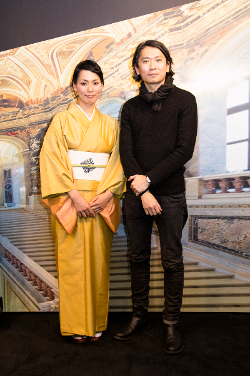
MaruwakaBy the way, what is the story behind the kimono you are wearing today?
YoshiokaI studied dyeing for over two years in Nomura Town, Seiyo City, Ehime Prefecture, before returning to my studio. During that time, I also helped with silkworm cultivation. I learned to spin the thread from the cocoons I was given and weave it myself, and this kimono is made from that. The other reason I chose this is the color. For the coming season, many flowers that start to bloom in the mountains and fields are yellow, aren't they? Like the Japanese adonis or rapeseed flowers.
MaruwakaEven on the photo shoot, we were thinking about the changing seasons, like "This is spring," or "This is summer."
YoshiokaIn the past, expressing the season through color was apparently a sign of high education. If someone wore something that evoked plum blossoms during cherry blossom season, they might be called "foolish." It seems that a slight anticipation, rather than being too early, was preferred.
MaruwakaIs that so? That's a concept often found in Japanese culture.
YoshiokaIt seems that people sensitive to the seasons were considered to have an appreciation for beauty.
MaruwakaThe words "beauty" and "season" have overlapping meanings, don't they? When translated into the Western word "Renaissance," it sounds like a grand event, but perhaps Japan's four seasons are a renaissance each time they change.
YoshiokaYes. Yes, exactly.
MaruwakaWith USM furniture, while frequently changing panels might be difficult, there's a similar feeling in enjoying the colors. Japanese people don't typically seek strong colors in their furniture. But USM furniture really lets you experience how much life changes with color. Is the perception of color different between Japan and Europe?
YoshiokaWhen I take my work overseas, people are surprised, asking, "How can this color come from plants?" The reaction is particularly strong in Europe. Incidentally, synthetic dyes originated in Britain and Germany. Before that, dyeing was done with natural materials.
MaruwakaThe creation of synthetic dyes suggests that Europeans had a strong affinity for color. But perhaps at some point, they forgot their starting point of passion for color and moved too far ahead? Does your family's tradition involve only natural colors?
YoshiokaNot entirely. The first generation was at the end of the Edo period, when everyone in Japan used plants for dyeing. With the introduction of synthetic dyes during the Meiji era, there was a sense of "Isn't it cool to adopt new things?" and Kyoto's dyeing houses all switched to synthetic dyes. So, our family also started using synthetic dyes in the latter half of the second generation. The third generation exclusively used synthetic dyes.
MaruwakaI actually thought the word "chemical" shouldn't even be used in relation to you, Ms. Yoshioka.
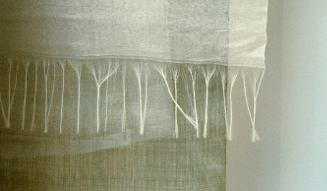
YoshiokaMy grandfather, the fourth generation, had to close the dyeing business once due to the war. When he reopened and revisited dyeing, he was apparently deeply moved by the beauty of the colors derived from plants that had been passed down through generations. Since the post-war period favored synthetic dyes, my grandfather researched and relearned plant-based dyeing methods. My father, the fifth generation, completely abandoned synthetic dyes and now uses only natural ones.
MaruwakaI see. There's quite a history behind it.
YoshiokaIt was a period of transition for Japan as a whole.
MaruwakaAt that time, everyone must have considered using synthetic dyes as the equation for beauty, right? The equation of beauty changes with the times, and also with gender and nationality. Among these, what many people, including yourself Ms. Yoshioka, find beautiful now, is ultimately the color of nature.
USM
Hiroyuki Maruwaka x Sara Yoshioka: "USM Color Renaissance – The Equation of Beauty" (2)
<RENAISSANCE> The Equation of Beauty Incorporated into Maruwakaya's Concept
The Sense of Beauty Arises After Awe and Comfort
MaruwakaWith "USM Color Renaissance," we wanted to provide an opportunity for people to re-recognize the colors in their daily lives. The inspiration for this came when I saw USM furniture. I was impressed by how it conveyed a sense of luxury through color. And, since we were doing this in Japan, I wanted to connect with Japanese colors as well. When my mind was filled with thoughts of color, color, color, I remembered Ms. Yoshioka's studio, overflowing with color. First, with theSpring versionand so on.
YoshiokaThe fabric on the right is inspired by cherry blossoms, so you could call it cherry blossom pink. The one on the left is willow. There's a phrase in the old Kokin Wakashu that says, "Mixing willow and cherry blossoms," and the combination of cherry blossom pink and light willow green is very beautiful.
MaruwakaAs it's spring, I wanted to express the image of the trunk emerging from the snow, followed by the new green leaves, and then the blooming flowers.
YoshiokaThe furniture Mr. Maruwaka selected has a rather subdued color palette, so it matched perfectly.
MaruwakaThe photo shoot was challenging. This is because the points where USM's colors shine and the moments when the naturally dyed fabrics glow have different lighting conditions. It took a considerable amount of time to achieve lighting that made both look beautiful.Summer versionfeatures white and blue for both the fabric and the furniture.
YoshiokaThis is indigo dyeing, using a technique called itajime shibori, where the fabric is clamped between boards to create resist dyeing. This results in a striped pattern. The one on the left uses the same technique, but I chose a design with a structure similar to the checkerboard pattern of USM furniture. We wanted to deliver a beautiful image, like a clear stream, for the hot summer.
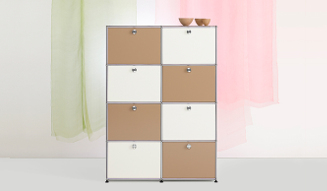
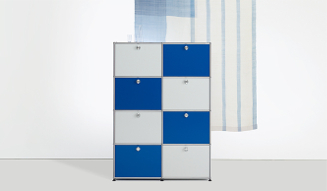
MaruwakaLooking at this, one might think of spring, and this one feels cool, as if seeing not just the color but also the image it evokes. Even though it's just a different color.
YoshiokaBy changing the panel color from beige to blue, it becomes summer.
MaruwakaIndeed, this blue is truly beautiful. We installed the same setup in the shop window, and it conveyed a sense of coolness at night and during the day. Even amidst the trial and error, I felt like we had discovered something.
For spring and summer, we focused on the objects themselves, but for autumn and winter, there were various ideas. What kind of atmosphere would be created if people were here? That furniture and natural dyes are completed by the presence of people. Furthermore, USM furniture is meant to be used; it's not an art piece. And I wanted to showcase Ms. Yoshioka's fabrics in large formats, so my desires grew.
Then, we came across a Japanese house belonging to a mutual acquaintance. It's not a permanent residence, but someone actually lives there. When we first visited for location scouting, before even considering if it would work or be possible, I felt an overwhelming desire to shoot there.
YoshiokaWe started from the perspective of, "What can we do here?"
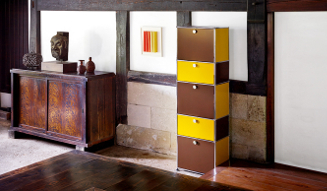
MaruwakaDuring the shoot, we proceeded without assigning specific purposes, like "This is for shoes." In an era where objects are abundant, owning things is essential for necessity, but another motivation is the desire to use them or enrich one's life. I believe it's important to convey the latter.Autumn version's fabric gradient is in what colors?
YoshiokaFive colors. Mr. Maruwaka's selection was in subdued tones of yellow and brown, so I arranged colors from yellow to red to represent the autumn foliage of Japan.
MaruwakaSeeing the actual pieces, they are so vibrant they almost leap out at you, making it hard to believe they were dyed with natural materials. Yet, they are colors that then blend in harmoniously. There is no experience of beauty without awe.
YoshiokaIndeed.
MaruwakaAfter the awe, when there's a lingering sense of comfort, one probably perceives it as beautiful. First surprise, then silence.
YoshiokaLike savoring the afterglow.
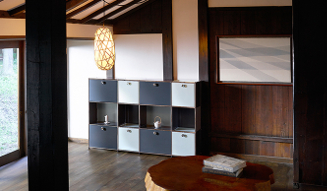
MaruwakaIt was truly an experience of feeling beauty. Not to spoil the surprise, but theWinter versionwas also shot on the same day. However, we changed the location. While autumn was at the entrance, winter was in the inner room.
YoshiokaFor winter, the framed piece in the upper right is ours, and it's made of Japanese paper. And as I mentioned earlier, it's dyed with plants, but this one is finished with light ink. It's something I wrote freely by hand, and it matches perfectly, both in color and with the house.
MaruwakaRegardless of the country or era, when Japanese people see it, it brings a sense of calm without any particular reason. And when people from overseas see it, they feel a sense of Japaneseness, or perhaps a sense of closeness to their own lives. I believe it was a mysterious space and visual.
USM
Hiroyuki Maruwaka x Sara Yoshioka: "USM Color Renaissance – The Equation of Beauty" (3)
<FUTURE> The Equation of Beauty They Envision for the Future
To Preserve Tradition is to Keep Creating Forward
MaruwakaBefore we discuss the FUTURE, there's something I wanted to ask. What kind of child were you, Sara?
YoshiokaMy father is currently the fifth-generation head of the family, but when I was born, he was running an art publishing company. One of his tasks was to publish the research done by my grandfather. So, I felt like I was observing the process of creating something from both perspectives. Also, my grandfather's work was very old-fashioned, and children weren't really allowed in. Because I wasn't allowed in, I became even more curious, and my childhood was spent peeking in through the gaps.
MaruwakaEven as a child, when you saw dyed objects, did you think they were beautiful?
YoshiokaI did. And because it was a place with many people, I was drawn to the idea of many people working together to create something.
MaruwakaI see. The reason I asked is that the theme of FUTURE reminded me of a friend's story. He loved Gundam dearly as a child, and now he's a car designer. It's not quite "the soul of a three-year-old lasts until eighty," but he was talking about how people unconsciously pursue what they found beautiful or enjoyable as children. Color is the same; what we find beautiful might stem from childhood experiences and sensibilities. That connects to the future.
YoshiokaPeople often ask me, "Are you looking for new colors?" or "Are you creating new works?" But from the moment I decided to go back to using plants, my basic principle has been to preserve the techniques used before the introduction of synthetic dyes. I believe that using only natural materials, including fixatives, is part of preservation, so I rarely feel the urge to search for new things. However, through this project, I realized that I can create new expressions while still preserving tradition.
MaruwakaWe often use the word "preserve" in relation to tradition, but I think we can redefine the word "preserve" itself. Preservation fundamentally requires always looking forward and having conviction and passion in one's heart. When foreigners praise Japanese traditions, it's because of that forward-looking spirit and unwavering determination.
However, the Japanese concept of preservation can sometimes feel a bit backward-looking, with phrases like "We mustn't change it." I believe what mustn't be changed is the feeling, the inner conviction.
YoshiokaThat's right. We also say that we don't change our techniques, but we are always making small improvements. Nowadays, the earth's vitality is weakening, and the pigment content in plants is decreasing. This means we have to increase the amount we use. Two years ago, when there were many typhoons and indigo didn't grow well in Tokushima, we made indigo paste ourselves from the indigo we grow. So, while preserving, I think we are also evolving little by little.
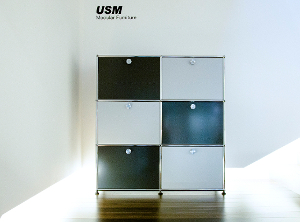
MaruwakaEven with rules for continuous preservation, the possibilities for the future are infinite, aren't they? USM's visual appeal remains unchanged, but the pipes that form the joints and the opening mechanisms have undergone numerous model changes. They are completely different from the originals. It truly feels like they are constantly advancing and evolving. And I believe they will continue to change. The fact that they do this without showing it externally is also remarkable.
YoshiokaI hope there will be more opportunities for beautiful colors and aesthetics to emerge in new places.
MaruwakaWe are undoubtedly living in the 21st century, and we cannot go back to the 18th or 16th centuries. With no choice but to move forward, I want to continue creating new inspiration through our craft. I am very happy to have collaborated on such a refreshing project that inspires such feelings.
USM
Tel. 03-5220-2221
http://www.usm.com
Maruwakaya
Based in Japan and France, Maruwakaya accurately captures the essential and absolute beauty hidden within traditional objects. Through innovative initiatives that find infinite potential in the highest levels of craftsmanship across a wide range of fields, from traditional crafts to cutting-edge industry, they offer surprise and joy to the lives of people living in the 21st century. They opened "NAKANIWA" in Saint-Germain-des-Prés, Paris, an exhibition and sales space for exquisite Japanese goods.
www.maru-waka.com
Sometsukasa Yoshioka
A dyeing house in Kyoto that has continued since the late Edo period, now in its fifth generation. They draw beautiful colors from plants nurtured by nature, such as gromwell (Murasaki), safflower (Beni-bana), madder (Akane), indigo (Tadeai), and dwarf lilyturf (Kariyasu), and dye natural materials like silk, hemp, and cotton in faithful adherence to ancient methods. Using these traditional techniques, they are involved in events for ancient temples and shrines, such as dyeing the artificial camellia flowers used in the Shuni-e ceremony at Todai-ji Temple. Supported by water drawn from 100 meters underground and hands that carefully engage with nature, they repeat their quiet days, cherishing the past.
www.sachio-yoshioka.com