REPORT: C.W. Nicol and Others Advance the “Forest School” in Higashimatsushima City, Miyagi Prefecture
REPORT
Rebuilding an Elementary School in Higashimatsushima City, Miyagi Prefecture, Spearheaded by C.W. Nicol and Others
Learning the Wisdom of Life at the "Forest School"
In Higashimatsushima City, Miyagi Prefecture, a plan is underway to create a school within a forest, utilizing the local natural environment, as part of rebuilding an elementary school that was devastated by the tsunami. This initiative is known as the "Forest School." Supporting this project is C.W. Nicol, who resides in Nagano Prefecture. Drawing on his experience with the "Afan Forest" he revitalized in Kurohime, Nagano, he has launched a school in collaboration with local government, experts, and residents, where children can learn extensively from nature.
Text by MINOWA Yayoi (Environmental Journalist)
A Story of Rebirth Beginning with a Treehouse
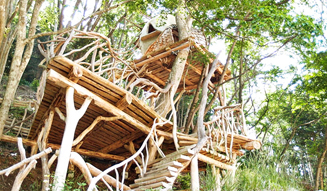
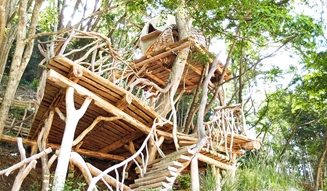
Beyond a road lined with serene rice paddies on both sides, a peculiar treehouse suddenly appears, nestled against the forest. Called the "Tree Dragon" for its shape, which seems to ascend like a mythical creature along the forest slope, it also symbolizes the "Forest School"—a beacon of hope and aspirations for the people of Higashimatsushima City, Miyagi Prefecture, connecting them to the future.
The "Forest School" is a project spearheaded by C.W. Nicol, who has dedicated himself to revitalizing Japan's forests for many years since arriving in the country 50 years ago. It aims to rebuild a school lost in the earthquake and tsunami for the sake of the children. The treehouse stands as a symbolic presence for this endeavor.
Completed in June 2013, the treehouse saw children and local residents assisting with tasks such as stripping bark from the wood and painting the walls. Over 90% of the materials used were sourced from the trees and stones originally found on this site. The twisting wood and the sensation of spiraling upwards into the forest make it a fun and magical structure that brings smiles to both children and adults upon experiencing it.
Dragons are said to symbolize rebirth. What kind of story of renewal will begin from this treehouse?

In Higashimatsushima City, where the Forest School is planned, the 2011 earthquake and tsunami resulted in over a thousand deaths and inundated more than 60% of the urban area. Of the 14 schools, six were submerged, and three, including Nobiru Elementary School, became unusable. Currently, children from these three schools are studying in temporary facilities or at other schools.
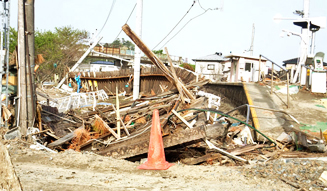
I cannot forget my visit to the Nobiru district of Higashimatsushima City in May 2011. One nursery school was flooded, with uprooted trees lodged in its windows, and the railway tracks were twisted like a fence. The phrase 'lost for words' is truly apt. I remember being unable to speak for quite some time.
Visiting the Nobiru district of Higashimatsushima City again and seeing this treehouse, with its surrounding fields and paddies restored, brought me joy. It was because I felt a definite sense that 'something new is about to begin.'
Hearts Wounded by Nature Can Only Be Healed by Nature
C.W. Nicol has lived in Japan for 50 years. Upon his arrival, he was astonished by the richness of its biodiversity, noting that despite being an island nation like his native Britain, it was home to two species of wild bears. However, as Japan reveled in the bubble economy of the 1980s, he witnessed firsthand the destruction of its primeval forests and began protecting and restoring the forest near his home in Kurohime. Over 28 painstaking years, he revitalized a forest locally known as the "Ghost Forest," renaming it "Afan Forest."
Today, Afan Forest nurtures a rich ecosystem, with approximately 52 species of flora and fauna, some of which are regionally endangered, now found there. To ensure the forest's perpetual existence, it was established as a foundation in 2002, and activities such as the "5 Senses Project" have been conducted, offering "forest healing" and "forest activities" for children, including those with disabilities.
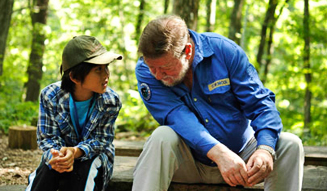
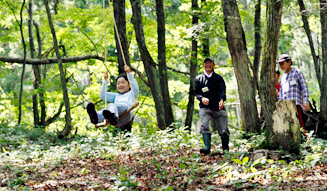
Nicol, who says, "I once learned about Japan's nature from its children," likely felt it natural to apply his wisdom and experience of the forest to heal children who were traumatized and emotionally scarred by the disaster.
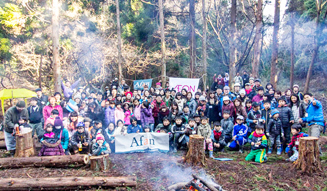
In May 2011, children from Higashimatsushima City, their families, and 27 city officials were invited to Afan Forest. Despite their short three-day stay, upon returning to their shelters, those around them were astonished, remarking that they had "returned with the faces they had before the earthquake."
"The fact that Afan Forest was revitalized over 26 years means that Higashimatsushima City can achieve the same."—The thoughts of the city officials who participated, sensing the city's future in Afan Forest, led to the concept of the Forest School. Subsequently, in February 2012, the "Higashimatsushima Forest School Project Committee," comprising the city and experts, was established.
Learning in the Forest, Acquiring the Skills to Live
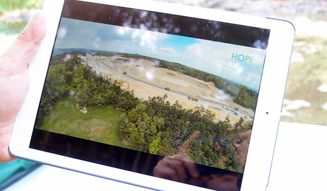
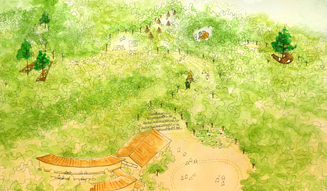
Currently, in the Nobiru district of Higashimatsushima City, a decision has been made for residents to relocate to higher ground, and plans are in place to build the affected JR Senseki Line's Nobiru Station and the Forest School on this elevated site.
A 8.7-hectare forest adjacent to a wooden school building constructed with domestic timber will be designated the "Reconstruction Forest." The plan includes various elements within the forest designed for children to learn skills for living in nature, such as an outdoor skills learning field.
However, some children will graduate before the completion of the elementary school, which is a lengthy process. For these children, the Forest School has begun offering outreach classes this year, utilizing the local fields and the treehouse.
A diverse range of classes are being conducted, including observing creatures in the rice paddy irrigation channels to learn about the local biodiversity, experiencing rice planting and harvesting, and creating biotopes for displaced wildlife.
"The entire community is the school."—Risako Noguchi, Director and Secretary-General of the Afan Forest Foundation, who also serves as the secretariat for the "Higashimatsushima Forest School Project Committee," explains this.
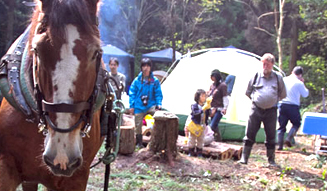
The construction process of the facilities scattered throughout the Reconstruction Forest also offers learning opportunities. "Horse logging," a traditional Japanese technique, is being utilized for transporting materials and thinning timber. Horses, working alongside humans without expending energy and without damaging the forest, are also popular among children. Children who experience horse logging, a practice being reconsidered in countries like the UK and Canada, gain yet another vital life skill.
The elementary school is scheduled for completion in three years, in 2017. The town and the station will be relocated, with the entire town moving to higher ground. Some children will commute to the Forest School via the treehouse. It is essential to keep an eye on Higashimatsushima City to see how the revitalized town will evolve, what experiences the children will have in the Reconstruction Forest, and how they will apply these lessons to the future.
Reference Sites
C.W. Nicol Afan Forest Foundation Reconstruction Project
https://www.afan.or.jp/af-fukkou/gakkou.html
*Support is being sought for the "Reconstruction Forest and Forest Classroom Plan" as it is being carried out through private initiative.
C.W. Nicol
Author / Chairman of the Board, General Incorporated Foundation C.W. Nicol Afan Forest Foundation
Born in Wales, UK, in 1940. Drawn to nature, he moved to Canada at age 17 and subsequently worked in nature-related fields in various countries around the world. In 1980, captivated by Japan's natural beauty, he settled in Kurohime, Nagano Prefecture, and began his career as an author. In 2002, he established the General Incorporated Foundation C.W. Nicol Afan Forest Foundation and assumed the position of Chairman. Alongside his writing, he expresses concern over the degradation of Japan's natural environment and actively works to restore nature and ecosystems by purchasing and revitalizing devastated forests. His numerous works include "The Story of Afan Forest" (Art Days).
箕輪弥生|MINOWA Yayoi
Environmental writer and board member of the NPO "Sorabea Fund." She engages in activities that promote and practice renewable energy, organic food, and natural materials through writing environmental articles and books, and by managing "Froma Cafe & Gallery," a green cafe near Yanaka, Tokyo. Her books include "Towards an Energy Shift: 123 Tips for Saving Electricity and Energy" and "A Recommendation for an Eco-Friendly Lifestyle" (Asuka Publishing).
http://gogreen.petit.cc/