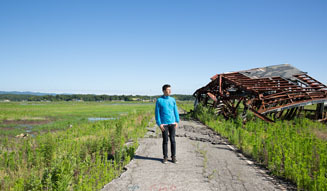
INTERVIEW: Roland Kirishima on “After 3.11”
INTERVIEW
A Sustainable Community Cafe in Minamisoma City, Fukushima
Roland Kirishima's Vision for Post-3.11 Regional Revitalization
Roland Kirishima, a photographer and creator involved in a wide range of projects, is beginning to establish a community cafe—a place for people to gather—in Odaka Ward, Minamisoma City, Fukushima, located within 20km of the Fukushima Daiichi Nuclear Power Plant. We asked him why Fukushima, and about the significance and concept behind creating a cafe there.
Text by MINOWA Yayoi
Broadcasting a New Way of Life from Minamisoma City
Three years have passed since the Great East Japan Earthquake. Over 260,000 people are still unable to return to their hometowns. It is also true that real information about Fukushima's current situation is scarce, and the interest that was so strong immediately after the disaster has waned.
Roland Kirishima, who had acquaintances in Soma City, Fukushima, had visited Minamisoma City in Fukushima Prefecture several times since right after the earthquake. He had also passed through Odaka Ward in Minamisoma City, within 20km of the Fukushima Daiichi Nuclear Power Plant, on his motorcycle a few times.
This area includes the 'Evacuation Order Lift Preparation Zone,' where people can only enter from morning until evening, and the 'Restricted Residential Zone,' where entry is prohibited. Recently, some businesses, such as barbershops, have begun to reopen in the areas accessible during the day.
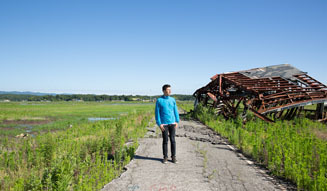
'In a sense, I believe it's the most challenging place,' Kirishima says. 'However, when I come to places like this, see the actual situation, and talk with the local people, I strongly feel the need for a place to inform people about Fukushima's current situation.'
'We must not let the lessons learned from the earthquake and nuclear accident fade,' he continues. 'Precisely because it is such a difficult place, I believe there is meaning in proposing a new way of life for the next generation.' With this conviction, he has begun working to create a community cafe in Odaka Ward where people can gather.
A Place to Learn About Energy
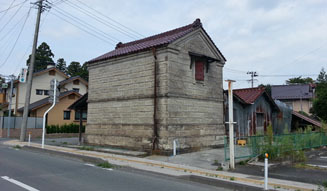
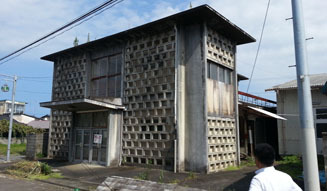
The cafe he envisions would involve renovating an existing, currently vacant building. The structure would incorporate systems designed for self-sufficiency, minimizing the use of conventional energy. He plans to frequently host events such as talk shows, live performances, and opportunities for interaction with local residents. It would be a place where young people from the city, residents of Fukushima, workers at the Fukushima Daiichi plant, and tourists wishing to see the affected area with their own eyes can stop by, chat, and enjoy a delicious cup of coffee.
Kirishima, who has long been interested in energy issues, aims to incorporate not only batteries and solar panels but also the concept of 'Exergy'—the idea of skillfully utilizing natural forces in architecture. Exergy, advocated by environmental architect Tetsuhiko Kuroiwa, is a system for creating comfort without relying on energy, such as warming rainwater with solar heat and using its radiant heat for warmth, or utilizing the cooling effect of rainwater and wind in the summer. He also wants the cafe to openly share its energy balance, creating a space where people and children can learn about energy.
Architect Kengo Kuma, known for his extensive experience in sustainable architecture, is expected to join the project as a member, contributing to the actual design and renovation. The collaboration with Kuma, whom Kirishima knows well and who also designed Kirishima's home, is sure to bring about new developments.
'I have seen many examples where young people moving into depopulated areas trigger some kind of chain reaction,' Kirishima says with anticipation. 'Even in places that are currently lifeless, when young people start new initiatives while involving the local community, it can become a catalyst for creating movement.'
Making Soma a Hub for 'Modern Warhorses'—Custom Motorcycles
Kirishima has another plan: to make Minamisoma famous for custom motorcycles. Soma City in Fukushima Prefecture hosts the 'Soma Nomaoi,' a traditional festival that has continued for over a thousand years. It is a magnificent and heroic festival where over 500 mounted samurai, clad in armor and carrying swords at their waists and banners on their backs, charge forward. The history of Nomaoi resonates in Minamisoma City.
He conceived the idea of developing motorcycles, the 'modern warhorses,' into an industry for Minamisoma. 'Japanese custom motorcycles, with their high quality, are popular worldwide—they are essentially Cool Japan products,' explains Kirishima, who enjoys motorcycles and has experience in racing.
'Soma has plenty of space, and if the product is motorcycles, the issue of reputational damage will have almost no impact. On the contrary, the world will likely accept the 'Made in Fukushima' label. It's not too far from Tokyo, and it could be a business that young people can get involved in,' he explained the significance.
Naturally, he wants to connect this with the community cafe to create a place that attracts many people. Furthermore, he emphasizes the importance of making the process of creating both the community cafe and the custom motorcycle shop public, and resonating with the story itself.
This plan also involves crowdfunding from those who resonate with the project, and Kirishima intends to follow its progress closely.
Roland Kirishima
Photographer, filmmaker, and creator. Graduated from New York University's Tisch School of the Arts with a degree in photography. Began his career as a photographer in New York before moving his base of operations to Tokyo in 1993. His father is American, and his mother is the writer Yoko Kirishima. His siblings include model and actress Karen Kirishima and essayist Noel Kirishima. He married in 2002 and is a devoted father of two children. In 2007, he participated in the Dakar Rally for the first time in the motorcycle category and completed it. In the 2013 Upper House election, he ran for a seat in the Tokyo constituency. Although he did not win a seat, he garnered over 320,000 votes. Currently, while busy as a photographer, he is steadily continuing to support disaster-stricken areas affected by the Fukushima nuclear accident and engage in volunteer activities, doing what he can with his own efforts. His co-authored book is 'Kirishima-kun, Nande Kimi wa Senkyo nanka ni Dōshiyō to Omoitandai?' (a dialogue with Soichiro Tahara / published by Magazine House).
http://rowland.jp/
MINOWA Yayoi
Environmental writer and director of the NPO 'Sorabea Fund.' She engages in activities to promote and practice renewable energy, organic food, and natural materials through writing articles and books on environmental topics, and by running 'Froma E Café & Gallery,' a green cafe near Yanaka, Tokyo. Her books include 'Energy Shift e Mukete: Setsuden/Shōene no Chie 123' and 'Kankyō Seikatsu no Susume' (published by Asuka Shinsha).
http://gogreen.petit.cc/