REPORT | The "Metabolism, the Future City: Visions and Dreams of Post-War Japan's Reconstruction" Exhibition
REPORT: "Metabolism's Future Cities: Reimagining Post-War Japan's Dreams of Reconstruction and Vision"
Metabolism: A Reconsideration for Japan's Reconstruction Today (1)
Metabolism is a unique architectural movement that emerged in Japan, and its activities have been re-evaluated worldwide in recent years. It represents an era in Japan that culminated with the post-war reconstruction and the EXPO '70.Great East Japan EarthquakeThere are many parallels between present-day Japan, which is on the path to reconstruction after overcoming the Great East Japan Earthquake, and the period when Metabolism began, following post-war recovery and heading towards high economic growth. We want to take Metabolism as an opportunity to reconsider the ideas that architects and designers of that era held as they sought to build Japan.
Photos and text by Takashi Kato
Over 500 Works: A Highly Engaging Exhibition
Metabolism, a Japanese architectural movement, is now in its 51st year. Its first major retrospective exhibition is currently being held at the Mori Art Museum in Roppongi. The Mori Art Museum has previously hosted architectural exhibitions, such as the "Le Corbusier Exhibition" in 2007, showcasing the appeal of architecture and cities in a broad sense, encompassing art and design as well as architecture. The "Metabolism's Future Cities: Reimagining Post-War Japan's Dreams of Reconstruction and Vision" exhibition offers a compelling, multi-faceted exploration, examining not only the architectural aspects of Metabolism but also its relationship with the politics of the time, its role in society, and its reception globally.
Metabolism, a term from biology meaning "new life," is a global architectural movement that originated in Japan in 1960. Its activities are known for bringing together prominent creators of post-war Japan, including architects Kisho Kurokawa, Masato Otaka, Fumihiko Maki, and industrial designer Kenji Ekuan, and critic Noboru Kawazoe, who were influenced by architect Kenzo Tange, as well as architect Arata Isozaki and Yoshio Otani.
The exhibition is divided into four main sections, tracing Metabolism's development from its inception to its global reach: "The Birth of Metabolism," "The Age of Metabolism," "From Space to Environment," and "Global Metabolism." Featuring over 500 works, it dynamically presents approximately 80 projects associated with Metabolists, brought to life through models and newly created CG visualizations for this exhibition.
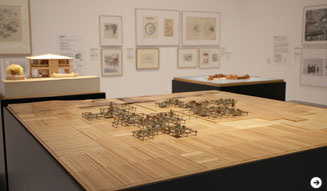
Foreground: "Rural City Planning - Kisho Kurokawa" (1960)
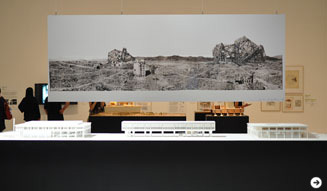
Foreground: "Hiroshima Peace Memorial Park - Kenzo Tange, Takashi Asada, Yoshio Otani, et al." (Completed 1955)
The first section, "The Birth of Metabolism," introduces the historical context in which Metabolism, meaning "new life," emerged. It covers Japan's post-war reconstruction and the World Design Conference held in Tokyo in May 1960, which invited renowned designers from around the world and served as a catalyst for the movement. Through timelines and valuable archival materials, visitors can understand the struggles of architects and designers striving to improve people's lives in the austere post-war period.
Particularly striking are the model of Kenzo Tange's "Hiroshima Peace Memorial Park," a symbol of the city's reconstruction after its devastation by atomic bombing, and the sketches and model of Kisho Kurokawa's "Sky House." Both structures, with their elevated platforms reminiscent of the Horyu-ji Temple's treasure house, evoke traditional Japanese architectural styles. This highlights that Metabolism was not merely about creating novel forms but also about forging a new Japanese architectural identity by incorporating traditional elements.
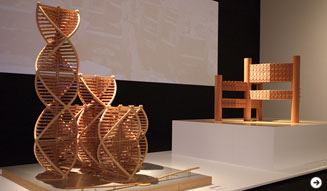
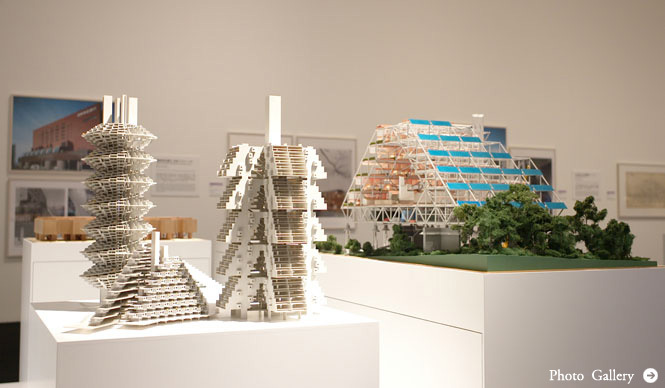
Left: "Tokyo Plan 1961 - Helix Plan - Kisho Kurokawa" (1961), Right: "Aerial City - Shinjuku Plan - Arata Isozaki" (1960)
REPORT: "Metabolism's Future Cities: Reimagining Post-War Japan's Dreams of Reconstruction and Vision"
Metabolism: A Reconsideration for Japan's Reconstruction Today (2)
Architecture That Liberated Fixed Values
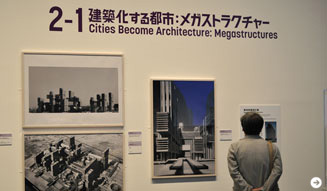
The subsequent section, "The Age of Metabolism," focuses on proposals for new cities with expandable structures in Tokyo Bay, beginning with Kenzo Tange's "Tokyo Plan 1960." It also features Kisho Kurokawa's "Floating City 1963" with towers on an amorphous floating platform, and his "Tokyo Plan 1961." Though incomplete, these projects, conceived amidst the urgent need for post-war reconstruction, showcase Metabolism's unique urban-scale proposals, conveying the dynamism of cities incorporating megastructures.
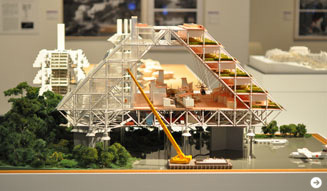
"Layered Structure Module - Kisho Kurokawa" (1972)
The keyword here is "megastructure." This refers to a single, immense structure that contains various urban functions, such as city structures and infrastructure. Metabolists viewed megastructures as symbols of "environment," liberating cities and architecture from the constraints of land and enabling dynamic fluidity and interchangeability, moving beyond conventional, fixed architecture.
The "capsules" and "modules" characteristic of later Metabolism architecture are concrete examples of this concept.
These works, focusing not only on their aesthetic appeal but also on their functional aspect of self-replication as needed, can be considered prescient proposals with enduring relevance even today.
Furthermore, considering the scarcity of grand visions encompassing urban planning by architects since Metabolism, these exhibits, rich with insights, can be seen as a timeless message from the Metabolists, especially relevant now as Japan strives for reconstruction following the 3/11 earthquake.
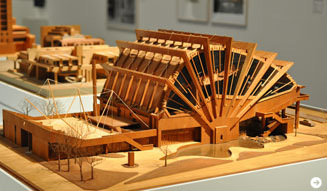
"Miyakonojo City Hall - Kisho Kurokawa" (Completed 1966)
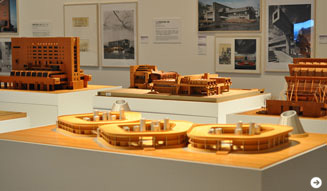
The "From Space to Environment" section explores how Metabolism's concept of environment interacted with people's lives during a period of rapid economic growth in the late 1960s, following over two decades of post-war recovery, and as the value of the environment began to be recognized globally. This era culminated in the 1970 Japan World Exposition, Osaka (Expo '70). The exhibition features a scale model of the entire Expo site and panels actually used in the capsule-shaped Expo Tower designed by Kisho Kurokawa, offering a delightful and colorful display that still evokes a sense of wonder.
Simultaneously, this period saw the global emergence of various countercultures, such as Pop Art, Happenings, and the Hippie movement, which questioned the uniformity of mass consumer society and focused on aspects of humanity. It was perhaps Metabolism's most vibrant era, where the architecture of the Metabolists, with its grand megastructures, uniquely coexisted with individual-centered lifestyles. This section also displays works related to the contemporary art, design, and music of the time, showcased at Expo '70.
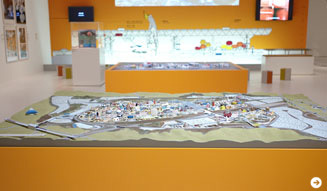
"Master Plan for Core Facilities - Kenzo Tange, Uzo Nishiyama"
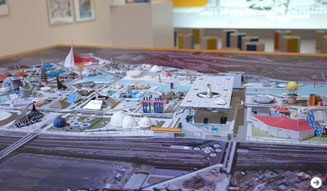
"Master Plan for Core Facilities - Kenzo Tange, Uzo Nishiyama"
REPORT: "Metabolism's Future Cities: Reimagining Post-War Japan's Dreams of Reconstruction and Vision"
Metabolism: A Reconsideration for Japan's Reconstruction Today (3)
Presenting Grand Visions for the Future
The "Global Metabolism" section focuses on the international activities of Metabolists. It showcases overseas projects, including Kisho Kurokawa's floating city model and the ongoing "Ruyi District Urban Planning Project in Zhengdong New District, Zhengzhou City," which passed from Kisho Kurokawa to Arata Isozaki.
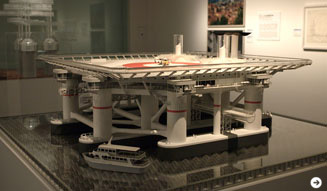
"Floating City - Aquapolis - Kisho Kurokawa" (1975)
Particularly noteworthy is the large-scale model of Kenzo Tange's "Skopje Urban Area Reconstruction Plan," a project for the reconstruction of the capital of Macedonia following a major earthquake. Skopje is known for being devastated by an earthquake in 1963. Kenzo Tange won the UN competition for its reconstruction plan. The model, exhibited in Japan for the first time, was miraculously preserved in Skopje and, despite some missing parts, evokes a sense of loss associated with the earthquake.
In addition to the four exhibition sections, the "Metabolism Lounge" displays ongoing projects influenced by Metabolism and offers a space for viewing related materials. These can be seen as proposals for new urban models that align the Metabolists' philosophy with the vision for reconstruction following the 3/11 earthquake. It's an engaging corner for contemplating Metabolism's past and future.
The "Metabolism's Future Cities: Reimagining Post-War Japan's Dreams of Reconstruction and Vision" exhibition brings together a diverse range of works that appeal not only to architecture enthusiasts but also to a wider audience. The materials, offering insights into post-war Japan, are largely from the private collections of the Metabolists themselves. Many of the sketches and drawings, showcasing the thinkers' and creators' processes, are also rarely seen by the public.
From post-war reconstruction and high economic growth to the birth of Metabolism and its climax at the World Expo, this exhibition captures a significant era of post-war Japan. The grand visions drawn by Metabolists, which then spread globally, seem to have diminished thereafter.
The subtitle, "Dreams and Visions of Reconstruction," seems to connect the philosophy of Metabolism, born from a forward-looking perspective, with the hopes and aspirations for recovery following the recent earthquake.
In the context of post-3/11 reconstruction efforts, the Metabolists' work, which aimed to design the social systems surrounding architecture and design itself by presenting concrete, grand visions for the future, rather than focusing solely on individual architectural designs, deserves renewed attention today.
Metabolism's Future Cities: Reimagining Post-War Japan's Dreams of Reconstruction and Vision
Exhibition Dates: On view until Sunday, January 15, 2012
Venue: Mori Art Museum (53F, Roppongi Hills Mori Tower)
Admission: General ¥1500, Students (High School/University) ¥1000, Children (4 years - Junior High) ¥500
Open daily during the exhibition period
http://www.mori.art.museum/contents/metabolism/