I want to leave something that can be passed down through generations as a family heirloom or a work of art (Part 2) | MEDICOM TOY
MEDICOM TOY | Medicom Toy
Kutani BE@RBRICK Producer
An Interview with Masato Naka (Midland Creation) (Part 2)
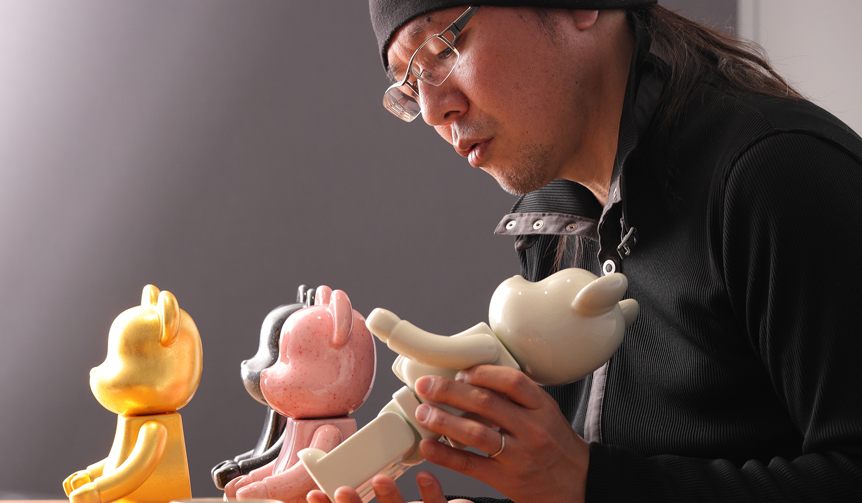
Masato Naka, President of Midland Creation Inc., found his passion for developing the Kutani BE@RBRICK undiminished even after the project's initial completion. He felt he couldn't let such a realized creation be the end of the line. He continued to research new molding technologies, including joint mechanisms and 3D printing, on his own.
Photographs by Kaku OtakiText by Kunihiko Shinno
If we could create articulated porcelain, I'm sure many people would be delighted.
"I'd known about BE@RBRICK for a long time. When BE@RBRICK first appeared, one of my manga assistants was a big fan of figures and told me, 'They're incredibly popular with high school girls right now.' I was intrigued when I learned they were made into phone straps and that many designs by artists had been released. Years later, it had become a prime example of a collection one couldn't possibly complete, so I thought, 'That's amazing.' I was also thinking about how to make Kutani ware more widely known and how I could contribute to my local community. I became convinced that if we could create articulated porcelain like BE@RBRICK, many people would surely be delighted," says Masato Naka.
Several years after producing the Mickey Mouse Kutani BE@RBRICK, Naka made up his mind. He contacted Tatsuhiko Akashi, President of Medicom Toy, and proposed that he wanted to mass-produce the Kutani BE@RBRICK, which had so far only existed as a one-off prototype, himself. Akashi readily agreed and suggested selling it at the following year's MEDICOM TOY EXHIBITION. However, several hurdles had to be overcome to achieve this.
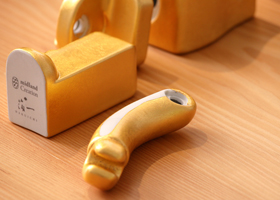
"If it were a flat, circular object like a plate, we could mass-produce it using a potter's wheel, but the parts of BE@RBRICK—the head, torso, waist, arms, and legs—are all hollow bags."
In ceramics, mass-producing complex shapes is done through slip casting. First, a plaster mold is made, and then liquid clay slip is poured in. After a while, as the plaster mold absorbs the water from the slip, it gradually solidifies from the contact surface. Once it reaches a certain thickness, the remaining liquid slip is poured out, and the mold is removed. However, for the plaster molds designed for BE@RBRICK, the pouring spout is extremely small.
"The artisans repeatedly asked if we couldn't just make a hole in the sole of the foot and seal it later, or if the pouring spout couldn't be made larger. But I wanted the finish to be as beautiful and flat as the regular BE@RBRICK," explains Masato Naka.
The parts Naka envisioned were realized by using molds designed and manufactured in Tajimi, Gifu Prefecture, an area renowned for its plaster mold expertise. The raw pieces were then formed and fired at a kiln in Komatsu, Ishikawa Prefecture. The biggest challenge was how to connect these parts. With plastic or metal, parts can be separated, accessed from the opposite side, and screwed together. However, this method is impossible with hollow porcelain parts.
"At Mr. Sasano's office, colleagues from the toy industry, including Mr. Hiroyasu Matsuoka from Takara Tomy's Technology Development Department, gathered and brainstormed ideas. For example, Mr. Matsuoka suggested using old-fashioned rubber rings. However, I was determined to have a satisfying click mechanism."
"Furthermore, being made of porcelain, they had to be able to support their own weight without breaking. I also wanted the angles to click into place at 45-degree increments, not just 90 degrees. Everyone gathered told me it was absolutely impossible. With only a little over six months until the planned release at the MEDICOM TOY EXHIBITION, developing custom joint parts and creating molds would simply not fit the schedule. Amidst this, Mr. Sasano mentioned he knew of one company, perhaps the only one in the country, that might be able to help," recalls Masato Naka.
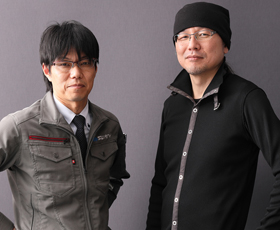
Swany Co., Ltd., headquartered in Nagano Prefecture, is a company involved in product design and prototype manufacturing using 3D data. After being introduced by Sasano, Naka immediately traveled to Nagano to explain the progress of the project to its representative director, Yoshihiro Hashizume. Let's hear from Mr. Hashizume now.
"I knew of BE@RBRICK, but I was surprised to hear they wanted to make one out of Kutani ware. Our company also handles commissioned design work for home appliance and toy manufacturers, but with Kutani ware, the size of the holes can vary by about 1 millimeter depending on the firing process in the kiln."
"For us engineers, who work with precision of one-hundredth or one-thousandth of a millimeter, this is unthinkable. But while it's difficult, I also found it to be a fascinating field," says Director Hashizume.
At Work Lab Yatsugatake in Chino City, Nagano Prefecture, where the interview took place, Swany had a secret weapon capable of prototype to small-lot mass production.
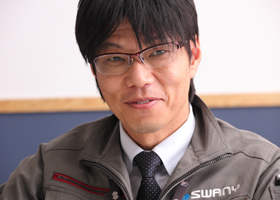
Yoshihiro Hashizume, Representative Director of Swany
"Normally, creating a mold takes over a month, and more importantly, it's expensive, so we can't afford to fail. Even with direct 3D printing of products, there are issues with mechanical properties like strength, temperature resistance, and friction coefficients. They are particularly weak to heat; if we make small, intricate items and ship them in the summer, they can deform in the delivery truck. Therefore, with our patented 'Digital Mold' technology, we can use resin molds created with 3D printers for injection molding, replacing traditional metal molds.
We have mold technicians and injection molding specialists, so it's a fusion of their knowledge with cutting-edge 3D printers—analog and digital, so to speak. I believe this kind of approach will become mainstream in future product development. With this, even complex designs can have molds created in about two and a half hours for smaller items, allowing time for trial and error. So, we decided to take on the challenge," explains Director Hashizume.
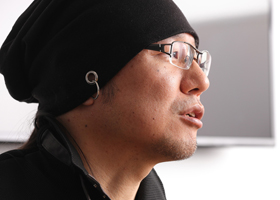
"I had known about Swany's interesting initiatives for some time, so I was very grateful to be introduced to them by Mr. Sasano."
"We immediately had them create a sample, but the finished product couldn't support its own weight at the hip joint and would just fall over. No matter how many times we tried, it didn't work. Finally, at the point where we absolutely had to finish it to meet the deadline, I wrote my structural design ideas on a whiteboard and explained them to Mr. Hashizume."
"Then he said, 'Mr. Naka, this should work!' and immediately got to work," says Masato Naka.
As a result, Naka's design succeeded in making the BE@RBRICK stand with the desired click and angle retention. From here, final adjustments for mass production began.
"We created the shape by converting Mr. Naka's sketches into 3D data and combining it with material suitability. However, what's unusual for typical toys is the variation in dimensions. Not only the shape of the holes but also the thickness varies between individual pieces. Due to their fragility, they would crack when being fitted. At first, we managed to fit them somehow, but when it wasn't working well, we proposed that secondary processing would be absolutely necessary to reduce the burden on the kiln operators, so we decided to use a rotary tool. Since we were working with ceramics, which we hadn't handled before, we tried various types of bits," explains Director Hashizume.
"To somehow meet the deadline, I was truly grateful for the cooperation of people from companies that Mr. Hashizume knew. Another fortunate aspect of connecting with Swany was that, although we would normally have had the assembly and packaging done by an assembler we prepared, they were able to handle everything from assembly to delivery using a specialized home-based work program," says Masato Naka.
"In Ina City, Nagano Prefecture, where Swany's headquarters is located, the shopping streets that were once vibrant are now seeing more and more shuttered stores due to an aging population and succession issues. In manufacturing, much of the detailed assembly that used to be done has been automated or moved to China. Meanwhile, we've heard many voices from housewives and the elderly who want to do piecework. So, we registered vacant spaces in the shopping district as business locations and created places where home workers could gather to work.
"For multi-product, small-lot assembly, proximity is better. We have people who want to work and vacant spaces. By combining these, we can create new workspaces where people can work according to their schedules. If we can secure continuous work, it will contribute to regional revitalization and enable more 'Made in Japan' manufacturing," believes Director Hashizume.
After hearing their story, holding the Kutani BE@RBRICK again, the satisfying click that Naka insisted on feels incredibly pleasant.
"Even after release, we continue to make improvements to enhance the overall quality, including the joint parts. If you compare the first 'Kutani BE@RBRICK Kannyu [Awata-yu]' with the new 'Kutani BE@RBRICK Hirioshi [Pure Gold Leaf],' you'll notice subtle differences," says Masato Naka.
Naka then went on to discuss his future vision for the Kutani BE@RBRICK.
"First, I want to make the wrist joints rotatable. And then, I want to release versions with painted designs. After all, for those familiar with ceramics, it might feel a bit odd to have Kutani ware developed only with glazes. I don't think we've reached a point where we can proudly declare, 'This is Kutani ware.'
"If we were aiming for one-of-a-kind, hand-painted pieces, no matter how expensive, we could do that immediately. But what we want to do is mass-produce them so that many people can obtain them. This will create more work for the artisans and open up possibilities for further business development," explains Masato Naka.
The bold and magnificent colored enamel decoration, for which Kutani ware is renowned, is its greatest charm, with the saying, 'There is no Kutani without overglaze painting.' A BE@RBRICK painted with the five colors—red, yellow, green, purple, and indigo—would surely be stunning.
"Fortunately, the Kutani BE@RBRICKs we've released so far have received a great deal of positive feedback from both domestic and international customers. Therefore, for future development, we are considering applying overglaze decoration using the decal technique employed on Midland Creation's decorative plates."
"I designed all the decals for those plates myself. When artisans carefully stretch them to fit the shape and fire them, the glassy patterns adhere beautifully. Although it's a technique for mass production, I also want to contribute to advancing decal technology. Those who already own a Kutani BE@RBRICK may notice the Midland Creation logo on the inside of the leg; this is a result of that decal technique.
While there are artists of traditional crafts, we are enabling mass production through modern methods. In terms of merging traditional craftsmanship with cutting-edge technology, I believe both are valuable artisan skills. Please look forward to future developments," says Masato Naka.
The next new product is scheduled for release this summer. We can't take our eyes off the further evolution of Kutani ware, a traditional craft.
BE@RBRICK TM & © 2001-2019 MEDICOM TOY CORPORATION. All rights reserved.