I want to leave something that can be passed down through generations as a family heirloom or a work of art (Part 1) | MEDICOM TOY
MEDICOM TOY | Medicom Toy
Kutani BE@RBRICK Producer
An Interview with Masato Naka (Midland Creation) (Part 1)
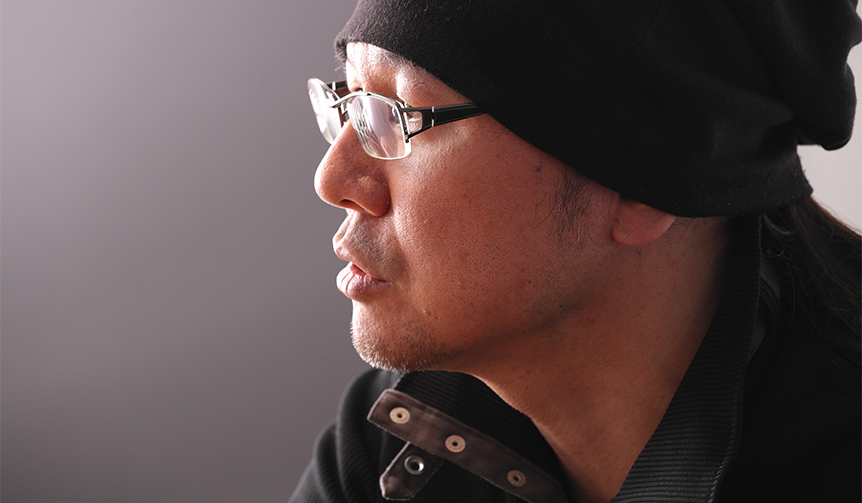
This installment features Masato Naka, President of Midland Creation Inc., who produced the 400% BE@RBRICK made of Kutani porcelain with movable joints. Naka states, "The high culture of fine arts inherited from previous generations. The popular subculture represented by manga and anime. Both are worlds where Japan's meticulous and delicate craftsmanship is highly valued, a culture we can be proud of globally. What is born from connecting these two? It is a new artistic sensibility and value that no one has ever seen before." Having relatives who are Kutani ware kiln owners and growing up familiar with Kutani ware, Naka established Midland Creation in 2013. The company creates new traditional craftworks using Japanese subcultures such as manga, anime, and illustrations as content, aiming for artistic evaluation both domestically and internationally. In this two-part series, we will delve into the secret story behind the birth of the Kutani BE@RBRICK, described as a "miracle," Naka's deep connection with manga, and the future of collaboration between Midland Creation and Medicom Toy.
Photographs by Kaku OTAKIText by Kunihiko SHINNO
What I can do is connect Japanese manga and traditional crafts
and revitalize them.
The interview took place at Work Lab Yatsugatake in Chino City, Nagano Prefecture. Masato Naka, who warmly welcomed the OPENERS team, first showed us the first edition, "Kutani BE@RBRICK Kannyu [Awata-yu]," released at the MEDICOM TOY EXHIBITION in July 2017. Holding it, I could feel the unique texture of porcelain and its substantial weight through my fingertips.
"If I were to make the very first Kutani ware piece, I thought a pure white, unadorned one would be best. I found the state without glaze, which prevents water and dirt from soaking into the base, to be truly beautiful, something that cannot be experienced elsewhere."
"However, without glaze, there are issues with strength, and applying glaze changes the dimensions due to its thickness, so I had to make adjustments many times."
"Awata-yu is a traditional glaze that has been around for a long time, known for its transparent finish. If you look closely, you can see fine cracks in the glazed areas, right? This is called 'kannyu' (craquelure), and with a teacup, it develops a unique patina as colors seep in with use. It's a charm unique to ceramics that values the world of 'wabi-sabi'" (Masato Naka).
"For the second edition, President Akashi of Medicom Toy said, 'Naka-san, let's do red and white. Since it's an April release, can you create something inspired by cherry blossoms?' Initially, I considered having cherry blossom patterns carved on the chest and ears, but mass-producing the same shape stably presented significant challenges."
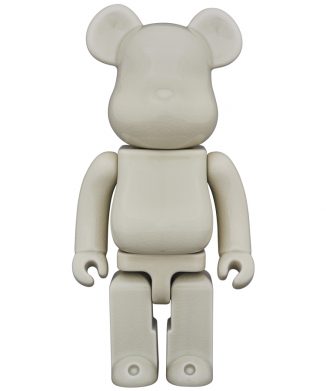
Kutani BE@RBRICK Kannyu [Awata-yu]
(Awata-yu)
Released July 2017
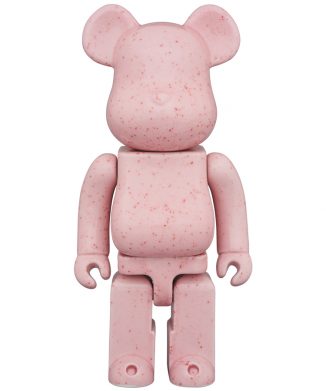
Kutani BE@RBRICK Kannyu [Sakurairo Hanten-yu]
(Sakurairo Hanten-yu)
Released April 2018
So, I consulted with Mr. Kida, a craftsman at the kiln that produces the base for Kutani BE@RBRICK, and he said he could adjust various shades of pink and even leave particles inside. He made several samples, and we chose the best one.
"This time, because it used a different glaze than before, we encountered a large number of defective products for unknown reasons once mass production began, which was quite difficult. However, President Akashi said, 'They're so cute,' and the sweet-like appearance also resonated very well with women" (Masato Naka).
Following the white and cherry blossom pink versions, the third edition released in August 2018, "Kutani BE@RBRICK Kirameki Tenmoku-yu," is a masterpiece featuring a glitter-like sparkle within jet black. The fusion of Kutani ware, popular for centuries as "Japan Kutani," and BE@RBRICK, born at the dawn of the 21st century, became a topic of conversation overseas, leading to orders exceeding initial expectations.
"When we first sold them at the MEDICOM TOY EXHIBITION, there were only 20 units, but we soon received substantial orders from overseas distributors, allowing us to produce a stable number. With online sales, the market was expanding, especially in Asia, so the timing was fortunate" (Masato Naka).
With positive feedback from China, the fourth edition released in February of this year, "Kutani BE@RBRICK Hirioshi [Jun Kinpaku]," is a resplendent piece, as its name suggests, entirely clad in pure gold leaf.
"President Akashi mentioned that demand for gold-colored products increases in China around the New Year's holiday, specifically during the Spring Festival. So, the idea of gold came up. However, for us, handmade items are fundamental. I consulted with Mr. Kida again, and he said that if applied by hand, the cost would be unpredictable as it depends on the market price."
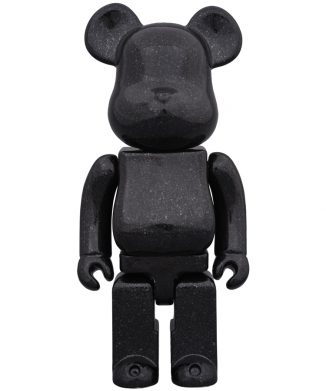
Kutani BE@RBRICK Kirameki Tenmoku-yu
(Kirameki Tenmoku-yu)
Released August 2018
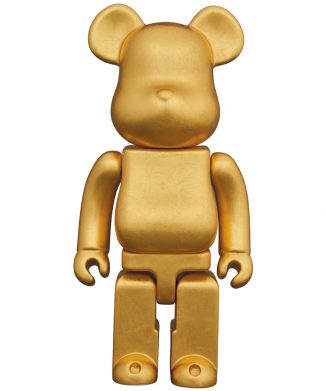
Kutani BE@RBRICK Hirioshi [Jun Kinpaku]
(Jun Kinpaku)
Released February 2019
"I didn't know how much gold would be needed, and securing the schedule of a truly skilled gold leaf applicator was essential for a perfect finish. So, I wondered what to do, and then I remembered that I had exchanged business cards with 'Hakuichi,' a Kanazawa gold leaf company, two years prior" (Masato Naka).
Kanazawa, which accounts for over 98% of Japan's gold leaf production, is home to Hakuichi, a leading domestic manufacturer that transmits the possibilities and charm of combining new technology with tradition to the world through "Kanazawa gold leaf," used in historically valuable temples and shrines, as well as various crafts. They have previously collaborated with Bandai to produce and sell Gundam gold leaf glass plates and have garnered attention for their work on the interior of GINZA SIX.
"I immediately visited their showroom in Ginza, Tokyo, and asked if it was possible to apply it to this shape. They replied, 'Only air and water cannot be applied' (laughs). They were also familiar with BE@RBRICK, and recognizing its value, they agreed, saying, '24-karat gold would be best. Being able to advertise it as PURE GOLD overseas is a strong point. Let's do it.'"
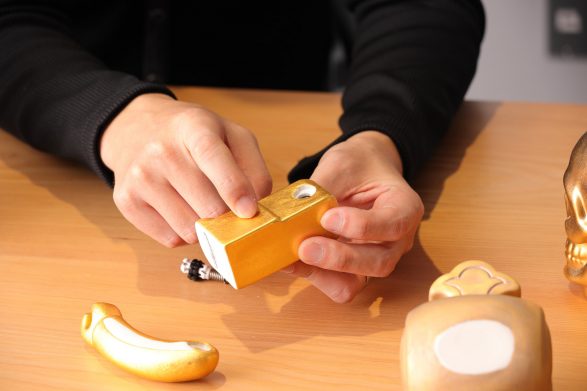
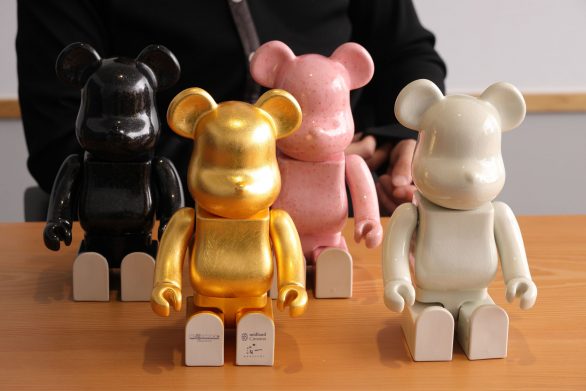
"Initially, they said they could only apply it to 20 units per month, but I am incredibly grateful to Hakuichi for actually managing to produce far more than that."
"Also, as you know, gold leaf is extremely fragile. It's far more delicate than anything we've worked with before, so we applied a urethane clear coat to prevent it from peeling off even when touched. We created several samples for the thickness and gloss of this coating, and finally decided on the finish through discussions with President Akashi. A thick clear coat would give it a plastic feel, which would be a shame, and too much gloss would lack refinement. We wanted a finish that allowed the porcelain's texture to be felt and evoked a sense of 'Japanese-ness.'"
"The wrinkles in the gold leaf are also part of the charm of the handmade process. Although this time it's fully covered in gold leaf, we've also proposed variations using flakes and other forms, so it would be interesting if we could change the design slightly next time and make it an annual series" (Masato Naka).
Now, changing the subject, many of you may recognize the name Masato Naka.
"I am from Komatsu City, Ishikawa Prefecture, and my maternal uncle was a Kutani ware artist. From a young age, I often saw artisans sitting in his studio, painting, and finished vases lined up. My first experience with Kutani ware was when I was allowed to paint a plate for my 5th-grade summer vacation homework" (Masato Naka).
Kutani ware is porcelain produced mainly in southern Ishikawa Prefecture. Its origins date back about 360 years to when high-quality porcelain stone was discovered in Kutani village, Enuma District, Kaga Province (now Kutani-cho, Yamanaka Onsen, Kaga City). Although the kilns were temporarily closed, efforts to revive them intensified in the late Edo period, leading each kiln to establish distinct artistic styles. In the Meiji era, the 'Sairen-de' style developed by Kutani Shozo was exported overseas, becoming known globally as 'Japan Kutani.'
Crushed porcelain stone is soaked in water, and only the fine clay particles are collected (haido). This clay is then shaped using a potter's wheel or casting molds. After bisque firing at 800-900°C for about 8 hours, designs are drawn with a cobalt blue pigment called 'gosu,' followed by glazing and firing at a high temperature of 1280°C for about 15 hours. Then, thick layers of paint called 'gosai' – red, yellow, green, purple, and indigo blue – are applied and fired again at 760-850°C. Finally, gold and silver decorations are applied in a 'kin'yo' (gold kiln) and fired at around 400°C to complete the piece. The bold yet beautiful works, born from a meticulous process, have been loved by many across generations.
"My family ran a metalworking company that grew as a subcontractor for Komatsu Ltd. As the eldest son, I was supposed to inherit it, but when I was in high school and seriously considering my future, I wanted to forge my own path."
"I was good at drawing, so instead of going to university, I told my parents I wanted to try becoming a manga artist for four years. They were strongly opposed, of course, but among my relatives, it was my uncle, the kiln owner, who showed the most understanding and support. He said, 'He has talent, so let him try.'"
"With my father's permission, my first apprenticeship was with Hirohiko Araki, who was serializing 'JoJo's Bizarre Adventure' in Weekly Shonen Jump. I worked there for about three years, from the early part of Part 3 of 'JoJo,' but Mr. Araki's studio had excellent schedule management, which allowed me time to work on my own manga. I made my debut in 1993 after winning an award in Weekly Young Jump" (Masato Naka).
In 1997, Masato Naka made his debut serialization with "Bouryoku no Miyako" in Weekly Young Jump. Since then, he has published numerous works, including "Bounty Hunter," "Cuisinier," "Oukoku Pasta," "Mikaiketsu Jiken," and "Gokuraku Bali Island: Takashi Maruo's Bo-Bo Monogatari." He has also undertaken significant projects such as designing the official support T-shirt for Saori Yoshida, the women's wrestling gold medalist at the Beijing Olympics, and writing the world's only official Disney biographical manga, "Comic Version of World Biographies: Walt Disney."
"As I approached 40, the fact that I could fulfill my dream was thanks to my parents, relatives, and the people of my hometown who supported me. So, I began to think about how I could give back. The region of Kutani ware, which I was familiar with since childhood, is facing a situation where some kilns have to close down because there's no one to inherit them. This is a phenomenon occurring in traditional craft regions across Japan. So, I thought, what I can do is connect Japanese manga and traditional crafts and revitalize them" (Masato Naka).
Therefore, in 2013, he established Midland Creation Inc. to create new traditional craftworks using Japanese manga and anime as content. The company name was inspired by his manga mentor Mr. Araki's studio name, "Lucky Land Communications." With the cooperation of his cousin, a kiln owner, Naka completed Kutani ware plates designed with popular manga artwork.
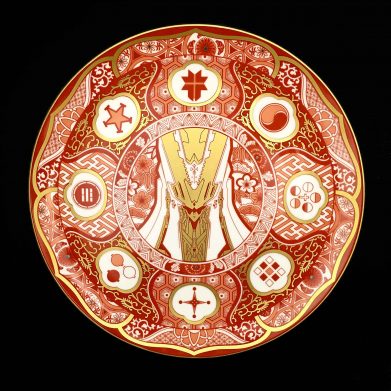
"The first work was the 'Kutani Akae Kinrande Seidou Seinto-zu Shokudai-zara,' exhibited at the Masami Kurumada 'Saint Seiya 30th Anniversary Exhibition' in June 2016. Instead of simply placing characters onto traditional Kutani ware designs, I designed the artwork from scratch to match the piece."
"If you look closely, you'll find hidden messages left by a certain character for the protagonists in the Zodiac Temple arc, incorporated as a hidden image. I added these elements to delight the fans. Because it involved hand-painting gold and some hand-drawn parts, each plate cost 100,000 yen, making it quite expensive, but the response exceeded our expectations."
"For me, I want to create something that the purchasers can treasure as a family heirloom. I want to leave behind items that can be passed down through generations as works of art. As a manga artist, it makes me happy that the designs are from Japanese manga and anime, and I believe it connects to the future" (Masato Naka).
The intricate designs of the five Bronze Saints protecting Athena are masterfully reproduced in Kurumada's style using a technique where special decals, with the design pre-printed, are carefully applied and then fired.
Since then, Midland Creation has also released plates and small cups featuring artwork from "The Five Star Stories" (Mamoru Nagano) and "Cobra" (Buichi Terasawa), all of which have been well-received.
Many of these are limited edition items and have sold out, but some products are still available for purchase on the Midland Creation online shop (https://mid-store.jp/). We encourage interested individuals to check it out.
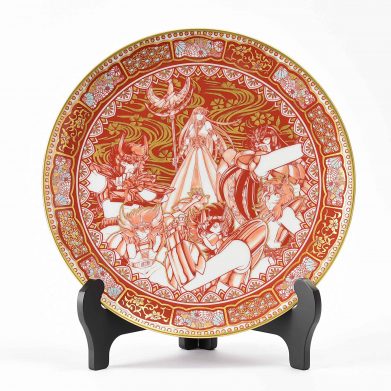
© KURUMADA PRODUCTION
© EDIT
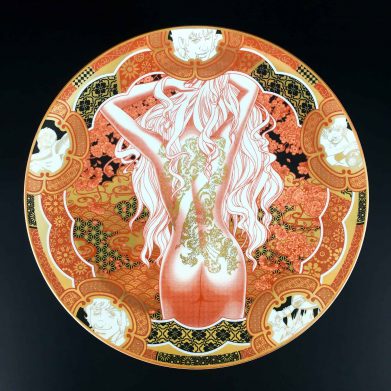
© BUICHI TERASAWA / A-GIRL RIGHTS
Naka's encounter with BE@RBRICK, however, predates the establishment of Midland Creation.
"A few months before establishing the company, someone I met through my manga work asked me, 'Can you make a BE@RBRICK out of Kutani ware?' I knew of BE@RBRICK, of course, and I had been keenly observing their various material experiments, including the wooden BE@RBRICK in collaboration with Karimoku. I consulted with my cousin, and he thought it was probably possible."
"However, that was overly optimistic. We decided to make three painted prototypes, and I took on the task of creating them. The truth is, making ceramic objects with shapes like BE@RBRICK is difficult. Moreover, I was too optimistic about connecting the individual parts."
"In any case, I rushed the production, so the size was slightly smaller due to not accounting for the shrinkage rate of ceramics, and the parts were only provisionally assembled. We exhibited it as a reference product at the 2013 MEDICOM TOY EXHIBITION. It was well-received, and I was delighted to overhear people saying, 'Look, it's really made of porcelain,' and wondering about the price. "
"Then, Medicom Toy approached me with a request to create a Kutani BE@RBRICK of Mickey Mouse for the first D23 Expo Japan, held at Tokyo Disneyland" (Masato Naka).
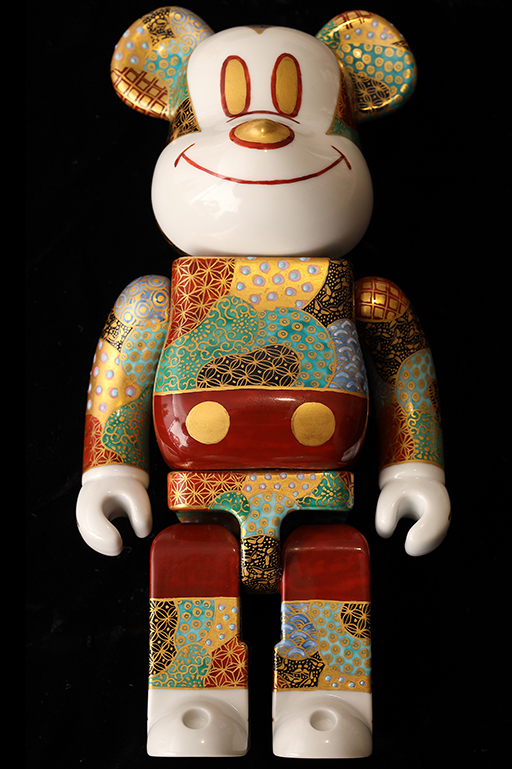
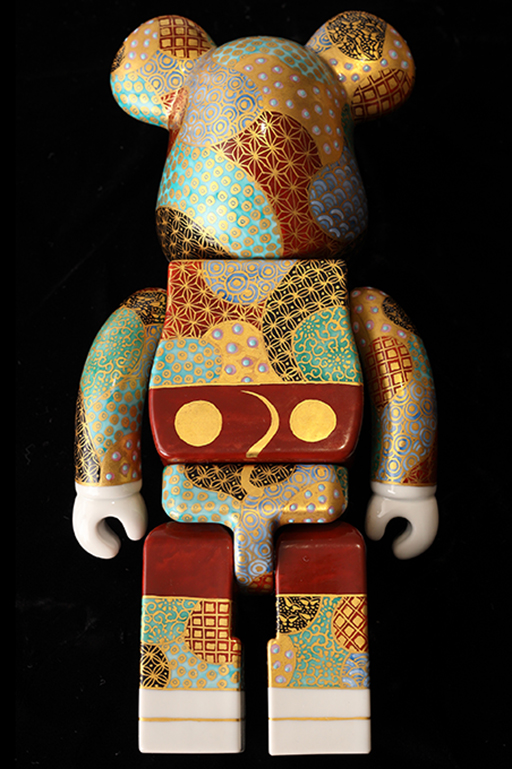
Thus, the one-of-a-kind Mickey Mouse Kutani BE@RBRICK was completed. It was popular with attendees, and the Kutani BE@RBRICK project involving Naka seemed to be concluding successfully.
However, Naka pondered.
If it ended here, the Kutani BE@RBRICK would remain an unattainable art piece for the general public.
Could it somehow be mass-produced for fans both domestically and internationally? More importantly, the joint sections connecting the parts could not be left unfinished.
From this point, the full-scale development of the Kutani BE@RBRICK, which would take four years until its release, began.
BE@RBRICK TM & © 2001-2019 MEDICOM TOY CORPORATION. All rights reserved.
© Disney