I feel that design is something an individual creates with absolute conviction, saying 'This is it!' | MEDICOM TOY
MEDICOM TOY
An Interview with SHAREEF Designer Jin Shimomura (Part 1)
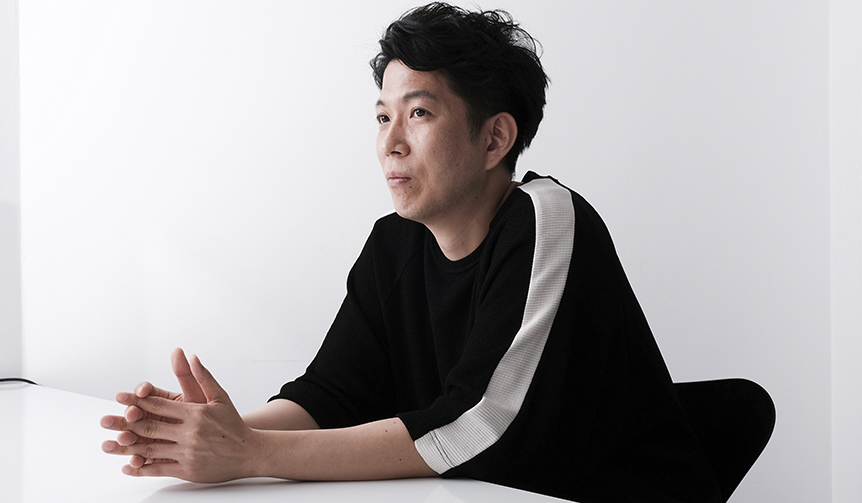
An up-and-coming domestic brand that creates items that evoke the joy of wearing clothes and the pleasure of coordinating them,SHAREEFcelebrates its 10th anniversary. Designer Jin Shimomura's philosophy is "to make clothes I want to wear." His original creations have garnered a large and passionate following, including MEDICOM TOY President Tatsuhiko Akashi. We spoke with Shimomura ahead of the release of "BE@RBRICK SHAREEF 100% & 400%," their first collaboration.
Photographs by OHTAKI KakuText by SHINNO Kunihiko
Fashion is for the young
—Congratulations on your brand's 10th anniversary. I understand you originally worked as a pattern maker (someone who translates a designer's drawings into patterns) before becoming a designer.
ShimomuraAt first, I didn't think I was suited to be a designer. I've always loved building plastic models.
—What kind of plastic models did you build?
ShimomuraGunpla, for my generation. They were incredibly popular when I was a kid, and very hard to find. I'm from Osaka, and there weren't many large toy stores back then, so by the time I got to one after school, only the unpopular ones were left (laughs).
—So you enjoyed the assembly process.
ShimomuraThat's why I thought I might be better suited to translating from two dimensions to three, assembling things based on a designer's vision. But looking back, I might have been better suited to being a designer after all.
—Did you have a clear direction for the kind of brand you wanted to create?
ShimomuraI don't have a specific keyword, but I believe fashion is for young people. For the past 10 years, I've consistently focused on creating pieces that people in their late teens and early twenties will want to keep wearing.
—Given your experience as a pattern maker, are you particularly particular about the shape?
ShimomuraIt's more about the fashion aspect than just the shape. While shape is certainly important, clothes aren't just about that; their quality isn't elevated without the perfect mix of color and material. If you only pursue shape, you end up with something like men's tailored jackets, which fall out of trend. I found myself increasingly drawn to aspects beyond just the shape.
—Your early designs are being re-released at STUDIOUS. Looking back at those collections, what are your thoughts?
ShimomuraTechnically, we can do so much more now than 10 years ago. We've also gained more external partners, and as a result, we can often bring ideas to life when we have them. This collaboration with MEDICOM TOY is an example of that.
Page02.How to Present the BE@RBRICK Canvas
MEDICOM TOY
An Interview with SHAREEF Designer Jin Shimomura (Part 2)
How to Present the BE@RBRICK Canvas
—Tell us about how you first encountered MEDICOM TOY.
ShimomuraI suddenly received a call from someone at MEDICOM TOY through a mutual acquaintance. President Akashi had been buying SHAREEF clothes for some time, and they proposed a collaboration to create a BE@RBRICK together.
—Were you familiar with BE@RBRICK?
ShimomuraOf course, I knew about it and had even bought one.
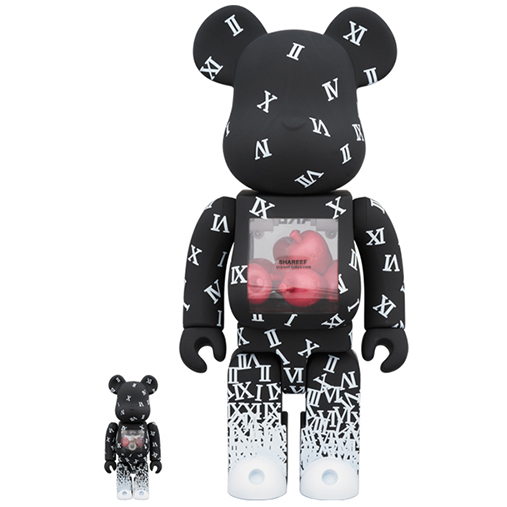
—The "BE@RBRICK SHAREEF 100% & 400%" has a transparent belly with an apple motif inside, and Roman numerals are designed all over its body. Please tell us about the development process.
ShimomuraWhen the proposal came, I immediately envisioned that look. So, the design itself wasn't a struggle; the process involved learning about what was technically feasible and what wasn't. Regarding the color, I initially thought a black base with black text would be best, but President Akashi suggested a black base with white text. I agreed that it would look better.
—It's scheduled to be released on June 30th (Saturday) at the SHAREEF FLAGSHIP SHOP (9-5 Sarugaku-cho, Shibuya-ku, Tokyo, Hideu Daikanyama Residence 107) and MEDICOM TOY's directly managed stores. You had specific ideas about this sales format, didn't you?
ShimomuraFor collections, it's common to have advance reservations at trade shows, but for this BE@RBRICK, I felt that customers would want to touch it in-store
BE@RBRICK TM & © 2001-2018 MEDICOM TOY CORPORATION. All rights reserved.
and take it home immediately. I thought, "Maybe customers feel the same way?" With clothing, there's a seasonal aspect; you can only wear fall items in the fall and winter items in the winter. But BE@RBRICK doesn't really have seasons.
—I'm sure SHAREEF fans will want to get their hands on it, and conversely, it will be an opportunity for BE@RBRICK fans to discover the SHAREEF brand.
ShimomuraI suspect that people who like SHAREEF will also like BE@RBRICK. When tastes in fashion align, I think there's often overlap in other hobbies, like music.
—What kind of music do you like, by the way?
ShimomuraI like Japanese bands. Bands that play live in Shimokitazawa. To put it bluntly, I appreciate that raw, slightly emo feeling. People who like that kind of music seem to come to my store often and buy things.
—As a designer, how do you perceive BE@RBRICK?
ShimomuraAgain, to be blunt, it really makes you compete. It feels like a question: "How will you finish this using the BE@RBRICK canvas?" It's a race to see how you can present it within the inherent limitations of the form.
—But isn't that different from designing human clothing?
ShimomuraCompletely different. I see it as two-dimensional. Essentially, it's about the surface graphics. Yet, the form itself is soft, isn't it? So, is soft x soft good, or soft x sharp? It depends on how you look at it.
For a T-shirt, it's fine if it's contained within SHAREEF, but a BE@RBRICK has to stand on its own. That's why if they asked me to design something completely new again, I would probably struggle immensely.
Page03.SHAREEF is, ultimately, 100% me
MEDICOM TOY
An Interview with SHAREEF Designer Jin Shimomura (Part 3)
SHAREEF is, ultimately, 100% me
—What are your impressions of working with MEDICOM TOY?
ShimomuraThree-dimensional objects like these were an unknown territory for us, but it was incredibly enjoyable. Collaborating with them has been nothing but stimulating. If the opportunity arises again, I would love to work with them.
—Do you already have ideas for what you'd like to do next?
ShimomuraNothing concrete, but perhaps something that extracts motifs like the apple or Roman numerals and builds upon them.
—We look forward to future collaborations, perhaps for your 15th or 20th anniversary.
ShimomuraEven for our 11th or 12th anniversary would be fine (laughs).
—How do you evaluate your own work?
ShimomuraSHAREEF is, ultimately, 100% me. What I want to wear, what I'm thinking – that's me, isn't it? In that sense, it's irreplaceable, and I think that's a good thing.
—In an era where unique things are increasingly being diluted, where do you find the strength to persevere?
ShimomuraIt all comes down to my love for clothes. I love fashion and I love clothes. No matter how difficult the process, when the finished product is complete, I'm incredibly happy. Even through hardships, when a good sample comes out, I feel immense joy, and it's a cycle of that.
—The items in your next Autumn/Winter collection prominently feature laundry care symbols as graphics, which I thought was an idea that could only come from someone who truly loves clothing.
ShimomuraLately, I haven't been setting specific seasonal concepts. Instead, I've been making what I want to wear in the next season. If I were to confine myself to words or keywords, the entire lineup wouldn't perfectly align. It's more likely that "I want to wear this next season, so I want everyone else to wear it too" will achieve 100% alignment.
—So, it's always something originating from you personally, Jin Shimomura.
ShimomuraI don't particularly like designs that look like they were decided by a majority vote among multiple people. You can see the compromises, and I question whether something that aims for an average score is truly design. For me, design is what an individual creates with absolute conviction, saying 'This is it!'
—When do ideas strike you?
ShimomuraI don't get inspired by things like traveling and seeing new things. Ideas only come to me at my desk in the office. I rely solely on my own imagination.
—Is the current situation in Japan conducive to your work?
ShimomuraI think the fashion industry as a whole finds it challenging, but my immediate environment is quite workable. This is the result of 10 years of building trust with factories that handle the time-consuming processes. Generally, people are reluctant to take on difficult tasks, so we are immensely grateful to all the factories that work with us.