What Matters in Car Manufacturing | Mazda
Mazda Design
What Matters in Car Making
Giving Life to Cars—In 2010, Mazda named its design concept “Kodo – Soul of Motion,” and with models ranging from the SUV CX-5 to the sports car Roadster, the brand has refreshed its image with dynamic styling. But where did this design originate? According to Mazda’s Public Relations department, one answer lies in Tsubame City, Niigata Prefecture. We explored the worlds of craftsmanship at Gyokusendo, a maker of hammered copperware, and Mazda.
Text by OGAWA FumioPhotographs by TSUKAHARA Takaaki
Common Ground Between Traditional Crafts and Mazda Design
Mazda cars are all appealing. The reason, though it may differ for each person, is that externally, they boast excellent proportions, and their high-quality construction in terms of surface treatment, paint, and pressing resonates with car enthusiasts. The interiors of Mazda cars are also well-crafted and attractive.
In recent years, Japan has seen a surge of interest in highly skilled techniques rooted in traditional craftsmanship, often referred to as “Monozukuri no Takumi” (artisans of craftsmanship). When I heard that Mazda found commonalities between this traditional craft and its own design, I understood it as a fitting combination. Mazda’s collaboration with Japanese artisans, known for their traditional crafts, at the “Milan Design Week” (commonly known as Salone del Mobile) in Italy in April 2015, was a memorable event that garnered significant attention.
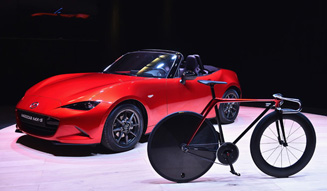
Mazda's booth at the world's largest design event, Milan Design Week, held in April this year.
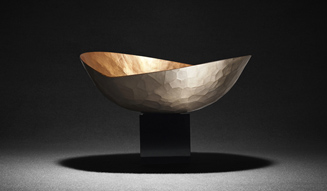
The “Kodo-ki” unveiled in Milan was born from the collaboration between Gyokusendo and Mazda.
Mazda’s partner is Gyokusendo, based in Tsubame City, Niigata Prefecture, which specializes in hammered copperware (Tsuiki Douki). Since its founding in 1816, the company has shaped copper sheets by hammering them. They create high-quality “tools” suitable for all occasions, from tea ceremonies to daily life, including teapots, kettles, and vases.
I was once impressed by Gyokusendo’s work on a cooler they made for a prestigious French champagne house. First, I was captivated by the beauty of its form and the exquisite finish of its surface. I was even more impressed to learn that the technique involved shaping by shrinking, rather than stretching, the metal.
The meticulous work, including post-shaping heat treatment and coating, demonstrated a profound understanding of copper’s properties, leaving a strong impression of a skill only an artisan could possess.
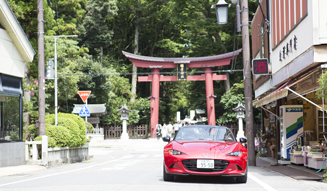
At Mt. Yahiko Shrine, located not far from Tsubame City, where Gyokusendo is based. Known as a power spot in the Echigo region.
The collaboration between Gyokusendo and Mazda culminated in a copperware piece named Kodo-ki, inspired by Mazda’s design concept, “Kodo – Soul of Motion.” How did this work, which garnered significant attention both in Japan and abroad, come to be?
To properly explain the background, Mazda organized an insightful design workshop in Tsubame City, which included a visit to Gyokusendo, in August.
Mazda Design
What Matters in Car Making (2)
Mastering Forms Born of Necessity
Car design is often shrouded in secrecy, and presentations are rare. In this context, the coverage in Tsubame City was not only valuable but also unprecedented.
“We want our cars to be beautiful tools. We want them to be living machines created by human hands. With that philosophy, we want you to understand our intention in collaborating with the craftsmanship of Tsubame, a region renowned for metalworking.”
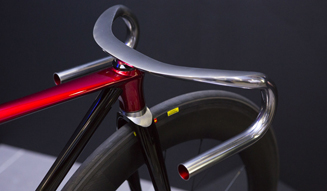
“Bike by KODO concept,” crafted by Mazda artisans by forging chromoly steel. Even the seemingly flat handlebar surface has a subtle curve.
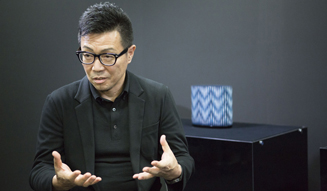
Mr. Yasushi Nakamuta, General Manager of Mazda’s Advanced Design Studio, Design Division.
So says Mr. Yasushi Nakamuta, General Manager of Mazda’s Advanced Design Studio, Design Division. When we think of car design, we only see the finished product. However, the process involves many stages, starting with sketches and engineering, followed by modeling by “soft modelers” using industrial clay, and then metal part creation by “hard modelers.” Mazda’s modeling studios employ both soft and hard modelers.
In the past, even for metal parts in mass-produced cars, models would be made to look convincing by covering clay with foil. “That didn’t convey the true image and wasn’t fitting for Mazda’s car manufacturing,” says Nakamuta. At some point, they shifted to creating hard models using authentic materials.
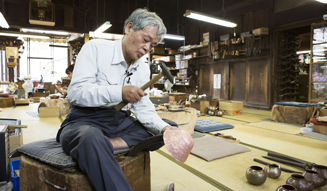
The traditional techniques of Gyokusendo are passed down through generations of skilled artisans.
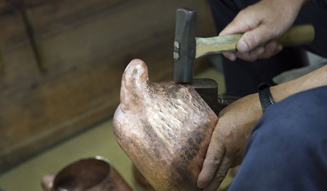
Gyokusendo’s kettles are formed from a single sheet of copper, rather than welding the spout on. The photo shows the “Kuchiuchidashi” (hammered spout) area.
“While Japan excels in woodworking, its metalworking capabilities are also quite high,” says Mr. Hirofumi Kureha, General Manager of Mazda’s Design Division Modeling Studio. He notes that automotive manufacturers have a particular affinity for metalworking. The idea was to find a connection between Mazda’s car manufacturing and Gyokusendo’s hammered copperware, and to realize this as a collaboration.
“We wondered if there was anything in Japanese craftsmanship that resonated with us. Initially, we considered various artisans, such as those in tea ceremony, woodworking, and carpets, but when I visited Gyokusendo for preliminary research, I knew this was it. The process of shaping copper sheets by hammering them to ‘master forms born of necessity’ struck me as functional beauty and the essence of craftsmanship.”
This led to the creation of Kodo-ki. However, the initial stages were not entirely smooth.
Mazda Design
What Matters in Car Making (3)
Differences Between Mazda and Gyokusendo
“Mazda’s request was to create hammered copperware based on the theme of ‘Kodo – Soul of Motion.’ To explain what Kodo meant, they showed us the posture of a leopard pouncing on its prey. I thought it was cool, but I struggled with how to express that in copperware. I was quite perplexed at first.”
Gyokusendo’s building has a charming, traditional gate. Passing through it and stepping on the stepping stones surrounded by greenery leads to the interior, where the sound of metal striking can be heard. Skilled artisans are hammering copper sheets in the workshop. In this traditional setting, there are few electrically powered machines in sight. Here, Mr. Motoyuki Tamagawa, President of Gyokusendo, spoke about the creation of Kodo-ki.
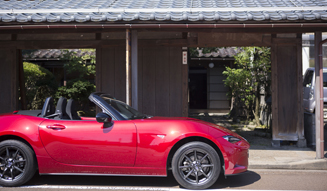
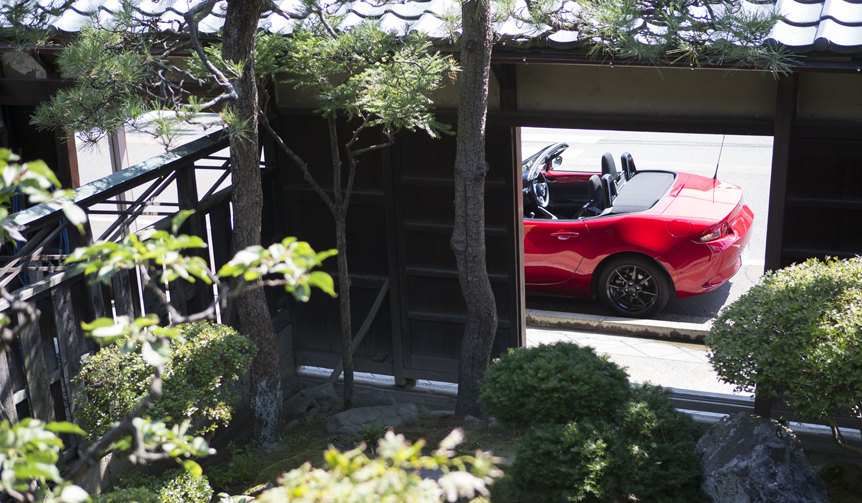
At the entrance of Gyokusendo, with a Mazda Roadster.
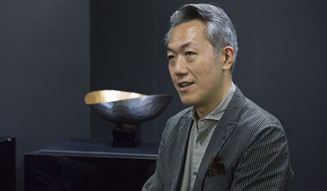
Mr. Motoyuki Tamagawa, President of Gyokusendo.
“These are daily necessities that make life enjoyable. This is my concept of hammered copperware. Unlike mass-produced items, we imbue them with life as we shape them with our hammers. When Mazda explained their philosophy of craftsmanship, I felt it was very similar. However, they told us that the first object we created for this collaboration was ‘not quite right.’”
Mazda makes cars. Gyokusendo does not make moving objects. This alone highlights the significant differences between the two companies. How to bridge that gap? The artisans’ struggles are imaginable.
“I realized that simple concepts like streamlining wouldn’t suffice,” says Mr. Mitsunori Watanabe of Gyokusendo, who was directly involved in creating Kodo-ki. He is also a car enthusiast, and his aspiration is the 1957 Alfa Romeo Giulietta Spider.
Mazda Design
What Matters in Car Making (4)
Gyokusendo's Craftsmanship
“After discussing with Mazda’s designers and contemplating the concept, I decided the form should be simple, designed to create an impact when light hits it.”
Watanabe adopted a technique that emphasizes the hammer marks. Without welding, he shaped a large copper sheet into a three-dimensional form. Furthermore, the exterior surface was designed to appear as a complex arrangement of polygons. Each polygon was formed by hammering from the inside outwards, pushing the metal towards the boundary with the adjacent polygon.
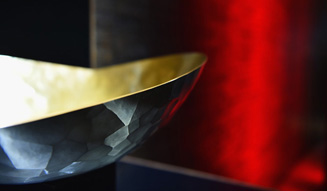
The “Kodo-ki” created by Gyokusendo is designed to highlight the contrast between two colors, achieved through the chemical reaction between tin, fired onto the copper surface, and a natural medicinal solution.
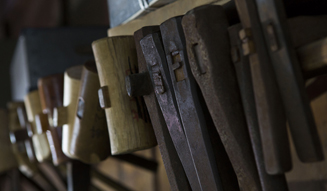
Countless hammers are lined up. The length and size of the wooden handles are shaped over years of training to suit the individual artisan.
To achieve a unique texture on the surface, tin plating is applied. Utilizing the property of tin, which melts at 250°C, color variations are created through heating and cooling. Watanabe decided to utilize the lines formed as the molten tin cooled. He also controlled the cooling temperature. While natural cooling is standard, he employed forced cooling for this piece to achieve color variations. This idea stems from his deep understanding of copperware.
“The reason I like the Giulietta is its body, which makes you want to touch it. It has a sense of tension, as if the panels are stretched from within. It has a sense of life. I believe that is essential for any object.”
The trial-and-error process of creating Kodo-ki provided Gyokusendo with an opportunity to re-examine the fundamentals of craftsmanship. They even revisited tools they hadn't used in a while. President Tamagawa states that this was “a very positive stimulus.” Mazda, too, was able to reaffirm what is important in car manufacturing as a result of this collaboration.
Mazda Design
What Matters in Car Making (5)
Gyokusendo's Craftsmanship
“When we shape cars, we don’t rely solely on computers. We sculpt everything by hand, except for the tires, using clay. Otherwise, we cannot achieve the sense of life that Kodo Design demands. Furthermore, while the conventional method of analyzing data with computers and then machining a 3D model takes one to two weeks, Mazda completes it in three to four days. We pride ourselves on being the fastest in the world. We are confident that we have modelers with comparable skills to no other company.”
Kureha spoke with such confidence, which was impressive. “The modelers’ job is essentially to create the bones, muscles, and blood of a car. Considering the importance of this role, we have been thoroughly dedicated to model creation through this internal process since 2005.”

View of the Sea of Japan from the Yahiko Skyline.
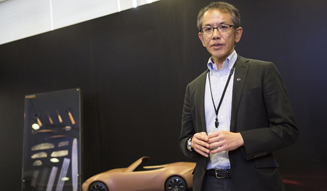
Mr. Hirofumi Kureha, General Manager of Mazda’s Design Division Modeling Studio.
As an example, Kureha mentioned the custom clay used by Mazda’s soft modelers. “It’s incredibly hard. If you don’t get it right on the first cut, there’s no redo,” Kureha explains. The reason for using such material is that it’s important to express their vision “in one go.” This also feels similar to Gyokusendo’s copperware creation.
The collaboration with Gyokusendo’s hammered copperware served as an opportunity to reaffirm the importance of craftsmanship. We were able to understand that the modelers gathered in Tsubame City are the people who support Mazda’s car manufacturing policy: “Function, material, and styling must align.” This was particularly fascinating.
Mazda Call Center
0120-386-919