The Creative Process Behind "Made in Japan" Design Challenging the World | CASIO G-SHOCK
CASIO G-SHOCK
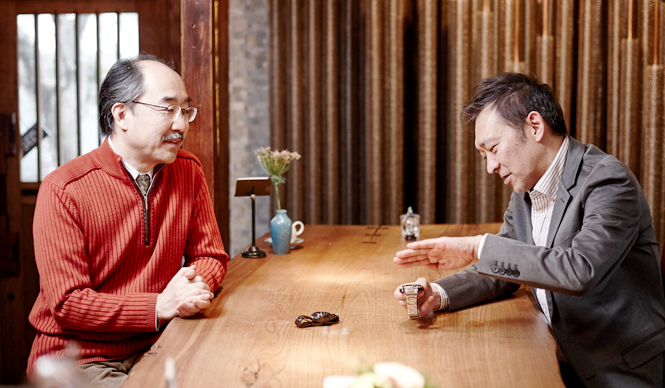
Designer Dialogue: Atsushi Goto, G-SHOCK Chief Designer x Miki Hattori, Car Designer
The Creative Process Behind "Made in Japan" Design Challenging the World (1)
In the 1980s, when watch brands worldwide were competing to create thinner timepieces, Casio’s G-SHOCK emerged with the revolutionary concept of a "tough, unbreakable watch." While watches have often been discussed in terms of their functionality, a shift in perspective to product design reveals a different kind of charm. In this conversation, car designer Miki Hattori and G-SHOCK chief designer Atsushi Goto discuss their respective creative design processes.
Photographs by SAITO RyosukeText by OHNO Takahiro (OFFICE Peropaw)
The Common Ground Between Cars and Watches That Men Love
For over 30 years since its inception, G-SHOCK has been highly regarded globally as a shock-resistant product watch. We invited car designer Miki Hattori and G-SHOCK chief designer Atsushi Goto to discuss the hidden appeal of this proud Japanese creation.
Miki Hattori (hereinafter, Hattori)I’ve been involved in the world of car design, and I’ve always felt a unique challenge in the product design of watches. What is it like in the actual production environment?
Atsushi Goto (hereinafter, Goto)For models like the MT-G and MR-G, which are flagship G-SHOCK models, any compromise would result in something mediocre. Therefore, we spare no expense or effort, meticulously focusing on every single part. The MT-G, which emphasizes the beauty of metal materials by foregoing excessive cushioning—unusual for G-SHOCK—is a pursuit of the fusion of strength and beauty, a kind of "subtractive design."

Car Designer Miki Hattori
Consequently, we were quite particular about the finishing. Separating the bracelet's center links into individual parts and dividing the case into several components was done to meticulously polish the details with satin and polish finishes. For the MR-G, fitting the GPS function into this size was a struggle. The shock-resistant design of the crown and buttons, inspired by the gunmetal, winding lever, and shutter shapes of vintage cameras, was only made possible by developing new technology to eliminate the traditionally necessary guards and achieve a more compact form.
HattoriI’ve also designed watches, and looking at these two models, what struck me was the three-dimensionality of the dials. The way depth is expressed is fascinating. Personally, I’m not particularly interested in watch functions, but as products, I found myself wondering why they are shaped this way.
GotoG-SHOCK has a clear identity of "shock resistance," and our brand vision is to evolve that. What designers need to do is also quite clear. However, if the shape deviates too much from the tough worldview, it stops looking like a G-SHOCK. There’s a constant push and pull at the boundaries of what’s permissible.
HattoriHow many designers are typically involved in designing a single G-SHOCK?

Atsushi Goto, Chief Designer of G-SHOCK
GotoBasically, one person. In my case, I start with hand-drawn sketches, and once the ideas are somewhat solidified, I scan the roughs into my computer. Many of our younger designers also prefer hand-drawing, but increasingly, their hand-drawn work is done using digital input devices.
Since it’s difficult to gauge the size of a watch, I used to go through the laborious process of drawing it at five times the actual size and then checking it at full scale. After that, I would create 2D drawings and request mock-ups. Now, however, we can go from sketch to 3D drawing and have a prototype ready for confirmation within a day using a 3D printer.
HattoriThe advent of 3D printing has significantly changed the design world. Individual designers can now easily create three-dimensional dummies.
GotoDo you also start with hand-drawing, Hattori-san?
HattoriYes. For product design, it’s much like your process, Goto-san; I design alone. And regardless of whether it’s analog or digital, I initially think in two dimensions. Allowing younger designers to play with 2D concepts often leads to more interesting, spontaneous ideas.
GotoExactly. The beauty of hand-drawing lies in its ambiguity. Once you go to 3D, there’s no room for ambiguity.
HattoriIt’s like the early stages of a romance (laughs). Car design also has specialized 3D software, but those who master it tend to become more like operators. In any case, for me, it’s more effective to think things through thoroughly in 2D and then bring the form to life all at once.
GotoIf you drag things out, you get all sorts of external input, which can be problematic (laughs).
HattoriThat’s true. While stress isn’t ideal, a certain amount of pressure from deadlines is necessary. However, in car design, it’s common to separate exterior and interior design. In Europe, design teams of three or four people are formed for each model to compete.
There’s competition within the team, and the ultimate goal is to push through one’s own proposal, even at the expense of others. It’s quite a rigorous process. It also differs by country; Japan and the US primarily use consensus-based approaches, often leading to compromise solutions, whereas in Europe, a single designer’s proposal is usually adopted.
CASIO G-SHOCK
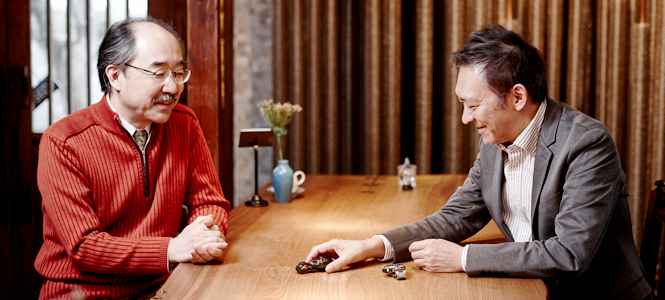
Designer Dialogue: Atsushi Goto, G-SHOCK Chief Designer x Miki Hattori, Car Designer
The Creative Process Behind "Made in Japan" Design Challenging the World (2)
All Industrial Design Has Its Roots in Bauhaus
GotoTo begin with, what do you think is the difference between Japanese and overseas design?
HattoriIt might sound cliché, but I believe it’s "cultural differences." While there isn't a difference in the level of innovation individuals produce, Japan has a culture of being mindful of standing out, leading to an immediate attempt to conform to standards. However, European designers will submit a design to a client even if they know it deviates from standards, simply because it’s a "good design." If you tried that in Japan, you might face criticism from various quarters and never recover. I feel there’s a difference in the environment surrounding designers: overseas, you can afford to fail, but in Japan, you cannot.
GotoI think that’s possible in Japan for non-mass-produced products, but within the framework of mass production, adhering to the project proposal is the absolute prerequisite. At Casio, our younger designers regularly visit overseas locations for inspiration, which has proven effective. Seeing different products daily in various places around the world seems to have a positive impact on their design thinking.
Moreover, watch design is a rather specialized genre within product design. Swiss mechanical watches are akin to vintage cars with carburetors; they can last for a century with proper maintenance, and a world where "unchanging" and "return to origin" are accepted.
HattoriI’ve only recently come to understand the option of "not changing" (laughs). Personally, I have a constant desire to create new things. I believe other designers feel the same; we want to maximize our originality and proposals to create designs that are ahead of everyone else. I want to remain steadfast in that attitude. On the other hand, I’ve finally come to accept that, as in the watch industry you mentioned, new isn’t always better.
GotoConversely, I don’t want to endorse designs that merely change the surface appearance. Technological advancements should be reflected in the design; perhaps you could say that functionality becomes visible.
That’s what leads to unique, original shapes. G-SHOCK is a watch that stands apart from ordinary watches, a watch that clearly divides opinion. In an extreme sense, if half the world likes it, I think that’s sufficient.
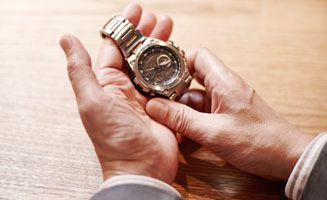
HattoriThere’s also the perspective that functionality itself is a form of fashion, isn’t there?
GotoIndeed. Successful Japanese apparel companies worldwide operate on precisely that principle, and mechanical watches continue to evolve as fashion through their complex mechanisms and finishes. In terms of appreciating the mechanics, it’s similar to the world of vintage cars. G-SHOCK, which continues to evolve with its functionality, is also, I believe, a cutting-edge fashion item.
By the way, how do you feel about the current state of Japanese cars? I feel like the concept of "solidness" has been heard frequently in recent years.
HattoriI think the criteria for design excellence have become a bit too broad lately. In other words, anything goes. It would be good if things became a bit more streamlined. "Solidness" conveys a sense of being packed with functionality, much like G-SHOCK. It’s also a Japanese aesthetic of condensation. In Germany, this might translate to meticulousness or refinement.
GotoJapanese products are sometimes likened to a "bento box" (makunouchi bento). The idea is how much has been condensed into such a small space. This might also be a characteristic of Japan.
HattoriFor car design presentation concept boards, G-SHOCK photos have long been used. Specifically, the rugged models with resin exteriors. For instance, when considering how to express masculinity by emphasizing a large protective bumper, the image of G-SHOCK comes to mind. It helps convey the design concept to clients effectively.
GotoWhen developing new G-SHOCK products, we often use images of cars, such as RVs, for our concept boards. It’s often said that "car enthusiasts are watch enthusiasts," and both hold a captivating appeal for the male psyche.

HattoriMoreover, G-SHOCK has become a globally independent brand, transcending its identity as merely a Casio watch. I think that’s truly remarkable.
GotoEspecially with our high-end lines, MT-G and MR-G, we have a strong desire to communicate the fusion of Japan's cutting-edge and traditional technologies to the world. Exhibiting limited models at Baselworld, held annually in Switzerland every spring, is one way we aim to achieve that. While cherishing the identity inherited from the first G-SHOCK, it’s crucial to continuously challenge ourselves with new endeavors rather than resting on our laurels. However, our fundamental philosophy remains unchanged: design evolves in tandem with technological advancements in electronics and mechanics.
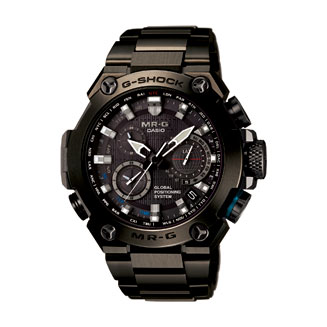
Price | ¥324,000
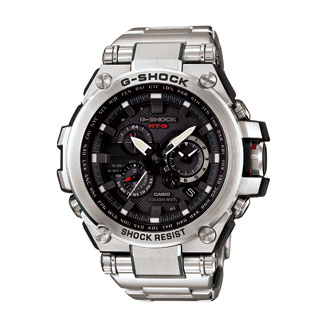
Price | ¥102,600
Since the debut of its first model in 1983, G-SHOCK has continuously incorporated groundbreaking technologies into its shock-resistant structure. The tough design, born from functionality, has fostered new street culture and led to the release of a wide array of variations. The highest-tier series in this lineup are the "MT-G" and "MR-G."
Upon holding the "MTG-S1000," one is immediately struck by the beauty of its finish. The Zaratsu polishing, the pinnacle of abrasive techniques, is applied to the case's slopes, bezel, and parts of the band, creating a luxurious mirror surface. This contrasts with the satin finish on the bezel surface and other areas, and combined with the four-layer dial, it forms an exceptionally three-dimensional exterior. The "MRG-G1000" is equipped with not only solar radio timekeeping but also GPS-based time correction. The use of lightweight titanium for the case and bracelet makes it surprisingly light to wear despite its appearance.
Atsushi Goto | GOTO Atsushi
Born in 1958. Chief Designer, Sixth Design Office, Watch Design Department, Design Center, Casio Computer Co., Ltd. Has dedicated over 30 years to watch design since joining the company. Past development projects include the water sports MQ-14W, the STR-800 runner LAP500, and the G-SHOCK Sky Cockpit GW-300, among many others. Received the Good Design Award in 2009 for the G-SHOCK Frogman GWF-1000. Currently engaged in the development of high-end G-SHOCK lines such as the MTG-S1000D and MRG-G1000.
Miki Hattori | HATTORI Miki
In 1980, after studying at Waseda University's Faculty of Science and Engineering, he transferred to the ArtCenter College of Design, renowned for automotive design. He subsequently worked on various projects at Opel and Stile Bertone in Turin before returning to Japan in 1992. After working at an independent design firm, he established a company specializing in product and interface design. Leveraging his innovative proposal capabilities, he meets client demands. In recent years, he has also been involved in nurturing the next generation of designers across borders.
Casio Computer Co., Ltd. Customer Service Center
Tel. 03-5334-4869
http://g-shock.jp